
The B2B industrial website as a verification tool, not a showcase
Transform your B2B industrial website into the verification tool that shortens the shortlist and accelerates sales with SEO, LinkedIn ABM, and CRM.
 Francesc Beumala · Founder, partner and CEO of ARTIC
In this article
- What role does each digital channel play in the industrial funnel?
- How to design a website so that a technical decision-maker contacts you
- What SEO tactics attract technical buyers who are already looking for a solution?
- How to use LinkedIn and ABM to reach strategic accounts
- How to connect paid lead generation with CRM without losing leads
- Which KPIs truly connect marketing with sales
- How to prioritize execution without getting scattered over 12 months
- What evidence of credibility should be shown and why?
- How to integrate the web with ERP systems and manufacturing software
- What challenges are truly hindering the digitization of an industrial company?
- What regulations affect the web presence of a B2B industrial company
- How ARTIC works to execute this no-dispersion strategy
- Sources
- Frequently Asked Questions
- Recommendations
Prioritize making your B2B industrial website the verification tool a technical buyer uses to decide whether to include you on their shortlist. That page, more than any brochure or trade show, is what filters suppliers before anyone even picks up the phone. Three key elements are coordinated around it: technical SEO by application, an active LinkedIn presence with an ABM focus, and CRM-connected automation that keeps every lead engaged.
What role does each digital channel play in the industrial funnel?
Not all channels serve the same purpose, and treating them as if they did is why many industrial marketing plans fall short. Each lever fulfills a distinct function within the technical buyer’s journey:
- Corporate website: verification and technical testing; this is where the “yes, let’s talk” or “next supplier” decision is made.
- Technical SEO: Silently attracting those who are already looking for a concrete solution, months before contacting sales.
- LinkedIn and ABM: building prior trust in strategic accounts, even before there is an active search.
- Google Ads and LinkedIn Ads: Demand capture with explicit intention, to shorten the cycle when the budget allows.
- CRM and automation: the fabric that connects all of the above and prevents a qualified lead from getting lost between departments.
In the first few months, the priority is to organize the website and on-page SEO; then, LinkedIn is activated with ABM and paid campaigns, followed by scaling up technical content and consolidating attribution in the CRM over time.
How to design a website so that a technical decision-maker contacts you
A purchasing engineer or a technical director doesn’t browse your website out of curiosity. They come looking to confirm three things: what you do, who you do it for, and whether you have proof that it works. Most B2B buyers check exactly three pages before deciding whether to send an email: the homepage, the services section, and the project evidence, according to a study. analysis of buyer behavior in industrial sites. If those three pages don’t provide a clear answer, you lose contact without even realizing it.
The minimum structure that converts follows a logical order:
- Home: In the first few seconds, state what you do, for which sector, and what makes you different from the competition.
- Service pages by application: Don’t talk about “precision machining” in the abstract, talk about the part and the sector where it is used.
- Structured evidence: Filterable cases by industry, downloadable technical data sheets and direct access to CAD files where applicable.
- Low-commitment form or CTA: A request for a technical data sheet weighs less than a generic “contact us” and converts better.
Technical performance isn’t just an aesthetic detail. A site that loads in under two seconds conveys operational competence before the visitor even reads a single line, according to the same Whitelam Media study. In an industry where reliability is paramount, a slow website is already saying something, and it’s not good.
Professional advice: Check how many clicks separate your homepage from a downloadable technical data sheet. If it’s more than two, you’re losing potential customers who just wanted to verify a specification before contacting you.
What SEO tactics attract technical buyers who are already looking for a solution?
The industrial buyer completes more than half of their evaluation process before speaking with sales, and whoever appears in that silent phase wins the game without directly competing on price. Organic technical authority and application-organized content are, according to the Rudo’s guide for manufacturers, the tactics with the best return in the medium term.
This translates into concrete decisions:
- Prioritize technical specification keywords (“iso 2768 tolerance”, “316l stainless steel for marine environment”) over generic high-volume terms.
- Create a page for each application or sector you serve, not a single “products” page that mixes everything together.
- Publish downloadable technical specifications, datasheets, and comparisons: this is the content an engineer looks for right before requesting a quote.
- Take care of your structured data and category taxonomy, because they make it easier for search engines and generative AI engines to understand your catalog.
- Design an editorial calendar that prioritizes content linked to purchase decision phases, not just search volume.
This approach requires consistency. App pages capture low-volume, high-value traffic, and that kind of ranking is built over months, not weeks. If you want to delve deeper into how to structure this investment, it’s worth reviewing why investing in technical SEO changes the conversation with finance: it ceases to be a marketing expense and becomes a way to generate a measurable sales pipeline.
How to use LinkedIn and ABM to reach strategic accounts
Technical profiles that regularly post on LinkedIn act as a trust multiplier when a strategic account enters the evaluation phase, according to the Loup sector guide. A sales engineer who shares real-world cases, resolves technical doubts, or compares materials builds credibility that no advertisement can buy.
The best-performing posts are not promotional: they explain a solved technical problem, share a lesson from a complicated project, or challenge a common industry practice with their own data.
ABM on LinkedIn adds surgical precision to that organic presence:
- Segment by target account, not just by position or sector, by uploading priority company lists directly to the platform.
- Combine educational content ads with retargeting of those who have already visited your website.
- Connect each interaction to the CRM so that sales receives an alert when a strategic account contact interacts with a campaign.
- Measure progress with process KPIs, such as meetings scheduled per account and progress rate between pipeline phases, rather than just impressions or clicks.
Professional advice: Ask your technical team to comment on customer and partner posts before asking them to post themselves. Visibility is built through participation, not just by publishing.
If you want an operational roadmap for setting up that first segmented campaign, there is one LinkedIn Ads practical guide which details the step-by-step configuration.
How to connect paid lead generation with CRM without losing leads
Google Ads and LinkedIn Ads work differently in the industrial sector: Google captures active intent from those already searching for a solution, while LinkedIn builds awareness among accounts that haven’t yet begun their search. Combining both, along with automation and a well-maintained CRM, is the foundation for generating qualified leads and reducing the cost per acquisition over time, according to the [source missing]. DeKeVa digital lead generation guide.
To do this without wasting budget:
- Prioritize technical specification keywords and brand or competitor campaigns to capture demand with already formed purchase intent.
- Design specific landing pages for each campaign, with a single message, a single offer (technical sheet, calculator, demo) and a short form.
- Build nutrition workflows that assign a score based on behavior: downloading a record, repeat visits, opening technical emails.
- Connect each conversion to the CRM with tracking up to the closed sale, not just up to the submitted form.
A significant majority of industrial companies miss opportunities because they lack a clear digital strategy that integrates these points., according to DeKeVa’s report. Automation isn’t a luxury here: it’s what prevents a quality lead from going cold while waiting for someone to review it manually. To design these workflows in more detail, it’s worth reviewing the Steps for nurturing industrial B2B leads.
Which KPIs truly connect marketing with sales
Vanity metrics (impressions, followers, clicks) don’t convince a CFO. What does convince is a clear chain of events from the first contact to the final sale.
- MQL and SQL: volume and quality of leads at each stage, with defined criteria for passing between marketing and sales.
- Marketing influenced pipeline: the value of opportunities where marketing had a documented point of contact.
- Closing rate by channel: Which channel produces leads that actually buy, not just those that contribute the most volume?.
- Marketing-influenced revenue: It is calculated by cross-referencing each won opportunity in the CRM with the marketing touchpoints that participated in its journey.
The best measurement combines simplified multi-touch attribution with pipeline metrics, because that’s the language finance understands, according to DeKeVa. A monthly dashboard with these figures, reviewed jointly with sales, prevents marketing and sales from measuring different successes. To build such a dashboard from scratch, it’s advisable to use a… guide to industrial B2B marketing metrics.
How to prioritize execution without getting scattered over 12 months
A realistic roadmap avoids the most common mistake: trying to activate all seven channels at once and not completing any of them properly.
- Weeks 1 to 4 (diagnosis and quick wins): Audit of speed, website structure and existing application pages; urgent corrections.
- Months 1 to 3 (impact initiatives): redesign of service pages with technical evidence, organic LinkedIn launch and first segmented acquisition campaigns.
- Months 3 to 12 (scaled): ABM in strategic accounts, sustained SEO editorial calendar and CRM-connected nutrition automation.
The rule of thumb: internalize what requires deep knowledge of your product (customer relations, technical content validation) and outsource what requires speed of execution and specialized tools (technical SEO, campaigns, automation).
What evidence of credibility should be shown and why?
A well-constructed client case study includes the technical challenge, the implemented solution, and a measurable result, with the company name included whenever possible. Certifications, technology partners, and figures on completed projects reinforce the verification that buyers are already looking for. Signing technical content with your name and title, as Francesc Beumala does in his industrial digital strategy materials, adds a layer of verifiable authorship that search engines and readers alike value.
How to integrate the web with ERP systems and manufacturing software
An industrial website that exists solely as a storefront, disconnected from the rest of the operation, loses much of its commercial value. Integration with the ERP system allows, for example, the display of real-time stock availability on product pages, or the generation of automatic quotes from a configurator connected to production data.
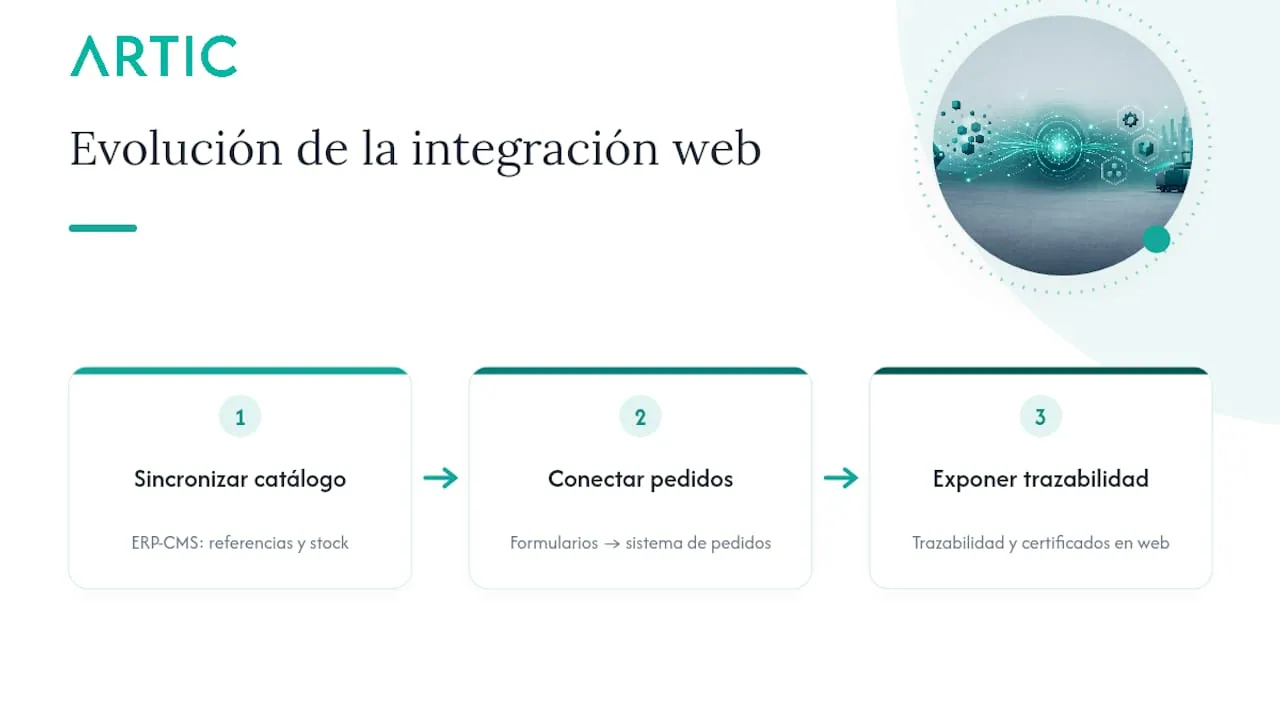
This doesn’t require full integration from day one. A reasonable first step is to synchronize the technical catalog (part numbers, specifications, availability) between the ERP and the website’s content management system, avoiding duplicate and outdated data. A second step is to connect the quote request forms with the order management system, so that a request generated on the website goes directly into the sales workflow without manual re-entry.
Advanced manufacturing platforms also allow for the display of production traceability or quality certificates directly from the web, something especially valued in regulated sectors such as pharmaceuticals or automotive. Not all companies need this level of integration from the outset, but it’s advisable to design the website architecture with this connection in mind, rather than building an isolated site that will have to be rebuilt when order volume demands it.
What challenges are truly hindering the digitization of an industrial company?
The most common obstacle isn’t technological, it’s organizational: marketing and sales departments working with different objectives and without a shared CRM. This lack of integration is a frequent reason why digital initiatives fail to deliver business results, something industry recommendations prioritize addressing, along with shared KPIs between both teams.
A second challenge is cultural: technical teams accustomed to selling through personal relationships and trade shows are not used to clients arriving already informed by digital content. This requires internal training, not just new tools.
The third challenge is one of resources. Many industrial companies have a budget for technology but not for the talent to operate it: buying a powerful CRM without anyone to design the lead nurturing workflows is money wasted. And the fourth, perhaps the most underestimated, is the resistance to measurement: sales departments accustomed to reporting only sales figures, not lead generation, make it difficult to calculate which digital channel is truly effective.
Overcoming these challenges requires sequence, not speed: first align objectives and KPIs between marketing and sales, then incorporate tools, and only then scale the volume of campaigns.
What regulations affect the web presence of a B2B industrial company
A B2B industrial website operating in Spain must comply with the General Data Protection Regulation (GDPR) on all forms that collect contact information, as well as the Law on Information Society Services (LSSI) regarding cookies and commercial communications. This directly affects forms for downloading technical data sheets, calculators, and configurators: each must clearly explain how the data will be used and have an explicit legal basis for sending subsequent communications.
If the company exports or distributes outside the European Union, it’s also advisable to check the CE marking on product data sheets published online, as an incorrect or outdated technical data sheet on the website can lead to liability if a buyer makes a decision based on erroneous information. Web accessibility, regulated by Royal Decree 1112/2018 for certain websites, is another point that many industrial companies overlook, although its mandatory scope focuses on the public sector and certain private organizations that provide services of general interest.
If you have any doubts about the exact scope of these obligations for your specific case, it is advisable to consult with a legal advisor specializing in digital commerce, as the conditions vary. according to the type of data processed, the destination of the export, and the size of the company.
How ARTIC works to execute this no-dispersion strategy
Coordinating technical SEO, LinkedIn/ABM, lead generation campaigns, and CRM automation requires a team that understands both the industrial sales cycle and daily digital execution. At ARTIC, we integrate as your company’s digital marketing department, providing quarterly planning, clear KPIs, and bi-weekly execution sprints alongside your sales team.
We work with a dedicated account manager and provide results reports that show the real impact on the pipeline, not just traffic. Our team covers everything from… redesign of the corporate website Focused on technical verification, from CRM-connected lead generation campaigns to automations that prevent qualified leads from going cold. Having certifications from Google, Meta, Holded, and SE Ranking supports the management of high-performance campaigns and automated processes.
If your website is still functioning as a digital brochure rather than a verification tool, the first step is a concrete conversation about your current situation. You can contact our team and review together which levers to prioritize according to your 6 to 12 month horizon.
Sources
- B2B Website Design Best Practices 2026: What Industrial and Construction Firms Get Right. Whitelam Media
- Manufacturing Website Design: The Complete Guide for B2B Manufacturers (2026) | Rude
- Industrial marketing strategies: 2026 guide | Loup
- Digital Acquisition Strategy for Industrial Companies (2026 Guide) – DeKeVa
Frequently Asked Questions
What is a B2B industrial website in practice?
It is the corporate website of a company that sells technical products or services to other companies, designed for a purchasing decision-maker to verify capabilities before contacting, not just to present the catalog.
How long does it take for industrial technical SEO to show results?
Organic authority in technical content by application usually takes several months to consolidate, although very specific pages with low competition can rank sooner.
Do I need ABM if my company is small?
ABM makes more sense when there are clearly identified high-value strategic accounts; if your portfolio is large and of medium ticket size, prioritize SEO and general paid acquisition first.
Which agency can help me coordinate all of this without wasting time?
A specialized agency can work integrated as a digital marketing department for B2B industrial companies, coordinating web, technical SEO, LinkedIn/ABM and CRM automation under the same quarterly plan.
Which KPI should I review first if I have limited resources?
Start with the marketing-influenced pipeline and the closing rate per channel: these are the two metrics that justify investment to the financial management with less setup effort.
Recommendations
Related services