

Account-based marketing treats each target account as its own market: instead of generating leads in bulk, marketing and sales select a small group of companies and design tailored campaigns for their decision-makers. This makes sense when the average contract value is high, when multiple positions are involved in the purchase, and when the sales cycle lasts for months. If your company meets these three conditions, the logical next step is to launch a pilot program focused on a well-defined ideal customer profile, not a mass campaign.
What is account-based marketing and why does it matter in B2B?
Account-based B2B marketing reverses the traditional funnel order. Instead of acquiring high volume and filtering later, the team first selects the accounts they want to win and then builds content, ads, and conversations for those specific companies. It's the difference between fishing with a net and fishing with a harpoon: every shot counts, and the message is tailored to a buyer you already know by name and job title.
This market logic also changes how results are measured. A lead generation program measures completed forms; an ABM program measures whether the priority account is progressing through the buying process. HubSpot collects case studies and benchmarks which show relevant improvements in return on investment and reductions in the length of the sales cycle when personalization reaches the account level, not just the segment.
ABM doesn't replace inbound marketing; it complements it. Generic content continues to build authority and feed the top of the funnel, while ABM focuses sales efforts on accounts where closing deals truly matters. Teams that combine both approaches typically use inbound marketing to generate brand awareness and reserve the manual personalization work for their shortlist of strategic accounts.
The benefits provided by the sector can be grouped into three blocks:
- Less budget waste: Spending on advertising and content is directed at buyers with a real fit, not a broad, cold audience.
- Shorter sales cycles: By speaking with multiple decision-makers at once instead of escalating one by one, the internal consensus of the account is formed sooner.
- Highest average ticket price: Accounts worked on with ABM tend to close higher value deals because the proposal is tailored to their reality, not to a generic case.
The catch is that ABM requires more manual work per account than a standard lead generation campaign. Therefore, the decision to implement it depends less on whether it "works" (it does) and more on whether your business has the type of sales that justifies the effort.
When to apply ABM: signals, checklist and prioritization criteria
ABM isn't suitable for every B2B business. If you sell a low-ticket product with a single point of contact and a one-week cycle, the account-specific personalization doesn't justify the effort. The signs that do justify investing in ABM are quite clear.
Quantitative criteria:
- The average contract value (ACV) exceeds a threshold that makes it profitable to dedicate hours of strategy to each account, not just each campaign.
- The purchase decision involves three or more people with different interests: purchasing, operations, financial management, and technical management.
- The target company has a size (turnover, staff, number of plants or branches) that makes a formal purchase process and decision committee foreseeable.
Operating criteria, Equally important: your CRM must have clean and accessible data, marketing and sales must share at least one regular account review meeting, and someone on the team must be able to dedicate real time to researching each account before activating any channel. The business buying process It rarely depends on a single person, so without visibility into who is involved in the decision, any ABM campaign is shooting in the dark.
Professional advice: Before writing a single piece of content, ask sales for a list of the five most painful lost accounts from the past year and ask why they were lost. That conversation reveals more about your selection criteria than any firmographic spreadsheet.
A minimum checklist to decide whether to start: Do you have at least 10 accounts with enough ACV to justify customization? Can you name the three typical decision-makers in that purchase? Is Sales willing to commit to a follow-up SLA on those specific accounts? If you answer yes to all three, the pilot has a basis to operate.
ABM models: 1:1, 1:few, 1:many and scale ABM
Choosing the right model is the decision that most influences your budget and the equipment you need. There isn't one "best" model; there's one that fits the number of accounts you can manage while maintaining the quality you require.
- ABM 1:1 (strategic): Each account receives an individual plan, tailored content, and often a microsite or proposal designed specifically for it. It operates with portfolios of between 5 and 15 very high-value accounts, where losing a single trade represents a significant blow to annual revenue.
- ABM 1:few (per cluster): Accounts with similar challenges (same sector, same size, same buyer role) are grouped together, and a shared campaign with minor variations is created. This is the typical middle ground for teams with 20 to 50 target accounts.
- ABM 1:many (to scale): Dozens or hundreds of accounts are managed using message templates that are automatically personalized with signature and intent data. Here, volume replaces individual depth.
The scaled ABM model is the best fit for most mid-market industrial companies because it allows them to manage between 50 and 300 accounts organized by tiers without requiring a team of ten people. A practical ABM guide indicates that with well-built templates and AI support to personalize variables, it's possible to achieve first qualified conversations in 8 to 12 weeks.
Tiering works like this: Tier 1 concentrates the accounts with the highest ACV and receives almost one-to-one attention; Tier 2 receives cluster campaigns with some manual customization; Tier 3 receives pure automation with dynamic variables. The more accounts you put in Tier 1, the more human resources you'll need, so the temptation to "put everything in Tier 1" usually ends in an exhausted team and mediocre results in the accounts that truly deserved that effort.
How to run: ICP, account selection, and plan per account
A poorly defined ideal customer profile (ICP) is the number one reason why an ABM pilot fails before it even begins. Simply stating "industrial companies with more than 50 employees" isn't enough: the ICP must describe the problem you solve, the point in the business cycle when that problem becomes urgent, and the type of buyer who has the authority and budget to act.
Building an actionable Buyer Profile requires cross-referencing three sources: your current highest-value customers (to identify real, not assumed, patterns), firmographic data from databases like LinkedIn Sales Navigator, and purchase intent signals, which indicate which companies are actively researching solutions like yours. B2B buyers often begin their research before speaking with any vendors, so intent signals allow you to pinpoint the opportune moment to enter the market.
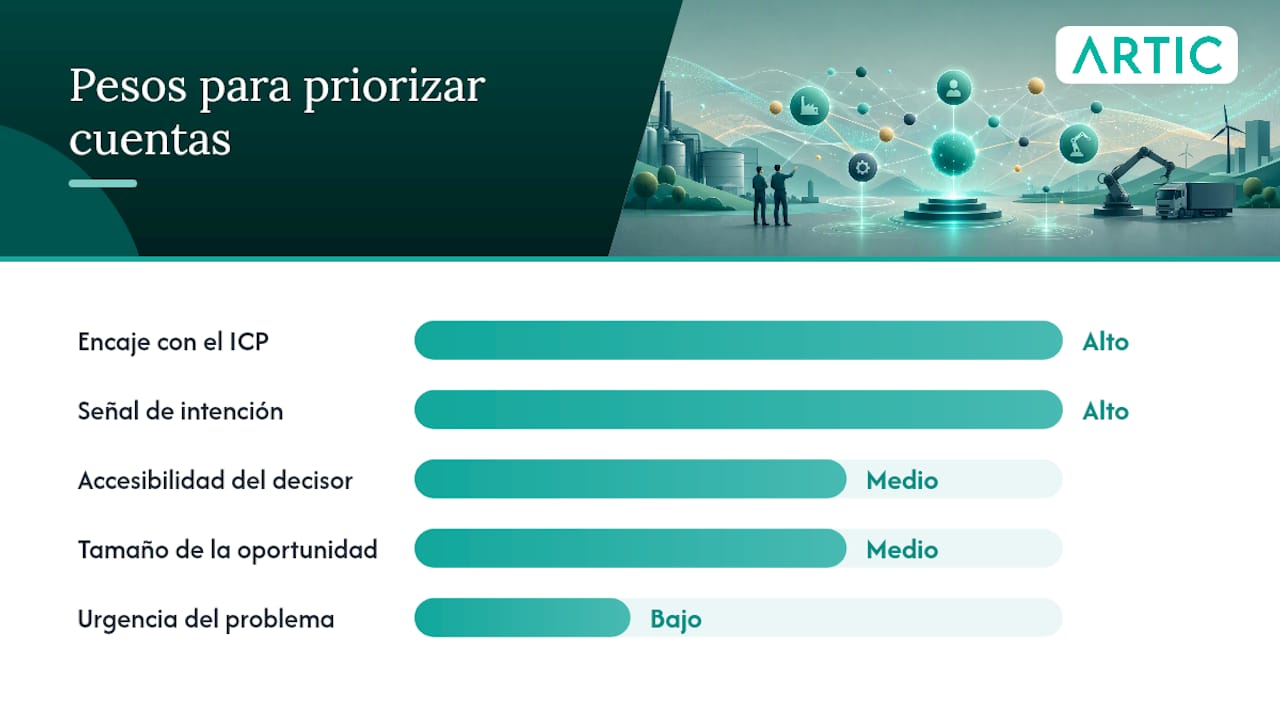
To prioritize the list of candidate accounts, it is advisable to score each one using a simple matrix:
| Criterion | Suggested weight | What does it measure? |
|---|---|---|
| Fit with the ICP | High | Similarity to your highest historically valuable customers |
| Signal of intent | High | Activity of searching for or consuming relevant content |
| Accessibility of the decision-maker | Half | If you already have contact or an indirect connection with any stakeholder |
| Size of opportunity | Half | estimated potential LCA according to company size |
| Urgency of the problem | Low | Signs of recent change (new direction, expansion, incidents) |
Once the accounts have been selected, each one needs a minimum working template before activating any channel:
- Stakeholder map: name, position, role in the decision (user, influencer, economic buyer) and preferred contact channel.
- Account business initiatives: announced projects, organizational changes, or public signals indicating current priorities.
- Key messages by stakeholder: The same problem is explained differently to the finance director than to the plant manager.
- Activation timing: estimated campaign start date and sales tracking milestones.
Without this information, any multichannel campaign becomes spam disguised as personalization.
Multichannel activation: concrete tactics and effective sequences
Each channel plays a distinct role in the process of convincing a buying committee, and mixing them illogically dilutes the effort. LinkedIn builds brand awareness among identified stakeholders; highly personalized emails initiate one-on-one conversations; targeted advertising reinforces the message while the committee deliberates internally; and events and corporate gifting serve to close the final stretch with key decision-makers.
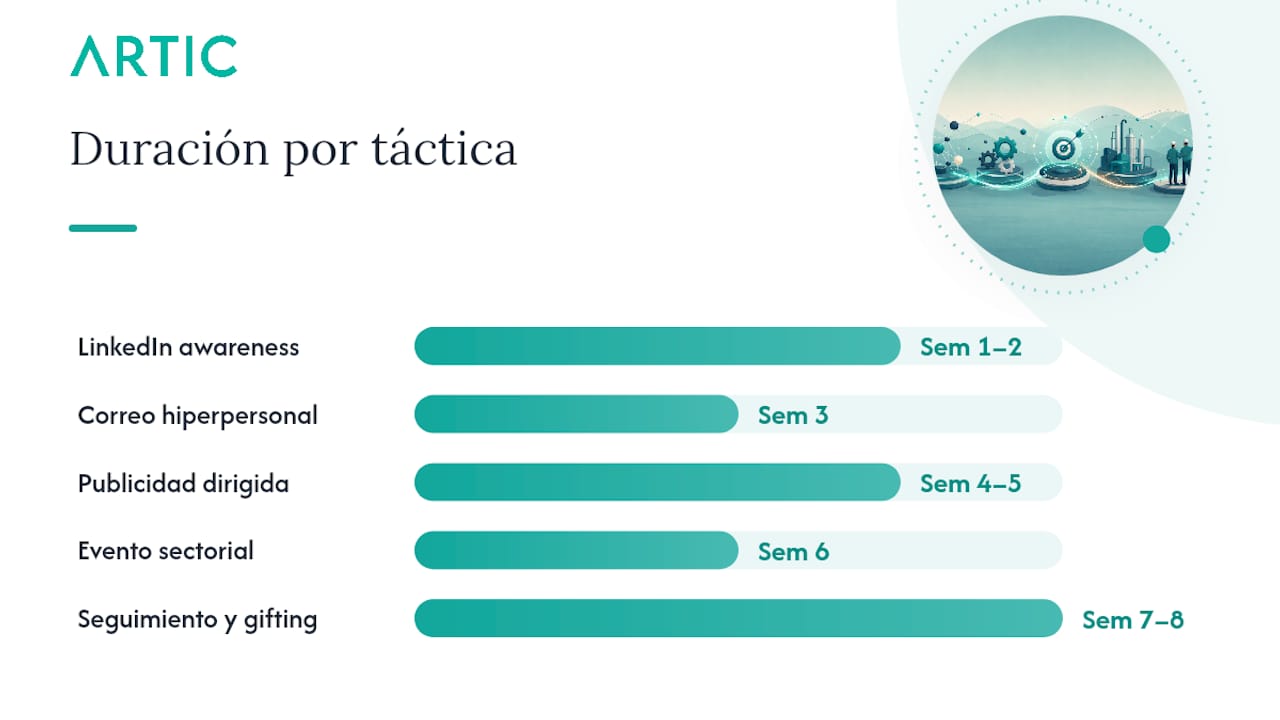
A reasonable sequence for a level 1 account could be organized as follows:
- Weeks 1 to 2: The mapped stakeholders begin to see sponsored content on LinkedIn related to their specific challenge, without direct product mention.
- Week 3: The sales team sends a highly personalized email to the economic buyer, referencing a public initiative of the company and proposing a brief conversation.
- Weeks 4 to 5: If there is a response, targeted advertising is activated for profiles connected to the account to reinforce the message while the meeting is being scheduled.
- Week 6: Invitation to a small industry event (closed webinar, round table) where key figures who already work with you participate.
- Weeks 7 to 8: Follow-up with a tailored piece of content (success story adapted to your sector) and, if the LCA justifies it, a personalized physical shipment to the key buyer.
HubSpot documents similar tactics such as the use of customized ROI calculators and scaled-down executive events, which work best when coordinated with the sales calendar rather than launched in isolation from marketing.
The coordination between both teams is what separates an ABM sequence from a simple ad campaign with a fancy name. Sales needs to know exactly what message each stakeholder received and when, to avoid repeating the same argument in the follow-up call. Tools like Meta Ads campaign tracking connected to the CRM or proper configuration of LinkedIn Ads for B2B They allow marketing to see which stakeholders have interacted before sales makes the next call.
Minimal technology stack and alternatives without enterprise platforms
You don't need a seven-figure ABM platform to launch a serious pilot. The minimum viable stack covers four functions: a CRM that houses account and stakeholder data, a source of intent and firmographic data, an email automation tool, and an AI-assisted personalization layer.
For the pilot phase, this is usually sufficient:
- CRM with views by account: Any decent CRM allows you to create custom fields to track the tiering level and status of each stakeholder within the account.
- LinkedIn Sales Navigator: to identify stakeholders, track changes in position, and detect signs of relevant activity.
- Data enrichment tool: to complete firmographics and detect signs of intent without relying on manual account-by-account investigation.
- Email automation with dynamic personalization: It allows you to insert variables per account without writing each email from scratch.
- Artificial intelligence assistants for writing and research: They accelerate the creation of message variants per stakeholder and summarize news or public initiatives from each account.
This basic stack is sufficient until you're working with more than 100 active accounts simultaneously or you need highly granular multichannel attribution. Beyond that volume, enterprise ABM platforms (with integrated ad orchestration and proprietary intent scoring) begin to justify their cost, because the manual work of coordinating spreadsheets and individual campaigns stops scaling. Before reaching that point, investing in automating processes with artificial intelligence usually yields a higher return on investment than buying a complete suite that will only be used occasionally. 20 % of their capacity.
Metrics that matter: how to measure ROI and report by account
Measuring an ABM program with volume metrics (number of leads, email open rate) is the most common mistake and the one that most quickly depletes the program's budget. The metrics that truly reflect whether ABM is working are measured at the account level, not the campaign level.
Professional advice: If your monthly ABM report is still showing MQLs as the primary metric, you've already lost the conversation with finance management. Change the report title to "progress by priority account" and you'll see how the conversation shifts.
Key metrics that replace volume include:
- Stakeholder coverage: How many of the decision-makers mapped in the account have interacted with any content or message?.
- Sales velocity: how long does it take for a target account to progress from one stage to the next compared to the standard cycle?.
- Account Acquisition Cost (ACC): Total investment dedicated to winning a specific account, including customization hours.
- Conversion rate per account: Percentage of accounts worked that reach a real opportunity, not just a response or meeting.
- Average contract value earned (ACV): If it rises above the historical average, then personalization is working.
Without a service level agreement between marketing and sales that clearly defines the shared KPIs, an ABM program tends to lose internal support during the first slow quarter because each team focuses on its own metrics and no one takes ownership of the overall result. The tracking dashboard should be reviewed every two weeks with sales, not just in the monthly report to management, and it should show the status of each priority account, not an aggregate that masks which specific accounts are progressing and which have stagnated. You can learn more about building this type of reporting in this [link/resource]. guide to key B2B marketing metrics in industry.
Agency vs. in-house team: criteria, SLAs, and key questions for suppliers
The decision to outsource ABM or build your own team depends on three variables: the average order value of your transactions, the internal resources available, and the urgency with which you need results. If your average order value is high but your marketing team has fewer than three people, outsourcing tactical execution is usually more cost-effective than hiring and training a complete team from scratch. If you already have clean data, a mature CRM, and internal analytical capabilities, an in-house team can iterate faster because they know the product without a learning curve.
Whichever option is chosen, the working agreement between marketing and sales needs to be put in writing. A minimum SLA for ABM should include:
- Shared KPIs: pipeline influenced by account, sales velocity and conversion rate, agreed upon by both teams before starting.
- Sales response times: How many hours does the sales team have to act after an interaction signal from a priority account?.
- Joint review cadence: fixed bi-weekly meeting where the status of each account is reviewed, not just the aggregate.
- Clear responsibilities: who investigates each account, who approves personalized content, and who makes the first business contact.
Professional advice: Ask any agency that presents its ABM proposal to show you a real-world example of an SLA they've signed with a previous client, not just a list of services. If they can't show you one, they've probably never implemented it.
When evaluating a vendor, the questions that separate a strategic agency from a purely tactical one are: How do they build the Account Performance Profile (APP) before proposing channels? What account metrics do they report, beyond impressions and clicks? How do they integrate their work with existing CRMs? What happens if a priority account doesn't respond in the first month? Checklist for choosing a B2B marketing agency It gathers additional criteria useful for that conversation, and comparing several proposals against these digital agency selection criteria helps to calibrate what is industry standard and what is a real differentiating value.
Evidence: ARTIC experience in ABM programs for industry
This article is written by Francesc Beumala, who works with B2B industrial companies on key account acquisition strategies from ARTIC. The agency operates with quarterly strategic planning and KPIs defined from the first sprint, executed in bi-weekly cycles with the client—the same review frequency recommended by any healthy SLA between marketing and sales.
This sprint-based work model is precisely what an ABM program needs to avoid dying from success or abandonment: frequent reviews, quick adjustments per account, and a dedicated account manager who knows the status of each priority account without relying on a generic quarterly report.
To delve deeper into specific parts of the process, these resources are useful:
- How to define metrics and tracking dashboards in this guide to key metrics for the B2B industry.
- How to structure the complete strategy before launching any channel in this 11-step guide to building a digital strategy.
- How to understand and improve conversion per account in this analysis of B2B conversion rate.
ARTIC as a digital marketing team for your ABM program
Setting up a serious ABM pilot requires coordinating SEO, targeted advertising, LinkedIn, automation, and a CRM that communicates with all of these elements simultaneously, and few in-house teams have that complete mix available from the start. An external agency can integrate seamlessly as your industrial company's digital marketing department, with a dedicated account manager and a bi-weekly sprint schedule that a well-executed ABM program demands, rather than simply delivering a quarterly report and disappearing until the next quarter.
If your company already meets the criteria that justify ABM (high ACV, purchasing committees with multiple decision-makers, long cycles) but doesn't have the internal team to execute account selection, multichannel personalization, and account reporting simultaneously, then a 360 consulting in digital marketing for B2B companies You can design that pilot with KPIs shared between marketing and sales from the very first sprint. The next logical step is to request an initial consultation to review your current ICP and assess whether your target accounts are ready for a scalable ABM pilot.
Sources
Frequently Asked Questions
What is account-based marketing in B2B?
It's a strategy that treats each target account as its own market: instead of capturing massive leads, marketing and sales select high-value accounts and design customized campaigns for their key decision-makers.
What types of ABM exist?
The three main models are 1:1 (one account, one fully customized plan), 1:few (clusters of similar accounts with shared campaigns) and 1:many or ABM at scale (dozens or hundreds of accounts with customization assisted by templates and data).
What practical example of ABM can I apply?
A typical example is to identify 10 accounts with high ACV, map their top three decision-makers, and launch an eight-week sequence that combines LinkedIn, hyper-personalized email, and a closed event targeted only at those accounts.
What is the difference between general B2B marketing and ABM?
General B2B marketing seeks lead volume within a broad segment, while ABM focuses the budget and message on a short list of accounts already identified as strategic before launching any campaign.
When is it better to outsource an ABM program instead of setting it up internally?
Outsourcing is advisable when the average ticket is high but the internal marketing team is small; in that case, an agency with experience in shared SLAs between marketing and sales usually accelerates the pilot without the need to hire and train a team from scratch.
