

A B2B digital audit is the systematic process of analyzing every touchpoint, tool, and metric in an industrial company's sales funnel to identify where budget is being wasted and where real opportunities are being generated. If you lead marketing in an industrial B2B company, this diagnostic is the starting point for any realistic digital investment decision. Tools like Google Analytics 4, enterprise CRMs, and AI-powered automation systems now allow you to perform this analysis with a precision that was impossible a decade ago. Companies that implement structured audits achieve CAC reductions up to 40% within a 3-6 month timeframe.
How does a B2B digital audit work step by step?
A B2B digital audit is not a superficial review of traffic metrics. It's a structured diagnostic that covers the entire funnel, from the first brand impression to the sale and after-sales service. The most accurate technical term in the industry is digital sales funnel audit, although in practice it is used interchangeably with “B2B digital audit” or “B2B marketing audit”.
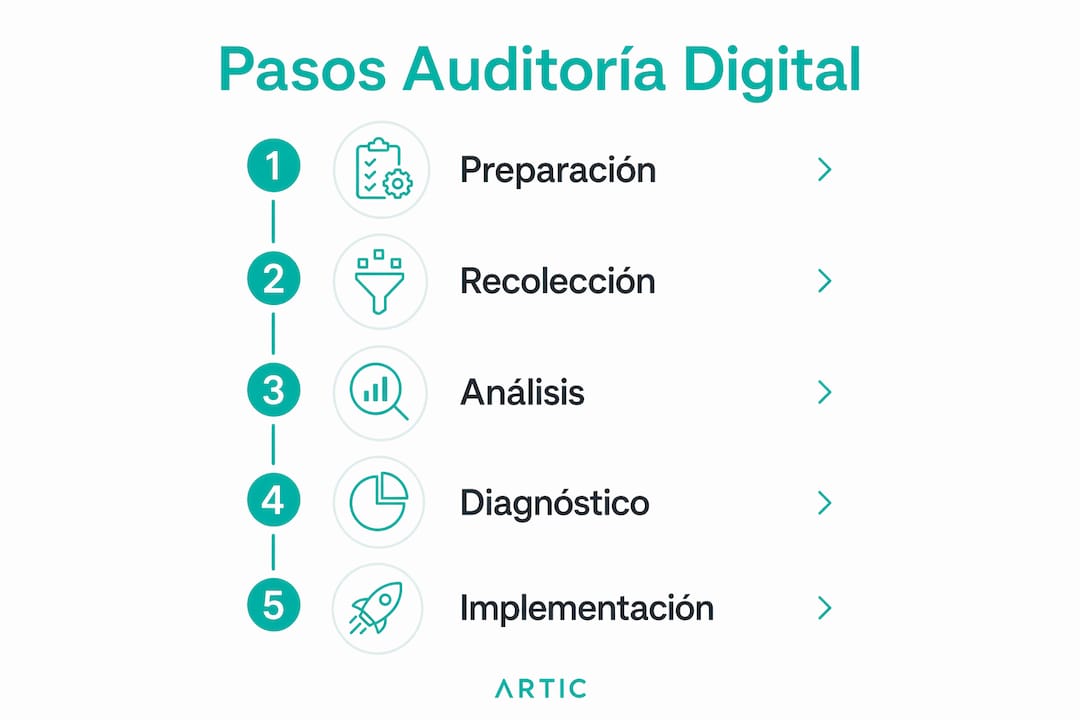
The process follows these stages:
- Mapping of touchpoints. Most companies only measure 3 touchpoints in their sales funnel when they actually have between 12 and 25 active points. The first step is to identify them all: web forms, landing pages, follow-up emails, sales calls, demos, and proposals.
- CRM and sales process review. The audit verifies whether the CRM correctly records each interaction, whether the marketing and sales teams share qualified lead definitions, and whether there is a playbook Updated. This analysis reveals whether lead generation has real continuity in the sales process.
- Technical evaluation of the website. Loading speed, user experience, form structure, and conversion tracking configuration are measured in Google Analytics 4. A poorly configured form can invalidate weeks of investment in lead generation.
- Data analysis and business metrics. Conversion rates per stage, actual acquisition cost, and response time to new leads are cross-referenced. This step transforms the data into a diagnostic tool.
- Report preparation and prioritization. The findings are ordered by economic impact. Not all improvements have the same return: the audit should indicate what to correct first.
A structured audit lasts between 1 and 3 weeks, Depending on the size of the operation and the complexity of the funnel, external audits provide market benchmarks that internal audits cannot generate on their own, making them especially useful when the operation has been stagnant for some time.
Professional advice: Before starting the audit, document in writing how you believe your current funnel works. Comparing that description with the actual data is, in itself, one of the most revealing findings of the process.
What metrics are key in an industrial B2B audit?
The value of a B2B digital audit depends directly on the quality of the data being analyzed. Measuring only visits or clicks is insufficient for making business decisions in the industrial sector.
The metrics that must be included in any B2B audit process are:
- Conversion rate per funnel stage. It's not enough to know how many leads come in: you need to know at what stage they're lost and why. A low conversion rate in the proposal phase indicates a different problem than a low rate in the lead generation phase.
- Actual customer acquisition cost (CAC). True CAC includes internal resources, team time, and unconverted leads, not just media spend. Many industrial companies underestimate their CAC by 30–50% by not accounting for sales time.
- Response time to new leads. The probability of qualifying a lead drops sevenfold if the response takes more than an hour. In industrial sectors where sales cycles are long, losing a lead on the first contact is very costly.
- Traffic and conversion per page in Google Analytics 4. Pages with the highest traffic but lowest conversion rates are identified. These pages are the prime candidates for content improvements or calls to action.
- Effective use of CRM. It is verified whether sales representatives record activities, whether the opportunity statuses reflect reality, and whether the system generates reliable reports for management.
One specific practice that ARTIC uses in its diagnostics is sending test forms outside of business hours to measure real-time automated response times and detect silent leaks. This technique reveals inefficiencies that no traffic report shows.
What tools enhance a B2B digital audit?
Technological tools determine the speed and depth of the analysis. An audit performed using only spreadsheets takes weeks to produce conclusions that a modern analytics platform delivers in hours.
The most relevant tools for a B2B online audit are:
- Google Analytics 4. It allows you to segment behavior by user type, traffic source, and landing page. Its event-based data model is more accurate than the session model of its previous version.
- Corporate CRM (HubSpot, Salesforce, Holded). It centralizes sales history and allows you to cross-reference marketing data with actual sales results. Without a properly configured CRM, auditing works with incomplete information.
- Marketing automation platforms. They allow you to track lead behavior from the first click to closing, identifying which content or channels accelerate the sales cycle.
- Artificial intelligence applied to funnel analysis. AI processes data in 48 hours, detects patterns invisible to manual analysis, and prioritizes actions based on their economic impact. This reduces diagnostic time from weeks to days.
Growth marketing methodology complements these tools by turning each finding into a measurable experiment. Instead of implementing massive changes without validation, specific improvements are tested in short cycles, and those that generate results are scaled up. This approach is especially effective in industrial companies where changes to the business process require coordination between several departments.
Professional advice: Don't install any more tools before auditing the ones you already have. Most industrial companies underutilize Google Analytics 4 and their CRM. Getting the most out of what you already have is always faster and cheaper than adding new technology.

To delve deeper into how the Artificial intelligence transforms digital marketing, ARTIC has documented cases and methodologies applied to the industrial B2B environment.
How to apply the audit results to the business strategy?
A B2B digital audit It does not seek to take further action., but rather to eliminate inefficiencies that consume budget without return. Results only generate value if they translate into an action plan with clear priorities and defined responsibilities.
The application process follows this sequence:
- Build the strategic roadmap. The findings are organized into three categories: urgent fixes (technical errors, lead leaks), performance improvements (form optimization, website speed), and growth projects (new channels, automations). This classification prevents everything from seeming equally urgent.
- Align marketing and sales. The alignment between marketing and sales, Smarketing, as it's known, is the organizational change with the greatest impact on lead quality and closing rates. The audit should define service level agreements between both teams: what constitutes a qualified lead, how quickly leads are contacted, and how the outcome is recorded.
- Implement in short cycles. Changes are implemented in two-week sprints with defined KPIs. This allows us to measure the impact of each improvement before scaling it.
- Sustain the process for 3–6 months. It takes 3–6 months of experimentation to stabilize the CAC after implementing the improvements. The results are not immediate, but they are predictable if the process is rigorous.
“Many businesses try to do more without auditing first, which only creates burden without improving results. Auditing should simplify and clarify strategy.” Source
A concrete example: an industrial company that discovers in its audit that 60% of its leads come through a single paid channel has a critical dependency. The roadmap will include diversification into SEO and LinkedIn, with quarterly tracking metrics. Without the audit data, that decision would have taken years to make, or would never have been made at all. To understand what prioritize digital channels Depending on the industrial profile, the context of each company determines the optimal combination.
Key points
An effective B2B digital audit requires mapping all funnel touchpoints, measuring the actual CAC, aligning marketing and sales, and applying the findings in short cycles for at least 3–6 months to obtain measurable results.
| Spot | Details |
|---|---|
| Complete funnel mapping | Identify the 12–25 actual touchpoints, not just the 3 that are usually measured. |
| Actual CAC as a base metric | Include internal time and unconverted leads to calculate the true cost of acquisition. |
| Response time to leads | Responding in less than an hour increases the probability of qualifying the contact by 7. |
| Smarketing Alignment | Define agreements between marketing and sales so that generated leads are closed effectively. |
| Improvement cycles of 3–6 months | Stabilizing CAC and improving conversion require sustained experimentation over time. |
Do you need a digital audit for your industrial company?
ARTIC conducts B2B digital audits for industrial companies with a direct approach: we identify where you're losing budget and opportunities, and deliver an action plan with clear priorities. We don't work as an external provider. We integrate as your digital marketing department, with bi-weekly follow-ups and measurable KPIs from the first sprint. If your strategy hasn't scaled in a while or you're unclear about what's going wrong, the diagnosis is the first step. Our team, Specialized in industrial B2B SEO, ARTIC combines advanced analytics, artificial intelligence, and growth marketing methodology to turn findings into tangible results. Contact ARTIC and request your free, no-obligation consultation.
Frequently Asked Questions
What exactly is a B2B digital audit?
A B2B digital audit is a structured diagnostic of a company's sales funnel and online presence, designed to identify inefficiencies and opportunities for improvement using real data. It covers everything from the website and CRM to lead nurturing processes and the alignment between marketing and sales.
How long does a B2B digital audit take?
A structured B2B sales audit takes between 1 and 3 weeks, depending on the size of the company and the complexity of the sales funnel. Implementing improvements and stabilizing results requires an additional 3–6 months.
When is it advisable to hire an external auditor?
External audits provide benchmarks and objectivity that internal teams cannot generate on their own. They are especially recommended when operations have been stagnating for some time or when the causes of poor performance are not clearly identified.
What metrics are a priority in an industrial B2B audit?
The priority metrics are the actual CAC, the conversion rate per funnel stage, the lead response time, and per-page behavior in Google Analytics 4. These four variables explain most budget leaks in industrial companies.
Can artificial intelligence improve a B2B digital audit?
Yes. AI processes large volumes of data in 48 hours, detects patterns that manual analysis misses, and prioritizes actions based on their real economic impact. This accelerates diagnosis and improves the accuracy of recommendations in the B2B audit process.
