Companies in Málaga: data and how to sell B2B
DIRCE 2025: Málaga has 142,401 active companies (+4.1%). Sizes, sectors and zones. How to win B2B with SEO, Local SEO, Google/LinkedIn Ads and a site that converts.
 Francesc Beumala · Founder, partner and CEO of ARTIC

In this article
- How many companies are in Málaga and what it means for B2B
- Where demand concentrates: municipalities and business hubs
- Anchor sectors in Málaga and how to spot buying signals
- Channels that work in the province (and how to combine them)
- Strategy by company size: micro, small, mid and large
- Málaga’s national ranking: position and opportunities
- Measure, automate and scale: from lead to revenue
- A 90‑day execution plan for Málaga
- Frequently asked questions
- Sources and methodology
Málaga (Andalucía, Spain) counts 142,401 active companies, up 4.1% versus 2024, and 5,533 of them (3.9%) have 10+ employees. Source: INE, Central Business Register (DIRCE), active companies as of 1 January 2025 (compared with 2024). For B2B sales, demand clusters in Málaga city, Marbella, Vélez-Málaga and Antequera, with hubs like Málaga TechPark and Polígono del Guadalhorce.
Key takeaways
- 142,401 companies in Málaga in 2025, +4.1% year-on-year (INE, DIRCE 2025).
- 57.1% have no employees and 39.0% have 1–9; a micro‑SME heavy market.
- 5,533 firms (3.9%) have 10+ employees; Málaga ranks 6th among provinces.
- Key hubs: Málaga TechPark, Polígono del Guadalhorce, Centro Logístico de Antequera.
- Anchor sectors: technology/software, tourism suppliers, construction/installations, logistics/transport.
How many companies are in Málaga and what it means for B2B
Málaga (Andalucía, Spain) has 142,401 active companies, up 4.1% year-on-year versus 2024. The size structure is highly atomised: 81,338 have no employees (57.1%) and 55,530 have 1–9 employees (39.0%). Above the more demanding B2B threshold, 4,861 companies have 10–49 employees (3.4%), 569 have 50–249 (0.4%) and 103 have 250+ (0.1%). In total, 5,533 companies (3.9% of the province) have 10 or more employees. Source: INE, Central Business Register (DIRCE), active companies as of 1 January 2025 (compared with 2024).
What does this mean if you sell to companies? Málaga is a large market in volume but dominated by micro‑SMEs. If you sell lower‑ticket products or self‑serve SaaS, the micro and small segments provide breadth. For complex solutions (projects, industrial services, corporate software), the core of 5,533 companies with 10+ employees concentrates recurring B2B potential, with decision processes and budgets.
Practical implications:
- Segment by size and pain: package a light offer (starter plans, guided onboarding) for micro‑SMEs and deploy a consultative proposal for 10+.
- Qualify by ICP: prioritise firms with internal teams and budget (signals: active website, team on LinkedIn, procurement notices, located in hubs like Málaga TechPark or Polígono del Guadalhorce).
- Match channel to segment: SEO and self‑serve for volume; ABM, LinkedIn and technical demos for 10+ accounts.
- No employees
- 1 to 9 employees
- 10 to 49 employees
- 50 to 249 employees
- 250+ employees
Source: INE, DIRCE 2025
Companies in Málaga (DIRCE 2025) by size
| Category | 2025 value | Notes |
|---|---|---|
| Total companies | 142,401 | +4.1% vs 2024 |
| No employees | 81,338 | 57.1% of total |
| 1 to 9 employees | 55,530 | 39.0% of total |
| 10 to 49 employees | 4,861 | 3.4% of total |
| 50 to 249 employees | 569 | 0.4% of total |
| 250 or more employees | 103 | 0.1% of total |
| Companies with 10+ employees | 5,533 | 3.9% of Málaga; 3.4% of Spain |
| Provincial rank (10+) | 6 | Out of 50 provinces |
Where demand concentrates: municipalities and business hubs
B2B demand concentrates in the main municipalities — Málaga city, Marbella, Vélez‑Málaga and Antequera — and in high‑density hubs: Málaga TechPark (PTA) as a technology pole, Polígono del Guadalhorce as an industrial cluster, and Centro Logístico de Antequera as a transport and warehousing node.
How to use this on the ground:
- Prioritised geographic coverage: build landing pages and campaigns by municipality and park/estate (e.g., “industrial solar installation in Guadalhorce”, “management software for PTA companies”).
- Field prospecting and events: quarterly on‑site visits to parks and estates to generate meetings; support with pre/post sequences via email and LinkedIn.
- Local SEO and NAP: optimise Google Business Profile for each site/warehouse, choose accurate categories/attributes, and capture proximity searches.
Step‑by‑step example for an industrial installer in Guadalhorce:
- Map 50 target accounts in the estate (industrial CNAEs), prioritising by activity and visible footprint.
- Publish three use cases per vertical (food processing, cold chain, logistics) and one ROI comparison page.
- Activate Local SEO with reviews from estate clients and geo‑tagged photos.
- Launch search campaigns on “industrial maintenance Málaga”, add remarketing to technical content and pilot offers.
If you want a tested methodology to rank for proximity searches and convert them, see our Local SEO Agency.
Anchor sectors in Málaga and how to spot buying signals
Four sectors stand out for B2B opportunity in Málaga’s fabric:
-
Technology and software (PTA): typical buying triggers include new tech hires, integration projects and security/compliance needs. Respond with technical content, comparisons and on‑demand demos. Strengthen solution‑search visibility with our SEO Agency.
-
Tourism suppliers: hotels, operators and professional F&B outlets buy software (PMS, channel manager), equipment and maintenance. Seasonal timing matters: align campaigns with pre‑season procurement. Capture in‑market demand through the B2B Google Ads agency.
-
Construction and installations: installers, engineering firms and multi‑trade maintenance compete for tenders. Differentiate with technical datasheets, downloadable method statements and documented jobs. Where committees decide, B2B LinkedIn Ads target by function and company.
-
Logistics and transport (Antequera): decisions revolve around efficiency and SLAs. Pivotal assets: savings simulators, guaranteed lead times and traceability.
What to build across these sectors:
- Vertical case pages (e.g., software + 4‑star hotel in Marbella; energy for agri‑food in the Axarquía area).
- Trials or audits with clear scope and deliverables to reduce risk.
- A conversion‑ready website: structure by problem/sector, “why now” arguments and crystal‑clear CTAs. For a blueprint, review our B2B Web Design Agency.
Channels that work in the province (and how to combine them)
In a market with many micro‑SMEs and a meaningful group of mid‑sized firms, the channels that best align intent with decision‑makers are:
-
SEO: capture problem/solution research with comparisons, how‑tos and case studies. This compounds over time and feeds remarketing and outbound.
-
Local SEO: essential for services and installations across municipalities and estates, driving Maps and Near‑Me visibility with consistent NAP, reviews and geo‑photos.
-
SEO for AI (AEO/Entity SEO): AI search and assistants increasingly answer supplier queries. Optimise entities, FAQs and structured data to be cited and surfaced. See our approach in the B2B AI SEO Agency.
-
Google Ads (Search): accelerates capture on high‑intent terms (e.g., “warehouse racking Málaga”). Integrate with CRM to measure SQLs and revenue. Learn more in the B2B Google Ads agency.
-
LinkedIn Ads: strong for account‑based education where search intent is low (e.g., industrial software). Formats like document ads and website retargeting work well; more in B2B LinkedIn Ads.
-
Website that converts: frictionless UX, sector‑specific proof, ROI tools and qualification forms. This is the spine connecting SEO, Ads and sales sequences.
Strategy by company size: micro, small, mid and large
Buyer size determines your go‑to‑market in Málaga:
-
Micro and small (up to 9 employees; 96.1% of the total): package offers, assisted onboarding and transparent pricing. Tactics: long‑tail local SEO, reviews, “X vs Y” pages, remarketing and time‑boxed trials. A 20‑minute demo plus checklist lead magnet is often enough to move forward.
-
Mid‑sized (10–49; 3.4%): consultative sale with diagnosis, business case and pilots. Tactics: technical content, webinars with clients, LinkedIn by seniority, and search terms for integration and RFP.
-
Large (50+; 0.5%): multi‑stakeholder processes and compliance. Tactics: ABM 1:1/1:few, workshops, benchmarks and security readiness. Anchor the narrative in time‑to‑value and risk mitigation.
Real ARTIC examples you can emulate locally:
- For scaled acquisition, a performance project generated 844 B2B leads at €4.40 per lead with CRM integration (Robots de Trabajo: 844 B2B leads at €4.40 via Meta Ads · ARTIC). A SaaS vendor at Málaga TechPark could replicate the structure (ads + content + CRM) to target micro and small accounts.
- For organic acceleration, an industrial site became twice as fast and saw 2× traffic in one month, boosting opportunities (Abujardar: a website twice as fast, 2× traffic in a month · ARTIC). An installer in Polígono del Guadalhorce can prioritise speed, technical pages and a topical cluster.
For buying committees, add consensus nudges: neutral comparisons, ROI calculators and sector‑specific cases to help multiple roles say yes.
Málaga’s national ranking: position and opportunities
With 5,533 companies that have 10+ employees (3.9% of its fabric), Málaga ranks 6th among Spain’s 50 provinces by number of mid‑sized and large firms. It contributes 3.4% of Spain’s total companies with 10+ employees (Spain total: 161,472). Reference: INE, DIRCE 2025.
Why it matters: firms with 10+ employees tend to have formal processes and higher LTV. Being 6th suggests two strategy vectors:
- Local depth: there is still room to specialise by vertical and estate, with a visible presence in Málaga TechPark, Guadalhorce and logistics clusters.
- Inter‑provincial rollout: if you saturate your Málaga niche, replicate the playbook to Sevilla or Valencia using city‑specific keywords and ABM lists, keeping testimonials local.
Turn this into a plan:
- Build dashboards by province and vertical to watch CAC and SQL rates.
- Maintain a case portfolio referenced by city and sector.
- Keep a calendar of events: tech meetups around the TechPark, logistics forums in Antequera and hotelier gatherings along the coast.
- Madrid
- Barcelona
- Valencia
- Alicante
- Seville
- Málaga
- Cádiz
- Granada
Source: INE, DIRCE 2025
Measure, automate and scale: from lead to revenue
To capture Málaga’s potential, align marketing, sales and operations in one flow:
- Attribution and CRM: track source, campaign and keyword through to won revenue. Define MQL/SQL and stages with clear SLAs.
- Qualification playbooks: forms that ask for sector, company size and urgency; pipelines segmented by vertical. Trigger email/LinkedIn sequences by intent (pricing visits, technical downloads).
- Content + Ads: align articles, cases and vertical landings with search and social campaigns. Sync remarketing with account maturity.
- Business tooling: integrate CRM/ERP so availability, stock and margins are visible at quoting time. If you need process support, a specialised partner can help implement request‑to‑invoice flows; see our Holded Agency.
Estimate ROI by modelling conversion rates, average deal size and margin. Use the calculator below to test scenarios with your own numbers.
Estimate the return of your B2B lead generation
Enter your numbers. The values shown are just an example to get started.
- Leads per month
- –
- New clients per year
- –
- Estimated yearly sales
- –
- Return on investment
- –
Indicative estimate: real results depend on the industry, the offer and sales capacity.
Get an estimate with my dataARTIC works with local teams to assemble these systems: vertical content, campaigns, CRM and reporting that connect spend to revenue. Weekly coordination and a backlog of experiments help iterate quickly in a dynamic market like Málaga.
A 90‑day execution plan for Málaga
An operational plan you can adapt whether you are a tech SME at Málaga TechPark or a logistics provider in Antequera:
Days 1–15
- ICP workshop by vertical and size (micro/SME/10+). Build a list of 100 TechPark accounts or 50 logistics operators around Antequera.
- Web and analytics audit: speed, CTAs, conversion. Wireframe landings by vertical and municipality.
- Configure Google Business Profile per site with service categories.
Days 16–45
- Content production: two case studies per vertical, three “solution vs alternative” comparisons and two technical guides.
- Launch Local SEO (NAP, reviews, photos) and first Google Search campaigns on transactional intent.
- Outbound sequences on LinkedIn to 30 target accounts and three roles per account.
Days 46–75
- Publish an ROI calculator and FAQs tackling objections.
- Controlled LinkedIn Ads test for mid‑sized accounts (ABM 1:few).
- Conversion rate optimisation (forms, trial/demo, chat). Weekly MQL→SQL review by vertical.
Days 76–90
- Pipeline review and forecasting. Close 2–3 public case studies with permissions.
- Expansion plan to Marbella and Vélez‑Málaga with localised keywording and map packs.
- Next‑quarter roadmap of content and accounts to win.
Below you can see the ARTIC team at work building and operating programmes like this in B2B.
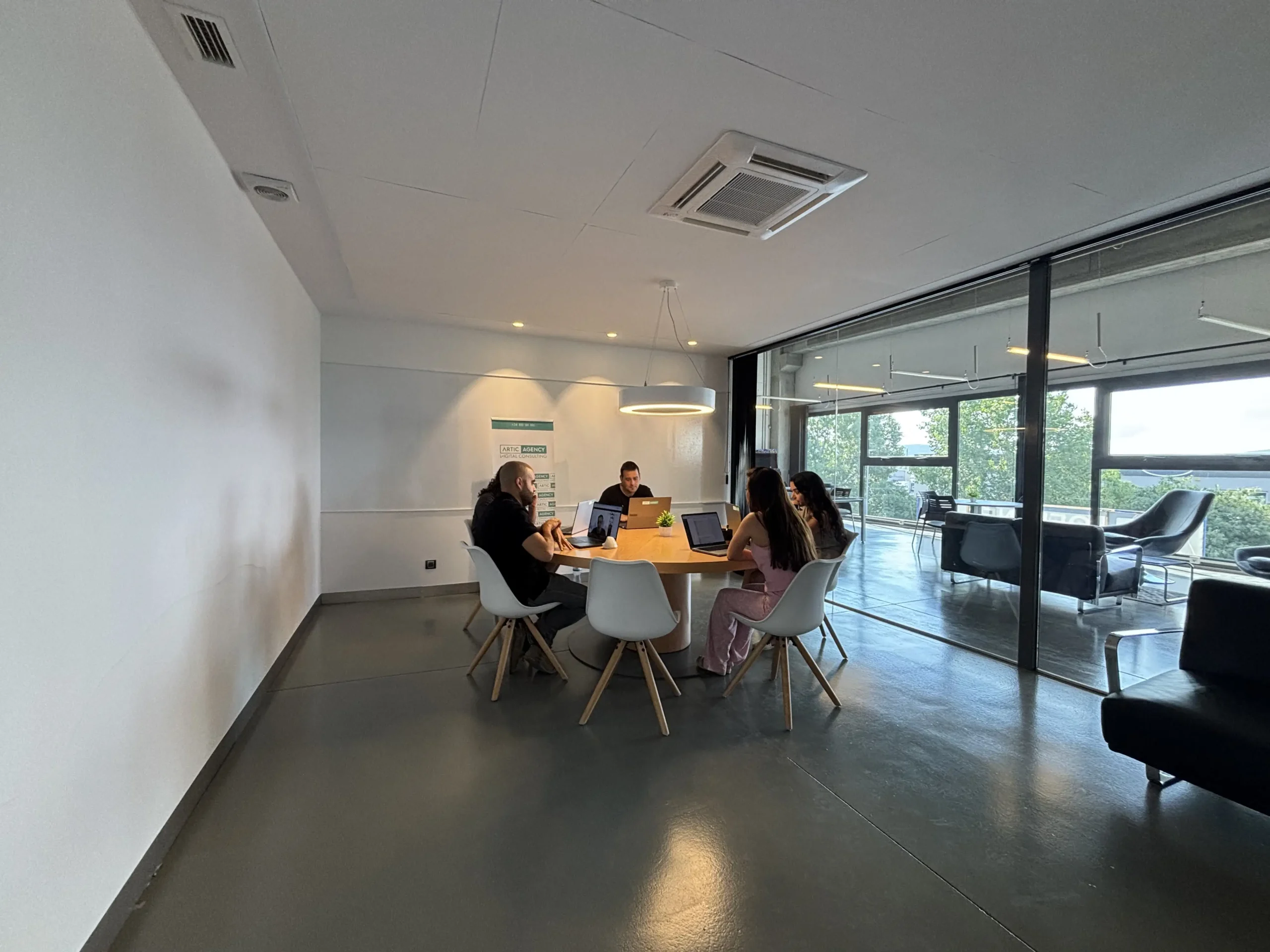
If you prefer to accelerate with a partner who already works with industrial and tech B2B, see how we operate as a B2B marketing agency in Málaga.
Frequently asked questions
How many companies are there in the province of Málaga?
There are 142,401 active companies as of 1 January 2025, up 4.1% versus 2024. Source: INE, Central Business Register (DIRCE) 2025.
How many Málaga companies have 10 or more employees?
5,533 companies (3.9% of the province) have 10+ employees. This is 3.4% of Spain’s total companies with 10+ employees, according to INE (DIRCE 2025).
Which municipalities and hubs concentrate B2B demand?
Málaga city, Marbella, Vélez‑Málaga and Antequera, with hubs such as Málaga TechPark (PTA), Polígono del Guadalhorce and the Centro Logístico de Antequera. These areas gather many decision‑makers and suppliers.
Which channels work best to win B2B clients in Málaga?
SEO and Local SEO capture intent, Google Ads captures in‑market demand, LinkedIn Ads reaches target accounts, and a conversion‑ready website closes the loop. SEO for AI helps surface in assistant answers.
How should I adapt my strategy by buyer size?
For micro/small firms, use packaged offers and self‑serve; for 10–49, run consultative sales with cases and pilots; for 50+, deploy ABM, compliance readiness and committee consensus. Always measure MQL→SQL→revenue in your CRM.
Where does Málaga rank nationally for mid‑large companies?
It ranks 6th among the 50 provinces by number of companies with 10+ employees. This opens room for local specialisation and for rolling the same playbook into nearby provinces.
How can I justify B2B marketing ROI in Málaga?
Model your funnel with conversion rates, average deal size and margin, and attribute source→SQL→sale in the CRM. Publish an ROI calculator and local case studies by vertical to reduce buyer uncertainty.
Sources and methodology
- Active companies by province and number of employees: INE (Spanish Statistics Institute), Central Business Register (DIRCE), table 39374.
- Sectors, towns and business areas: general public information compiled by ARTIC.
- The linked client examples are real ARTIC projects. Calculators are indicative.
Related services
- Google AdsSearch, Performance Max, YouTube and Shopping campaigns run by a certified Google Partner team.
- Google LocalAttract customers near you with geolocated ads on Google. Ideal for brick-and-mortar businesses that want more visitors or calls.
- SEOWe are experts in web positioning for service companies, brands and e-commerce