
Instagram isn't just for consumer brands. For industrial companies in Central Europe, the platform serves as a discovery channel, a means of technical validation, and a way to shorten the sales cycle, provided that the content and metadata are geared towards decision-makers, not end consumers. Instagram's role in the B2B marketing of industrial assets It focuses on three moments of the funnel:
- Discovery: A purchasing manager is looking for a machinery supplier and finds your demonstration reel before visiting your website.
- Technical validation: Carousels with specifications, plant tours, and test videos reduce the perceived risk before the first business contact.
- Qualified lead generation: Native Meta Ads forms and CTAs to landing pages connected to HubSpot or Holded turn interactions into trackable opportunities.
- Proposal support: The published content acts as a visual library that the sales team shares during the RFQ process.
LinkedIn identifies the decision-maker. Instagram convinces its team before the formal proposal arrives.
What real results can Instagram deliver at each stage of the industrial funnel?
The most common mistake is expecting Instagram to generate direct RFQs. It doesn't work that way, and understanding this protects your budget. What it does deliver, in a measurable way, is qualified visibility and reduced friction in the early stages.
According to Web Tonic's industry data for manufacturing, LinkedIn concentrates the majority of direct B2B leads, but Instagram shows sustained growth in engagement for industrial brands, especially when video is the main format.
KPIs by funnel stage:
- Awareness: Reels reach, impressions, and new followers on business profile.
- Consideration: saved and shared technical carousels (sign of real intent), full video views, clicks on bio.
- Lead capture: CTR to landing page, assisted conversions, cost per lead in Meta Ads campaigns with native form.
- Pipeline: leads assigned in CRM, open opportunities attributed to Instagram as a first contact or influence channel.
The realistic expectation for a three-month pilot in Central Europe: improved brand visibility among technical audiences and between 15 and 40 qualified leads if organic reach is combined with a prospecting campaign in Meta Ads. Instagram complements LinkedIn; it does not replace it in the decision-maker identification phase.
What formats work for showcasing industrial assets on Instagram?
Catalog content doesn't convert. What generates saves, shares, and clicks are formats that showcase the process, the result, and the real-world application. Demonstrating real processes and applications humanizes the brand and reduces perceived risk before the first sales contact.

| Format | Main objective | Recommended duration / length |
|---|---|---|
| Demonstration reel | Scope and discovery | 45 seconds |
| Technical Carousel | Consideration and safeguards | 8 slides |
| Plant tour (video) | Validation and credibility | 2–4 minutes |
| Stories with poll | Nurturing and segmentation | 1–3 Linked Stories |
Carousels function like micro-white papers: each slide advances a technical argument (problem, solution, specification, result). Reels generate organic reach beyond your existing follower base. The plant tour is the format that most reduces sales friction because it showcases actual capabilities, not promises.
Minimum production checklist:
- Technical script validated by the product manager before recording.
- Plant permits and safety verification (restricted areas, visible PPE).
- Subtitles in all videos (85 % of the video on networks is consumed without sound).
- Descriptive alt text with keywords in each published image.
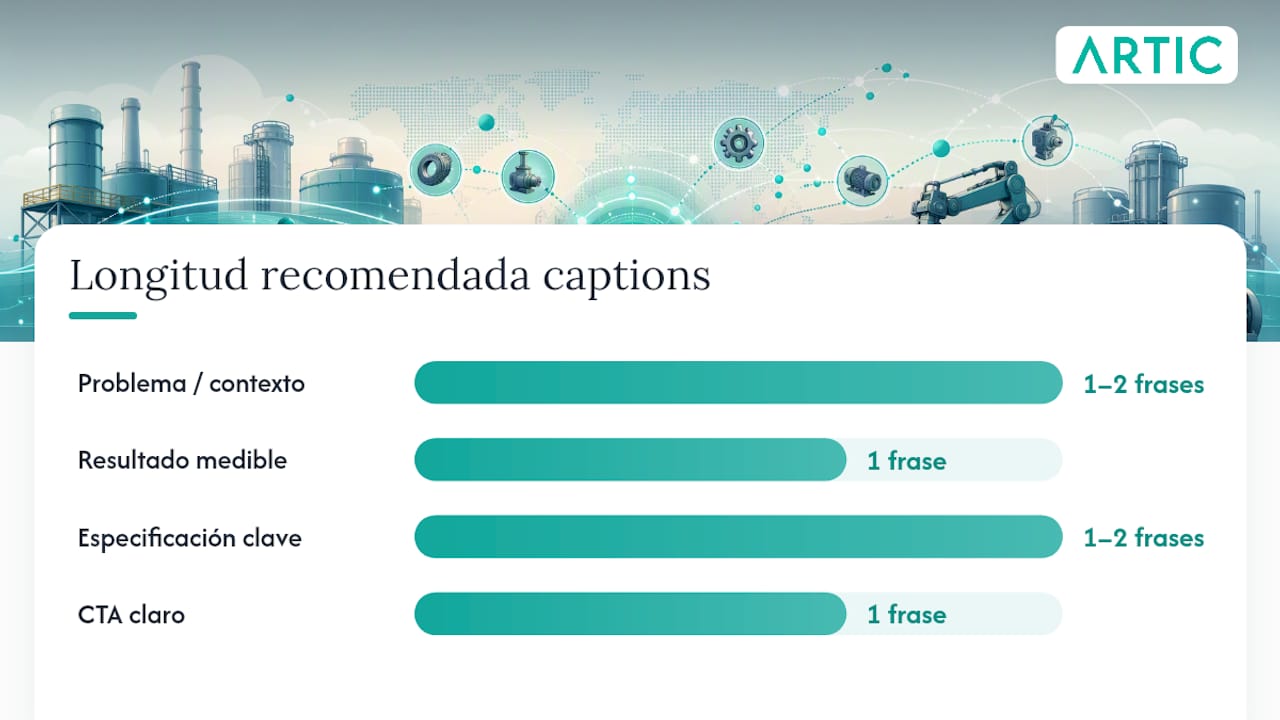
- Structured caption: problem, outcome, key specification, CTA.
Professional advice: A two-hour technical visit can produce a 45-second reel, an 8-slide carousel, and a longer YouTube video. Plan your recording with that goal in mind before entering the plant.
How to write captions that technical decision-makers will find on Instagram?
By 2026, Instagram will function as both a search engine and a discovery channel.Optimizing captions with keywords increases organic reach among technical decision-makers. Most industrial companies ignore this and publish generic captions that don't index.
Caption template for technical post:
- Problem or context (1–2 sentences): Describe the challenge that the asset or process shown solves.
- Measurable result (1 sentence): concrete data or observable improvement.
- Key specification (1–2 sentences): differentiating technical parameter.
- Clear CTA (1 sentence): "Download the technical data sheet in the link in bio" or "Write to us to schedule a demo.".
Checklist of hashtags and tags for Central Europe:
- 3–5 industrial niche hashtags (e.g.: #industrialmachinery, #automation, #manufacturingB2B).
- 1–2 relevant geographical hashtags (e.g., #industriaEuropa, #fabricacionEuropa).
- Avoid massive and generic hashtags: they compete with millions of posts and don't reach your audience.
For the alt text: describe the image with technical precision ("Automated assembly line with ABB robot for welding stainless steel components"). This improves accessibility and indexing simultaneously. It applies the same logic as Profile and content optimization for social search that works in local SEO.
Professional advice: Add timestamps to the captions of long videos ("0:00 Problem / 0:45 Solution / 1:30 Specifications"). They improve retention and signal structure to social search algorithms.
When to use organic and when to invest in Meta Ads for industrial assets?
The answer depends on the objective and the stage of the funnel, not the available budget. Combining LinkedIn and Instagram offers executive reach and emotional brand validation.LinkedIn appeals to decision-makers, while Instagram convinces their technical environment.
| Tactic | When to use it | Main KPI |
|---|---|---|
| Organic (Reels + carousels) | Always: Build authority and a content library | Saved, shared, reach |
| Prospecting in Meta Ads | When you need to reach new audiences fast | CPM, CTR, cost per lead |
| Retargeting | Website visitors who did not convert | Assisted conversions, ROAS |
| Native lead forms | Demo campaigns or technical data sheet download | Cost per lead, conversion rate |
For an initial pilot in Central Europe, it's recommended to invest a moderate amount in Meta Ads to validate audience and format hypotheses. Scaling makes sense when the cost per qualified lead is lower than the margin of the first sale.
GDPR Note: Meta's native forms must include explicit consent, a link to the privacy policy, and data minimization measures. In Central Europe, lead data processing must comply with the General Data Protection Regulation (GDPR). Document the legal basis before launching any campaign.
How to connect Instagram to CRM and measure the real impact on the pipeline?
Without attribution, Instagram is just an image expense. With UTMs, lead routing, and automation, it becomes a measurable business asset. Quarterly planning with bi-weekly sprints and CRM integration are the levers that transform Instagram into a real sales pipeline.
Recommended UTM structure:
utm_source=instagramutm_medium=socialutm_campaign=product_reel_name(either_carousel,_story)utm_content=variant_A(for creative A/B testing)
Basic automation workflow:
- Lead form in Meta → GDPR consent validation → automatic assignment to salesperson in HubSpot or Holded → email nurturing sequence → follow-up on LinkedIn if no response within 48 hours.
Professional advice: Set up a "first contact channel" property for each lead in HubSpot or Holded. In six months, you'll have real attribution data that will justify (or not) scaling your Instagram investment.
Integration KPIs to review in each bi-weekly sprint: leads generated per channel, lead-to-opportunity conversion rate, CAC per channel, and Instagram-assisted conversions into opportunities closed by other channels.
How to organize content production in bi-weekly sprints?
The biggest bottleneck in industrial companies isn't a lack of ideas: it's approval. A bi-weekly sprint model with clear roles eliminates that problem.
Biweekly sprint checklist:
- Week 1: technical briefing with product manager, on-site recording, compilation of specifications.
- Week 2: editing, writing captions, legal review/communication, scheduling and publishing.
- At the end of each sprint: quick report of metrics (reach, saved, leads) and adjustment for the next one.
Minimum roles required:
| Role | Responsibility | Estimated time/sprint |
|---|---|---|
| Community manager | Post, captions, replies | two hours |
| Content producer | Recording and editing | 8–12 hours |
| Product Manager | Technical validation | 1–2 hours |
| Sales Leader | Final approval and lead feedback | 1 hour |
Professional advice: Set a maximum approval time of 48 hours. Each day of delay reduces the post's organic reach because the algorithm penalizes content that takes time to accumulate initial engagement.
Anonymous example: industrial pilot in Central Europe
A company that manufactures components for industrial automation in Central Europe launched a 12-week pilot project with the following parameters:
- Aim: generate visibility among purchasing engineers and technical directors in Central European markets.
- Initial resources: two on-site recording sessions, a monthly budget of €800 for Meta Ads, and integration with HubSpot.
- Tactics: Four demonstration reels, six technical carousels, prospecting campaign segmented by job title and industry, retargeting of product page visitors.
Results at the close of the pilot: increased web traffic from Instagram and lead generation through native forms, with opportunities opened in HubSpot attributed to Instagram as an influence channel. Key takeaway: technical carousels generated more saves than Reels, but Reels generated more direct leads.
Checklist to start the pilot in three months
Phase 1 (weeks 1–2): audit and brief
- Audit Instagram profile: bio with keywords, link to landing page, highlights organized by product.
- Draft technical brief: products to be shown, key messages, target audience, plant restrictions.
Phase 2 (weeks 3–8): production and publication
- Produce and publish 2 Reels and 2 technical carousels per month.
- Activate prospecting campaign in Meta Ads with native form.
- Configure UTMs and lead routing flow in HubSpot or Holded.
Phase 3 (weeks 9–12): analysis and scaling decision
- Review KPIs: cost per lead, conversion rate, attributed opportunities.
- Decide whether to scale Ads budget or adjust formats based on data.
Estimated pilot budget (Central Europe):
| Concept | Monthly guideline band |
|---|---|
| Content production (video + design) | €800–1,500 |
| Investment in Meta Ads | €500–1,500 |
| Management and strategy | 800 € |
| Total monthly pilot | 800 € |
The criterion for scaling is simple: if the cost per qualified lead is less than the gross margin of a sale, the channel is profitable. See the options for managed social media advertising to outsource the paid part of the pilot.
ARTIC manages the pilot and scale for B2B industrial companies
ARTIC works as an integrated digital marketing department for industrial companies in Europe and America. For a B2B Instagram pilot, the process includes technical content strategy, Reel and carousel production, campaign management in Meta Ads, integration with HubSpot or Holded, and bi-weekly reporting with pipeline KPIs.
As a certified partner of Google, Meta, Holded, and SE Ranking, ARTIC manages both organic and paid advertising with a quarterly planning model and bi-weekly sprints. There's no need to coordinate multiple vendors: strategy, production, paid media, and CRM are all handled by a single team with a dedicated account manager.
If you want to validate whether Instagram can generate qualified leads for your industrial company, request an initial audit and within a week you will have a diagnosis and pilot proposal with a fixed budget.
Sources
Frequently Asked Questions
Is Instagram useful for selling B2B industrial machinery?
Yes, as a discovery and technical validation channel. It doesn't generate direct RFQs, but it reduces sales friction and shortens the sales cycle when the content showcases real-world processes and applications.
What content format works best on Instagram for industry?
Reels generate more reach and direct leads; technical carousels accumulate more saves and act as micro-whitepapers for decision-makers in the consideration phase.
How much budget do I need for an industrial Meta Ads pilot?
An investment of €500–€1,500 per month in Meta Ads is sufficient to validate audiences and formats in Central Europe. The scaling criterion is the cost per qualified lead versus the margin of the first sale.
How do I integrate Instagram leads with my CRM?
Using UTMs in all links, native Meta forms with GDPR consent, and an automated flow that assigns the lead to HubSpot or Holded and activates an email nurturing sequence.
Is Instagram replacing LinkedIn in industrial B2B sales?
No. LinkedIn identifies and reaches decision-makers; Instagram validates the brand with their technical team. The most effective mix in 2026 uses LinkedIn for prospecting and ABM, and Instagram for visual credibility and retargeting.
