

Social media is the most effective lead generation channel for real estate agents and developers. The role of social media in real estate goes far beyond simply posting property photos: it defines who consistently generates leads and who loses market share to agents with a stronger digital presence. agents with active presence Those who rely solely on traditional portals generate 2.7 times more leads on social media. 84% of buyers check an agent's online presence before contacting them.
What is the role of social media in the real estate sector?
Social media is not a passive storefront. It's the first point of contact between a potential buyer and an agent, long before that buyer calls or submits a form. 92 % of the agents 70% of companies actively use social media, and % plans to increase their investment by 2026. This figure reflects a reality: those who are not present on social media simply do not exist for a growing part of the market.
The importance of social media in the real estate sector lies in three specific functions. First, they generate visibility for properties at a much lower cost than traditional advertising. Second, they build the agent's authority as a local leader. Third, they allow for audience segmentation with a precision that real estate portals cannot offer.

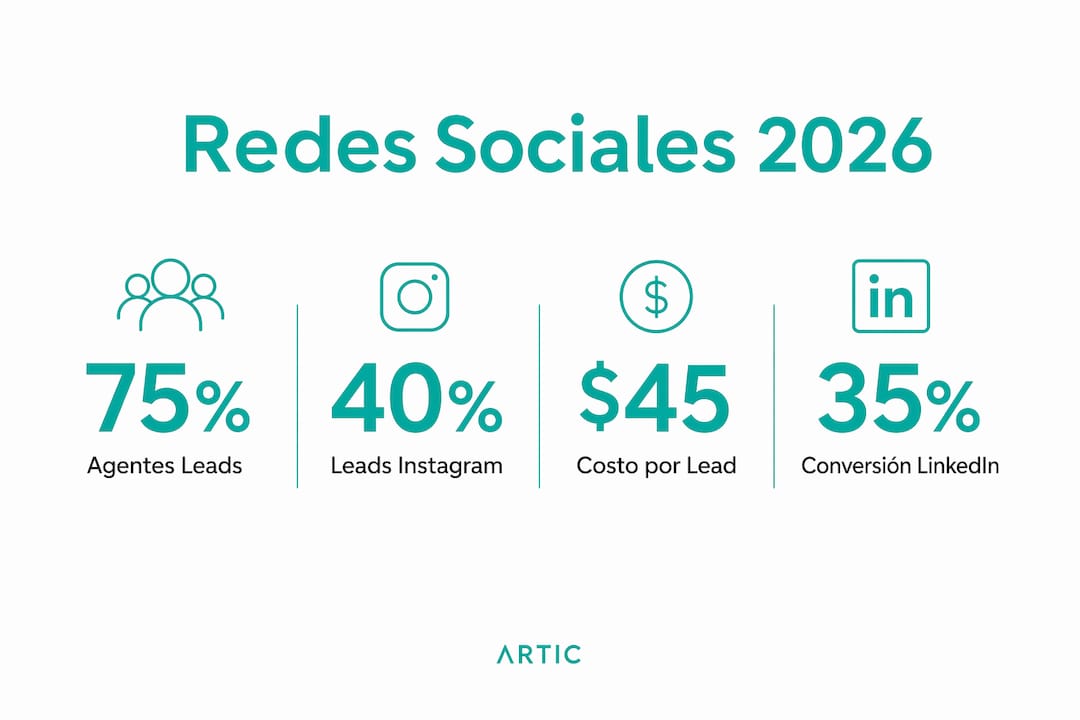
More than 75% of agents They identify social media as their primary source of leads. A clear and consistent personal brand on social media is crucial for generating contacts and building trust. Without that presence, the agent relies on luck or referrals, two unpredictable sources.
Which platforms work best for real estate agencies?
The platform you choose determines who you reach and at what cost. Not all social networks are equally effective for all buyer profiles.
Segmentation by platform and customer profile:
- Facebook It focuses on buyers aged 40–65, the segment with the greatest purchasing power for primary and secondary residences. Its local groups They generate 28 % of the leads Social media marketing in real estate is a powerful tool, and 82% of those contacts become clients within six months. Furthermore, the cost per lead for Facebook ads is around $45, compared to $120 for print advertising.
- Instagram It is the dominant platform for 18–34 year old buyers. 78% of agents use it, and it generates 40% of the industry's social leads. Its return on investment is 1.8 times higher than Facebook's for this segment.
- TikTok It boasts a 28% conversion rate among young buyers. Short videos of property tours or buying tips reach organic audiences that no other channel offers, at no cost.
- LinkedIn It is the network for institutional clients, investors, and B2B transactions. Its conversion rate for primary buyers reaches 35% per 1,000,000 (TP4T), making it the most effective platform for developers with high-value projects.
The appropriate segmentation by age And the type of customer maximizes the return on investment in digital ads. Managing four platforms simultaneously without a strategy produces mediocre results across all of them. The recommendation is to choose two networks aligned with the target customer profile and work on them consistently.
Professional advice: If you're selling new-build homes to investors, combine LinkedIn for direct contact and Instagram to showcase the project's progress. If your market is resale homes for families, Facebook and its local groups system is your primary channel.
What content generates the most interaction on real estate networks?
The content that converts best on real estate social media isn't the listing announcement. It's social proof. Share recent sales data And video testimonials generate more interaction than simply posting property listings. Potential buyers aren't just looking for an apartment; they're looking for an agent they can trust.
The formats with the highest proven performance are:
- Reels and short videos: Instagram Reels account for 35% of shares in the first 24 hours after publication. A 60-second video showcasing the interior of a property surpasses the reach of any static photograph.
- Professional photography: Low-quality images destroy brand perception before the buyer even reads the description. Professional photography isn't an expense; it's the filter that separates serious agents from the rest.
- Video testimonials: A satisfied customer speaking on camera for 30 seconds is worth more than ten promotional ads. It generates immediate trust and sets the agent apart from the competition.
- Educational content: Publications about the buying process, mortgage financing, or local market trends position the agent as an expert. This type of content attracts buyers in the research phase, before they contact anyone.
- Project updates: For developers, showing the progress of the work week by week generates anticipation and maintains the interest of buyers for months.
The recommended frequency is 4–5 posts per week, alternating between educational, emotional, and promotional content. Posting only property listings is the most common mistake and the one that most damages organic reach.
Professional advice: Record a customer testimonial right after they sign the contract. The emotion of the moment is genuine, and it shows. A video recorded on your phone at that instant has a greater impact than any elaborate production.
How to measure the performance of social media campaigns?
Measuring without criteria is as useless as not measuring at all. The metrics that matter in real estate marketing on social media are those that directly connect to generating business.
| Metrics | What does it measure? | Why it matters |
|---|---|---|
| Scope | Unique people who view the content | It indicates the actual visibility of the brand. |
| Interaction rate | Likes, comments, saves per post | Measure the relevance of the content to the audience |
| Cost per lead | Investment divided among leads generated | Compare efficiency across channels and campaigns |
| Conversion rate | Leads that advance to visit or signature | Evaluate the quality of the leads captured |
| Follower growth | New followers per period | It reflects the long-term health of the brand |
Responding to comments improves organic reach and benefits the algorithms of Facebook, Instagram, and LinkedIn. Each response triggers the algorithm and amplifies the post's visibility at no extra cost. Ignoring comments is leaving money on the table.
For paid campaigns, the native dashboards of Meta Ads and LinkedIn Campaign Manager offer sufficient data for weekly decision-making. Adjustments to audiences, creative assets, and budget should be based on real data, not intuition. well-structured editorial calendar And programming tools like Meta Business Suite allow you to maintain consistency without spending hours a day on management.
Professional advice: Review your metrics every Monday with a 10-minute report. Identify the two posts with the highest reach from the previous week and replicate their format in the following days. Consistency trumps one-off creativity.
What mistakes ruin a real estate social media presence?
The most frequent mistakes are not technical. They are strategic. And they are repeated in agencies and independent agents alike.
- Constant overselling: Posting only property listings with prices and features turns your profile into a catalog. Algorithms penalize this approach, and followers stop interacting. Valuable content, such as buying advice or local market analysis, generates more reach than any direct ad.
- Managing too many platforms at once: Being present on six social media platforms with mediocre content is worse than being present on two with excellent content. consistency trumps quantity of platforms. An abandoned profile conveys neglect and drives away buyers.
- Ignore the interaction: Failing to respond to messages or comments within 24 hours destroys trust. Buyers who don't receive a response will contact the next agent on your list.
- Low-quality visual content: A dark photograph or a shaky video conveys a lack of professionalism. Visual quality is the first filter any buyer applies before reading a single word.
- Not adapting the content to the platform: A long text written for LinkedIn won't work on Instagram. Each network has its own format, tone, and optimal length. Copying and pasting the same content across all platforms reduces its performance on every one.
You can see concrete examples of how companies in the sector They manage their networks to avoid these errors and maintain a consistent presence.
How to use artificial intelligence for real estate marketing on social media?
Artificial intelligence has transformed real estate social media management in a practical and measurable way. AI-powered automation for scheduling and visual enhancement allows for a consistent presence without sacrificing quality or consuming excessive time. Management time per property is reduced to 40 minutes when AI tools are used to create and schedule content.
The most useful applications for agents and developers are:
- AI-powered photo enhancement: Tools that correct lighting, remove unwanted objects, and generate virtual home staging images without the need for an additional photographer.
- Generating texts for publications: Language models like ChatGPT or Gemini create property descriptions, captions, and video scripts in minutes. The agent reviews and adjusts; the AI generates the draft.
- Automatic programming: Platforms like Meta Business Suite or social media management tools allow you to schedule weeks of content in a single session. Posting occurs automatically during peak audience times without manual intervention.
- Predictive analytics: Some management platforms analyze posting history and predict which formats and times will generate the most interaction in the coming weeks.
The artificial intelligence in social networks It doesn't replace the agent's strategy or judgment. It accelerates execution and frees up time for what truly generates business: visits, negotiations, and client relationships. Among the digital marketing agencies Those working with the real estate sector that integrate AI into their processes report significantly shorter content production times.
Specialized digital marketing for real estate agencies
Managing social media for measurable results requires more than just regular posting. It requires a content strategy aligned with the buyer's journey, well-targeted paid campaigns, and continuous analytics to adjust what isn't working. ARTIC works with agents and developers to build that structure from scratch or improve an existing one, integrating key digital channels in a coherent system. The ARTIC team manages everything from editorial strategy to the social media advertising campaigns, With clear KPIs and bi-weekly reporting. If you're looking for concrete results in lead generation, contact ARTIC.
Frequently Asked Questions
Which social network generates the most leads for real estate agencies?
Instagram generates 40% of social leads in the real estate sector, with a return on investment 1.8 times higher than Facebook for younger buyers. Facebook dominates among buyers aged 40–65, and its local groups convert 82% of leads into customers within 6 months.
How often should a real estate agent post?
The recommended frequency is 4–5 posts per week, alternating educational content, testimonials, and property listings. Consistency over time has a greater impact on the algorithm than occasional high-volume posts.
How much does it cost to generate a lead through social media?
The cost per lead for social media ads is around $45, compared to $120 for traditional print advertising. This difference makes social media campaigns significantly more efficient for most businesses.
Are social media platforms useful for selling high-value properties?
LinkedIn boasts a 35% conversion rate for core buyers and is the most effective platform for developers with high-value projects or institutional clients. Combined with Instagram to showcase the project visually, it forms the most effective duo for this segment.
What happens if I don't reply to comments on my posts?
Not responding to comments reduces organic reach because Facebook, Instagram, and LinkedIn algorithms penalize a lack of interaction. Furthermore, buyers who don't receive a response within 24 hours are more likely to contact another agent.
