ARTIC launches a new website: faster, in three languages and built for search engines and AI
We rebuilt articagency.com from scratch: no WordPress, in Spanish, Catalan and English, ready for Google and for ChatGPT, Claude or Perplexity, and connected to our CRM.
 Francesc Beumala · Founder, partner and CEO of ARTIC
In this article
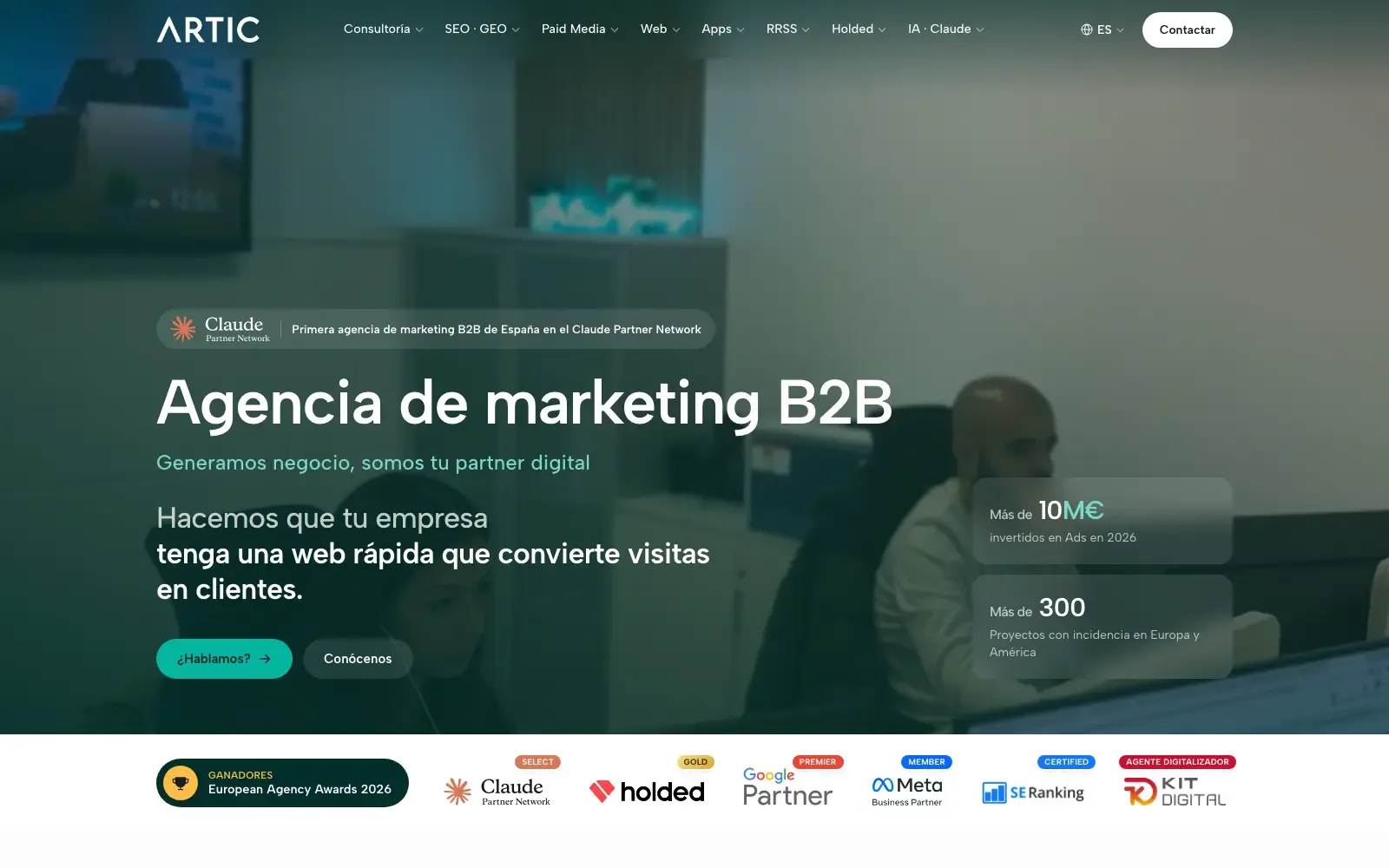
ARTIC has launched a new website at articagency.com. We rebuilt it from scratch, without WordPress, using the same approach we apply to our clients’ projects: it has to load fast, be understood by both Google and AI assistants, and make sure every visitor who wants to talk to us reaches the right person on the team.
In short
- A new ARTIC website in three languages (Spanish, Catalan and English), with around 1,190 pages.
- Built as a static site: no WordPress, no plugins and no exposed database.
- Ready for traditional SEO and for SEO for AI (GEO): structured data, an
llms.txtfile and open access for the ChatGPT, Claude and Perplexity crawlers. - All 637 addresses of the previous site were kept or redirected one by one, so no rankings are lost.
- Native forms connected to our CRM, our own cookie consent manager with Consent Mode v2, and a blog that publishes analysis based on official data.
Why we rebuilt the website
The way companies look for suppliers has changed. A marketing director or an industrial manager no longer just searches on Google: they also ask ChatGPT, Claude or Perplexity which agency can help with their CRM, SEO or campaigns. To show up in those answers, a website has to be fast, well structured and clear about who you are, what you do and what you have achieved.
Our previous WordPress site had done its job, but it carried the usual baggage: plugins to update, heavy pages, embedded third-party forms we could not measure properly and machine translations that did not always read naturally. If we want to help our clients solve that, we had to solve it at home first.
What the new website includes
Speed and security: a static website
The site is generated with Astro as static HTML: every page is ready before the visitor arrives. There is no WordPress, no plugins and no database to attack, and each page only loads the code it needs. For visitors, that means pages that appear straight away, on mobile too; for us, less maintenance and a smaller attack surface.
Built for search engines and AI (GEO)
We approached the site the way we approach SEO for AI for our clients:
- Structured data on every page: the organisation, each of our four offices, the people on the team, our services and FAQs, in the format Google and language models read.
- An
llms.txtfile summarising who we are and what we do, written for AI assistants. - Open access for AI crawlers (GPTBot, ClaudeBot, PerplexityBot, Google-Extended…): we want to be read and cited.
- Consistent local SEO for our four offices in Barcelona, Tarragona and Madrid: the same name, address, phone number and opening hours as on Google Business Profile, with each office linked to its listing.
- Three properly linked languages (hreflang), with reviewed content in Spanish, Catalan and English.
More useful content, with named authors
The new site organises our services by area (consultancy, SEO and GEO, Paid Media, web, apps, social media, Holded and AI with Claude) and adds sections that did not exist before:
- Industries: dedicated pages for the industrial sectors where we have real case studies.
- Success stories with verifiable data and per-service breakdowns, instead of generic testimonials.
- Team and authors: every person has a profile with their speciality and signs the content in their area. That is what Google calls experience and authority, and it lets an AI assistant attribute an answer to a real person. You can meet them on our team page.
- Claude Partner Network: a dedicated section on what it means to be Spain’s first B2B marketing agency in the Claude Partner Network.
A blog built on data, not opinions
The blog regularly publishes analysis in three languages based on official sources such as Spain’s National Statistics Institute (INE) and Eurostat, with charts and calculators generated from that data. Every article links to its sources and answers concrete questions companies ask: how many businesses there are in a province, how they use AI or how much to invest in ads.
Native forms connected to our CRM
We replaced embedded forms with our own. The contact form starts by asking what you need: a quote, support as an existing client, or press, partnerships and other enquiries. Each request reaches the right person in our CRM, and service pages include calculators so you can get an idea before talking to us. If you want to see it in action, get in touch.
Privacy: cookies only if you accept them
Analytics and advertising cookies are only activated if you accept them. We do this with our own consent manager, integrated with Google Consent Mode v2, without relying on external tools.
A switch without losing what already worked
The biggest risk when changing websites is losing search rankings. That is why we kept the same URL structure and checked every one of the 637 URLs of the previous site: they all still work or redirect in a single hop to their new page. The new sitemap has already been submitted to Google and Bing.
Built with the same method we use for clients
Our own team built the site with the help of Claude Code, Anthropic’s AI development tool, taking it from the first line of code to production in less than a month. It is the same way of working we offer in our AI web design service: people decide the strategy, design and content, and AI speeds up the work.
If you are thinking about rebuilding your company’s website, or want your brand to show up when your customers ask an AI, let’s talk.
Frequently asked questions
Why did ARTIC move away from WordPress?
For speed, security and control. A static site loads faster, does not depend on plugins or an exposed database and lets us control every technical detail of SEO and measurement. WordPress is still a good choice for many projects, and we keep using it with clients when it fits.
Have the website addresses changed?
No. We kept the same structure (Spanish at the root, Catalan under /ca/ and English under /en/), and the few pages whose address changed redirect automatically to the new one.
What is SEO for AI, or GEO?
It is the work of getting a brand to appear and be cited in the answers of assistants such as ChatGPT, Claude, Perplexity or Google’s AI Overviews. It combines clear, verifiable content, structured data, authorship and brand authority. We explain it on our SEO for AI page.
Can you build a website like this for my company?
Yes. That is what we do in our AI web design service, in Astro or WordPress depending on what each project needs.
Related services
- CRM implementationPipeline, source of every lead, automatic routing and integration with your website, ads and Holded.
- Marketing automation and CRMCRM, email, WhatsApp and AI calls connected to answer, qualify and follow up every lead.
- Google AdsSearch, Performance Max, YouTube and Shopping campaigns run by a certified Google Partner team.