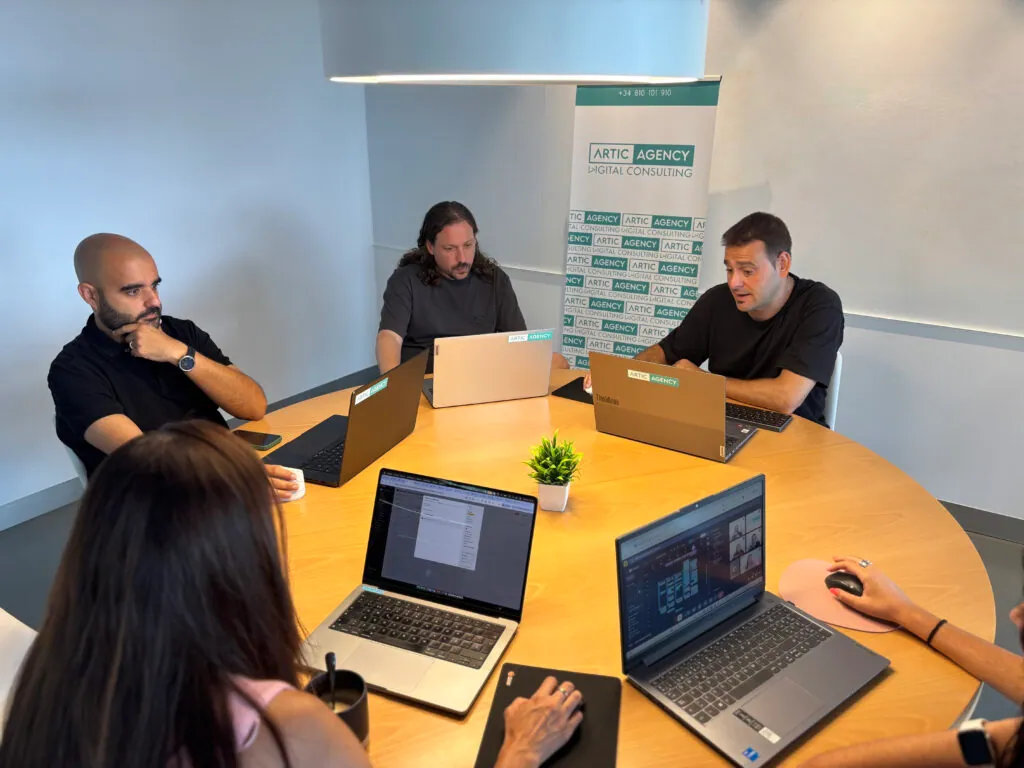
How we run monthly sprints for every B2B client
How we organise monthly sprints: objectives, hours per discipline, tasks created in ARTIC CORE and executed in ClickUp, fixed reviews and KPI meetings for impact.
 Alidmar Baricó · Chief Operating Officer (COO) of ARTIC

In this article
We organise work for each client in monthly sprints that run from the 1st to the last day of the calendar month. At sprint opening we set objectives, hours by discipline and ad spend; tasks are generated in our internal platform ARTIC CORE and executed in ClickUp. We hold a mid‑month status meeting and a close+open session on the last working Friday, and present a KPI report every month.
Key takeaways
- 1 sprint equals 1 calendar month; 12 sprints per year.
- At kick‑off we set monthly and per‑discipline objectives, hours and ad spend.
- Tasks are auto‑generated in ARTIC CORE and executed in ClickUp.
- Mid‑month status on the Friday closest to the 15th; close+open on the last working Friday.
- Impact first: never exceed hours without authorisation; every task goes through feedback before closure.
What a monthly sprint means for us
I’m Alidmar Baricó, Chief Operating Officer (COO). At ARTIC, we structure every client’s work in monthly sprints that always match the natural month: from day 1 to the last day. This gives us a predictable cadence (12 sprints a year) and clean comparisons month over month.
A monthly sprint is a closed loop where we align multiple disciplines—meetings and reporting, SEO, tracking, web, Ads and social—under one set of goals. Each sprint starts and ends with explicit decisions, outcomes and learnings.
Why monthly, not weekly? The month balances agility with traction: there is enough time to execute meaningful work while still having frequent feedback to steer the plan.
If you want the broader context of our end‑to‑end B2B approach, see how this cadence fits into our 360 Consulting in digital marketing for B2B companies. You can also explore our wider B2B digital consulting model for how strategy, execution and measurement connect.
Sprint kick‑off: objectives and hours by discipline
At the opening of each sprint, we define for every client:
- Overall objectives for the month and objectives by discipline.
- Indicative hours by discipline (meetings, reporting, SEO, tracking, web, Ads, social media).
- The planned advertising investment.
With this framing, ARTIC CORE—our internal management platform—automatically generates the sprint tasks. The team executes them in ClickUp.
Our golden rule is impact first: we focus on leads, cost per lead and search positioning. We do not “do hours for the sake of hours”. If an unplanned need appears, we subtract from lower‑impact tasks or move it to the next sprint. We never exceed the assigned hours without prior authorisation.
This keeps trade‑offs explicit: what we aim for this month, how much effort per channel, and what gives way if priorities change. For more on our mindset and culture, see our team and how we work.
Execution and quality control: from work to feedback
Tasks flow from their creation in ARTIC CORE to execution in ClickUp. When a task is completed, it always moves to the “pending feedback” state: the account manager reviews the deliverable and communicates it to the client before closing the task.
This gate prevents premature closure and ensures each deliverable serves the sprint objective. It also builds a traceable history of decisions and changes across the month, so improvements are grounded in what actually happened.
For teams that need more frequent touchpoints alongside the sprint rhythm, our 360 Consulting model includes weekly or fortnightly meetings to review results, propose improvements and adjust the plan in real time, complementing (not replacing) the fixed sprint milestones. Learn more in 360 Consulting in digital marketing for B2B companies.
Fixed reviews and monthly reporting
Two standing milestones anchor every month:
- Mid‑month status meeting on the Friday closest to the 15th to unblock issues, reset priorities and check progress.
- Close + open meeting on the last working Friday of the month to close the current sprint (what was achieved, what rolled over and why) and prepare the next (goals and hours).
In addition, every month the client receives a KPI report, which we present in the monthly meeting. The focus is on business‑level metrics: leads, cost per lead and positioning—keeping the conversation anchored to impact rather than activity.
To see how this cadence translates into outcomes across sectors, browse our B2B success stories. The constant plan–execute–review cycle you see there is the same structure we enact in our monthly sprints.
Change management and guardrails for focus
Unplanned work will happen. Our sprint framework sets clear guardrails:
- Impact first: assess changes by their potential effect on leads, CPL or positioning.
- Zero‑sum inside the sprint: if something new comes in, another lower‑impact task is reduced or moved to the next sprint.
- No overruns without authorisation: we never exceed assigned hours without explicit approval—protecting both budget and focus.
- Transparency: document what enters, what leaves and why in ClickUp so team and client share the same view of the month.
These rules reduce friction, keep effort under control by channel and preserve the learning loop that only comes with crisp sprint closures. For background on our principles and ways of working, see who we are and our approach.
What to do now: a practical checklist
Here is a simple, actionable list to adopt monthly sprints in your marketing team:
- Decide that 1 sprint = 1 calendar month; set 12 cycles per year.
- At kick‑off, set overall and per‑discipline goals; allocate indicative hours and ad spend.
- Use a single tool to manage tasks and enforce a “pending feedback” state before closure.
- Schedule two fixed milestones: status on the Friday closest to the 15th, and close + open on the last working Friday.
- Apply a zero‑sum rule: new work enters only if lower‑impact tasks exit; no hour overruns without authorisation.
- Deliver and present a monthly KPI report focused on leads, CPL and positioning.
- Review what rolled over, why, and how to prevent it next month; convert this into next‑sprint objectives.
For end‑to‑end execution with regular strategic touchpoints, see how we structure 360 Consulting in digital marketing for B2B companies.
Frequently asked questions
How do you decide the hours per discipline each month?
At sprint opening we assign indicative hours per discipline (meetings, reporting, SEO, tracking, web, Ads and social) based on that month’s objectives and the planned ad spend. Impact on leads, cost per lead and positioning guides the allocation.
What happens if an urgent request appears mid‑month?
We apply a zero‑sum rule: if something new comes in, other tasks are adjusted or moved to the next sprint. We never exceed the assigned hours without prior authorisation. The mid‑month status meeting helps re‑prioritise.
Which tools do you use to manage sprints?
Sprint tasks are generated automatically in our internal platform ARTIC CORE, and the team executes them in ClickUp. Every completed task goes through a “pending feedback” step where the account manager reviews it before closure.
Do you meet more often than the two fixed sprint meetings?
Yes. When we work in a 360 model, we also organise weekly or fortnightly meetings to review results, propose improvements and adjust the plan. These complement, not replace, the sprint milestones.
Shall we talk?
If you want your marketing to work like this, meet the ARTIC team, see our case studies or tell us about your project.
Sources
- 360 Consulting in digital marketing for B2B companies
- ARTIC: The B2B marketing agency
- ARTIC Success Stories
Informative article with the sources linked, up to date on the publication date.
Related services