
Email marketing in B2B is a system for building trust, not an immediate sales channel. In industrial sectors, where the buying cycle can extend over months and decision-makers evaluate suppliers using demanding technical criteria, email adds value at every stage of the process. The channel's ROI is high and proven. B2B email marketing is one of the most effective channels to generate and retain potential customers. Understanding why email marketing works in B2B is the starting point for any marketing or sales director who wants to improve their results in a measurable way.
How does email marketing build trust and qualify leads in B2B industry?
Email doesn't sell on the first visit. Its real function is to support the decision-maker for weeks or months, providing content that resolves technical doubts, eliminates objections, and positions the company as a leader in its field.
Email allows you to educate, resolve objections, and position technical viewpoints. that drive sales conversations. Formats like diagnostic emails, where a common industry problem is analyzed and a specific solution is proposed, improve lead quality and accelerate their progress through the buying cycle. An industrial machinery manufacturer, for example, might send a series of emails about the hidden costs of reactive maintenance before presenting its predictive maintenance proposal.

Trust in the industrial sector is built on evidence, not promises. The purchasing decision-maker in a manufacturing or engineering company needs to see that the supplier understands their business before agreeing to a sales meeting. Email is the channel that allows for demonstrating that understanding gradually and without pressure.
The most effective formats for building trust in industrial B2B are:
- Diagnostic emails: They raise a specific technical problem and offer a framework for analysis, not a direct sale.
- Objection emails: They address the most frequent questions in the sector before the buyer asks them.
- Application cases: They describe how a similar company solved a specific challenge with measurable results.
- Content from a technical point of view: They position the company as an expert in a specific area of the sector.
Professional advice: Design at least one diagnostic email for each segment of your list. The more specific the problem you describe, the higher the open rate and the quality of the responding leads.
What are the differences between B2B and B2C email marketing in the industrial sector?
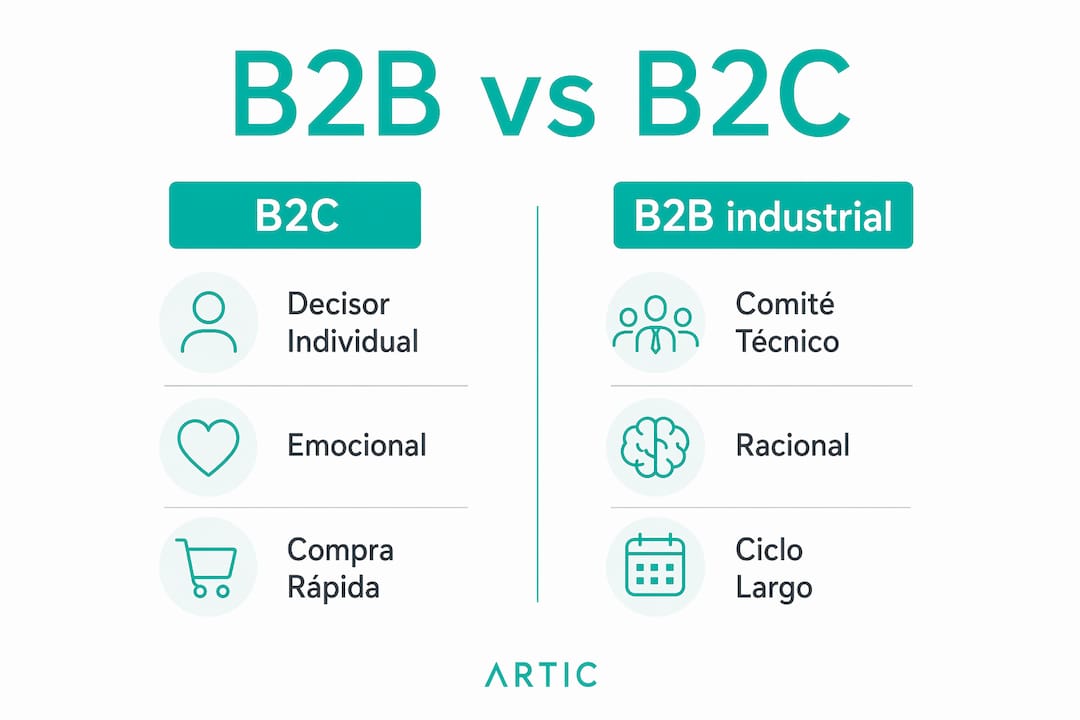
B2B and B2C email marketing share the same technical infrastructure, but they respond to completely different buying logics. Ignoring this difference is the most common mistake in industrial companies that apply consumer tactics to their email campaigns.
| Dimension | B2C | B2B industrial |
|---|---|---|
| Decision-maker | Individual, emotional | Committee, rational and technical |
| Purchase cycle | Days or weeks | Months or years |
| Message type | Offer, urgency, excitement | Technical content, trust, evidence |
| Optimal frequency | High | Moderate and segmented |
| Key metric | Direct conversion | Lead quality and progress in the cycle |
Generic newsletters don't work in B2B because industrial buyers aren't looking for inspiration; they're looking for solutions to specific problems. An email with the subject line "This Month's News" generates low open rates compared to one with "How to Reduce Downtime on Automated Production Lines.".
The difference between B2B and B2C websites This also applies to email: the tone, technical depth, and message structure must be tailored to the profile of the industry decision-maker. Segmentation by job title, sector, and stage of the buying cycle is not optional; it's the foundation of any effective campaign.
Professional advice: Before designing any email flow, define at least three distinct decision-maker profiles within your target market: the technical evaluator, the manager who approves, and the buyer who manages. Each profile requires a different message.
How to implement effective automation and nutrition workflows in industrial B2B?
Generic campaigns have stopped workingThe most effective B2B teams manage between 8 and 12 automated workflows tailored to specific behaviors. Each workflow responds to a specific contact signal, such as downloading a technical catalog, repeatedly visiting a product page, or attending a webinar.
The marketing automation It allows you to send the right message at the right time, without manual intervention. This doesn't mean eliminating the human factor: it means the sales team receives the lead when they are already educated and have shown genuine signs of interest.
An effective workflow system for industrial B2B includes the following steps:
- Welcome flow: The company presents itself, sets expectations, and delivers immediate value with a relevant technical resource.
- Evergreen education flow: A sequence of 6–10 emails that address the main issues in the industry without directly mentioning the product.
- Behavioral flow: It is activated when the contact visits pricing pages, requests information, or downloads technical documentation.
- Reactivation flow: Re-engage inactive contacts with new content or a direct question about their current needs.
- Sales transfer flow: It alerts the sales team when a lead accumulates enough signs of maturity for a direct conversation.
| Flow | Activation signal | Aim |
|---|---|---|
| Welcome | Added to list | Establish initial trust |
| Evergreen education | No specific activity | Nurture and position |
| Behavior | Visit technical page or download | Detect purchase intent |
| Reactivation | No opening in 90 days | Reconnect |
| Transfer to sales | Accumulation of signals | Start a business conversation |
Automated emails that respond to real-time behavior They are more effective than mass messaging. The reason is simple: they arrive when the decision-maker is actively thinking about the problem your company solves.
The detection of maturity signals in leads It's the critical link between marketing and sales. Without a clear criterion for when to pass on a lead, the sales team wastes time with cold calls and misses out on real opportunities.
Professional advice: Assign a numerical score to each lead behavior: opening an email is worth 1 point, clicking on a link is worth 3, visiting a pricing page is worth 10. When a contact exceeds 25 points in 30 days, automatically activate the sales transfer flow.
What are the main benefits of B2B email marketing for sales and customer loyalty?
Email marketing in the industrial B2B sector offers advantages that no other channel can replicate with the same cost and control. It's not just about sending emails: it's about building a long-term business relationship.
The most relevant benefits for marketing and sales directors in industrial companies are:
- ROI higher than other digital channels. B2B email marketing is one of the most effective channels for generating and retaining leads, with a cost per contact much lower than paid advertising.
- Progressive lead qualification. The nurturing cycle allows you to identify which contacts are ready for a sales conversation and which ones need more time, preventing sales from wasting resources on immature leads.
- Long-term customer loyalty. An industrial customer who receives useful technical content after a purchase has less reason to look for alternatives. Post-sales email directly reduces customer churn.
- Alignment between marketing and sales. The best email-generated lead is useless without a clear process for handing it off to the sales team at the right time. Email creates that bridge when the flows are well-designed.
- Channel ownership. Unlike LinkedIn or Google Ads, your email list is your own asset. No algorithm change can eliminate access to your contacts.
In B2B, the winner isn't necessarily the one who sends the most emails. but rather the one who best understands the buying cycle and the decision-maker's moment in time. Evergreen nurturing with progressive education is the strategy that makes email the obvious choice when the buyer is ready to decide.
Synergy with the sales team is the most underrated multiplier. A sales manager who receives an automatic alert when a lead visits the pricing page for the third time has a real advantage over someone who makes cold calls. Email doesn't replace the sale; it prepares it.
Furthermore, B2B emails should feel like a meaningful exchange, not advertising. When decision-makers perceive that each email offers them something concrete, open rates remain high for months. This perception is what distinguishes an active list from a dead one.
ARTIC and the email marketing strategy for industrial companies
Industrial companies that work with ARTIC integrate email marketing within a digital marketing strategy A comprehensive system where each channel reinforces the next. ARTIC designs nurturing flows tailored to each sector's buying cycle, aligns handoff criteria between marketing and sales, and measures impact with continuous analytics. Work is executed in bi-weekly sprints with clear KPIs, allowing for adjustments to the flows based on actual results. If your industrial company needs an email marketing system that generates qualified leads and supports the sales team, contact ARTIC for a personalized consultation.
Frequently Asked Questions
Why does email marketing work better in B2B than in B2C?
Email marketing works best in B2B because the buying cycle is long and decision-makers need multiple valuable touchpoints before making a choice. Email allows you to support this process with personalized, technical content that no other channel can replicate at the same cost.
How many automated workflows does an industrial company need?
The most effective B2B teams manage between 8 and 12 automated workflows tailored to specific behaviors. An industrial company might start with 3–5 basic workflows and expand based on behavioral data from its list.
What type of content works best in B2B industrial email marketing?
Technical diagnostic emails, application cases with measurable results, and emails that address common industry objections generate the highest open and click rates in B2B industrial environments.
How is the success of email marketing measured in B2B?
Key metrics in industrial B2B are open rate, click-through rate, cumulative lead score, and the number of leads converted to sales per month. Direct conversion is less important than the quality of the lead generated.
When should the sales team intervene in a lead generated by email?
Marketing should nurture leads until they show genuine interest, allowing sales to close the deal. The transfer should occur when the lead has accumulated specific behaviors, such as repeated visits to product pages or downloads of advanced technical documentation.
