

Marketing automation is the intelligent automation of marketing processes that allows SMEs to manage leads, communications, and sales follow-up without constant manual intervention. The role of marketing automation in SMEs goes beyond saving time: it's the difference between growing with the same team or needing to hire more people to scale. Tools like HubSpot, Shortway, and Klaviyo allow a small business to operate with the precision of a much larger organization. The first tangible business results appear between 30 and 60 days after consistent implementation, making this investment one of the fastest to recoup in digital marketing for SMEs.
How does marketing automation work in SMEs?
Marketing automation works through behavioral rules: when a contact performs an action (opens an email, visits a page, fills out a form), the system executes a predefined response without any human intervention. This mechanism transforms processes that previously required hours of manual work into workflows that operate autonomously, 24/7.
The areas where an SME can automate immediately are specific and measurable:
- Email marketing and follow-up sequences: Welcome messages, pending budget reminders, nurturing of cold leads.
- Lead scoring and dynamic segmentation: The system automatically scores each contact based on its behavior and moves it between segments. predictive lead scoring It allows you to prioritize prospects with the highest probability of conversion.
- Scheduled social media post: Content calendars that publish themselves, with generation assisted by artificial intelligence.
- Sales workflow management: from confirming an appointment to automatically sending a quote after a web request.
- Integrated CRM: the CRM integration It centralizes the customer lifecycle and allows personalized communication based on actual behavior.
Current platforms integrate email, SMS, WhatsApp, and social media into a single system, enabling multichannel orchestration without increasing the team's workload. To determine which processes to automate first in your company, it's advisable to map repetitive tasks with clear rules beforehand.
Professional advice: Before setting up any workflow, document the process exactly as you currently perform it manually. If you can't explain it in five steps, it's not ready for automation.

What are the tangible benefits of marketing automation for SMEs?
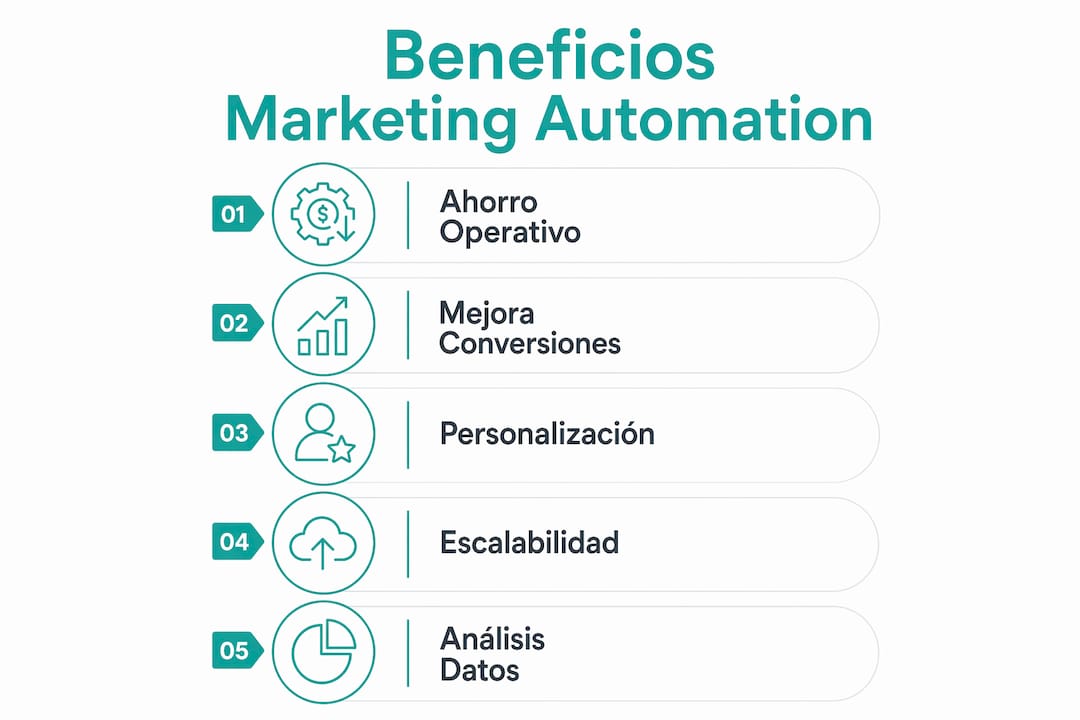
The most frequently cited benefit is time savings, but the real impact goes much further. 76% of companies using automation reported a positive return within 90 days, with a 68% reduction in time spent on repetitive tasks. This means that in less than a quarter, the investment in automation tools pays for itself.
The specific benefits that an SME can expect, ordered by impact:
- Scalability without increasing staff. Automation allows manage 5,000 contacts with the same consistency with which 50 were previously managed manually. For an SME with a small team, this completely changes the growth equation.
- Increase in qualified leads. A small business with the right tools can quadruple its volume of qualified leads in months without increasing its team or budget.
- Improved personalization. Each contact receives messages tailored to their behavior, not generic messages. This consistently increases open, response, and conversion rates.
- Automated analysis and data-driven decision making. The systems record every interaction and generate reports without additional work, allowing campaigns to be adjusted with real-time information.
- Greater commercial consistency. No lead is lost due to forgetfulness or lack of time. Follow-up always happens, at the right time, with the right message.
The impact of digital marketing on SMEs that adopt automation is not just operational. It's strategic: it frees up the team for higher-value tasks, such as closing sales or designing new offers, while the system works in parallel.
Common mistakes when implementing marketing automation in SMEs
Most failed implementations share a pattern: the company automates before having clarity about its own processes. fundamental error It's automating processes without having defined and tested them beforehand. Automating chaos only accelerates disorder, it doesn't solve it.
“The success of marketing automation depends more on the prior strategy than on technological sophistication.” Marketing automation for SMEs: a practical guide, Aula Marketing.
The most frequent errors that ARTIC identifies in SMEs that come seeking help after a failed implementation are:
- Duplicate or disorganized data in the CRM. A CRM with duplicate contacts generates repetitive, inconsistent communications that damage brand image. A properly integrated CRM should update in real time and avoid duplicates from day one.
- Lack of real segmentation. Sending the same flow to all contacts, regardless of their stage in the buying process, produces mediocre results and high unsubscribe rates.
- Measure only superficial indicators. Opens and clicks aren't business metrics. What matters is response time, conversions, and time saved. A well-measured implementation with clear metrics is the foundation of sustainable success.
- Not reviewing the flows periodically. A workflow configured six months ago may be sending outdated messages or triggering incorrect actions. Continuous monitoring and weekly review allow you to adjust messages and detect problems before they impact results.
- Automating too soon. Trying to automate everything from the first month overwhelms the team and creates incomplete workflows. Gradual progression is key.
Recognizing these errors before starting is what separates an implementation that generates results from one that generates frustration.
What tools and strategies should be used to implement marketing automation?
The choice of tools depends on the team size, budget, and the processes you want to automate first. There is no one-size-fits-all platform, but there are clear criteria for making the right choice.
| Platform | Ideal profile | Main fortress |
|---|---|---|
| HubSpot | SMEs with sales and marketing teams | Native CRM, advanced workflows, comprehensive reporting |
| Shortway | SMEs starting with automation | Easy setup, multi-channel, affordable price |
| Klaviyo | SMEs with e-commerce or large databases | Advanced segmentation, integrated email and SMS |
| Go High Level | Agencies and SMEs with complex business processes | Automation of sales follow-up without losing the human touch |
The implementation strategy should follow a logical order. First, identify the three repetitive tasks that consume the most time for the sales or marketing team. Second, design the workflow on paper before configuring it on the platform. Third, define the metrics that will confirm whether the workflow is working.
Automated email marketing remains the channel with the highest ROI in 2026, with a return of 4,200 per % according to the Direct Marketing Association. That's why it's the recommended starting point for any SME beginning with automation. Once email sequences are working, they can be integrated with advertising on Google Ads or Meta to create a complete lead generation and nurturing system.
Integration with artificial intelligence tools also allows microsegmentation and personalization of messages at a scale that was previously impossible for small teams. SMEs that combine automation with AI create workflows that learn and improve on their own over time.
Professional advice: Start with a single automated flow, measure it for 30 days, and optimize it before adding the next one. Premature complexity is the biggest enemy of a good implementation.
Key points
Marketing automation is not technology: it is a strategy executed with precision, and SMEs that understand it this way achieve business results in less than 90 days.
| Spot | Details |
|---|---|
| Results in 30 to 90 days | Operational savings are immediate; business results appear in the first quarter with consistent implementation. |
| Scalability without additional equipment | With automation, an SME manages thousands of contacts with the same quality it previously applied to dozens. |
| Internal order first | Automating chaotic or undefined processes only amplifies existing problems. |
| Business metrics, not vanity metrics | Measure conversions, response time and hours saved, not just opens or clicks. |
| Start with email and CRM | Automated email offers the highest ROI, and the integrated CRM ensures clean data from the start. |
What nobody tells you about automating your SME's marketing
I have been working with SMEs on automation projects for years and the pattern I see repeated is always the same: the company arrives convinced that it needs a more sophisticated tool, when in reality what it needs is order.
Technology isn't the problem. HubSpot, Shortway, or any other platform works well when processes are clear. The real problem is that many small and medium-sized businesses try to automate a way of working that isn't even documented. And when the system fails, they blame the tool.
What I've learned is that the SMEs that best leverage automation are those that dedicate more time to designing the process than to configuring the platform. A week of preliminary work mapping workflows, cleaning the database, and defining metrics is worth more than three months of subsequent technical adjustments.
There's also something that few guides mention: automation doesn't eliminate the human factor, it enhances it. The best results I've seen in small and medium-sized businesses combine automated workflows with human intervention at key moments in the sales process. The system qualifies and nurtures leads; the person closes the deal. That combination is unbeatable.
My advice to any manager or marketing professional considering taking this step: start small, measure rigorously, and scale only what works. Automation isn't a magic bullet. It's a lever that amplifies what you're already doing well.
— Francesc
How ARTIC can help you implement marketing automation
ARTIC works with SMEs that want to professionalize their digital marketing without wasting time on technical configurations that aren't part of their core business. The team designs workflows tailored to each business process, selects the most suitable tools for each company's size and budget, and supports the implementation from the initial flow to full integration with CRM and digital advertising.
If your company is already investing in lead generation but the results aren't consistent, the problem is usually in the follow-up. ARTIC combines automation, Google campaigns and Meta Ads and content strategy to build a system that generates predictable business. Request an initial consultation and discover which of your company's processes can be automated today.
FAQ
What is marketing automation for SMEs?
Marketing automation for SMEs is the automation of repetitive marketing tasks (emails, lead tracking, segmentation) using software that acts according to contact behavior, without constant manual intervention.
How long does it take to get results?
Operational savings are immediate, but tangible business results such as improved conversions and qualified lead generation appear between 30 and 60 days after consistent implementation.
Which automation tool is best for a small business?
Shortway is an affordable option for small and medium-sized businesses just starting out, while HubSpot offers greater depth for teams with more complex sales processes. The choice depends on budget and the level of CRM integration required.
Can an SME implement marketing automation without a technical team?
Yes. Current platforms are designed for non-technical users. The biggest requirement isn't technical knowledge, but rather having well-defined business processes before configuring any workflow.
Which processes should an SME automate first?
Small and medium-sized businesses should prioritize appointment confirmation, sending quotes, and post-contact sales follow-up. These are processes with clear rules, high volume, and a direct impact on conversion.
Recommendation
- ▷ No. 2 How to detect processes that can be automated in a company [2026]
- ▷ No. 2 How to automate sales follow-up with Go High Level without losing the human touch [2026]
- ▷ No. 2 Digitalization for Spanish SMEs 【2026】
- ▷ No. 2 Digitalizing Agents of the Digital Kit for SMEs and the Self-Employed: Digitalization Solutions with the Grant Program until 2024 【2026】
