
Digitizing your industrial SME by 2026 is not optional: it's a prerequisite for accessing European public funding, improving operational metrics such as OEE and downtime, and avoiding losing customers to competitors who have already taken the plunge. The first concrete step is a 4–6 week diagnostic to identify one or two high-impact pilot projects, such as a RAG co-pilot focused on technical manuals, parts automation, or predictive maintenance. With this diagnostic in hand, you can apply for funding under MANTRA (Horizon Europe) or the Digital Europe Programme before the active calls for proposals close in 2026.
- Access to financingMANTRA offers up to €50,000 by SMEs in lump sum format, with 12 months of execution.
- ROI measurable in weeksWell-defined pilot projects impact OEE, scrap, and maintenance hours within a few weeks.
- Immediate competitive advantage: 70% of industrial companies It acknowledges losing opportunities by maintaining outdated B2B channels.
Digitalization is not about adding technology to inefficient processes. By 2026, the B2B channel must function as a connected system that transforms technical complexity into a competitive advantage. —Isaac Bosch, CEO of eComm360
Why does 2026 mark a turning point for European industry?
The European Union has explicitly linked competitiveness, digitalization, and sustainability in what it calls the "dual transition." conclusions of the European Council Regarding competitiveness, they state that both transitions, the digital and the green, are inseparable and constitute the axis of European industrial policy for this period.
For an industrial SME, this has immediate practical consequences. Regulatory compliance requirements (emissions traceability, energy efficiency, ESG reporting) are no longer just future obligations: they affect tenders, contracts with major clients, and access to public funding today. A plant without structured data cannot demonstrate compliance, and without compliance, it loses contracts.
Furthermore, 2026 coincides with the operational closure of the Recovery and Resilience Facility, set by Regulation (EU) 2021/241 as the deadline for payments on December 31, 2026. Those who do not implement their projects before that date will lose the aid without the possibility of extension.
What specific benefits does digitizing an industrial SME produce?
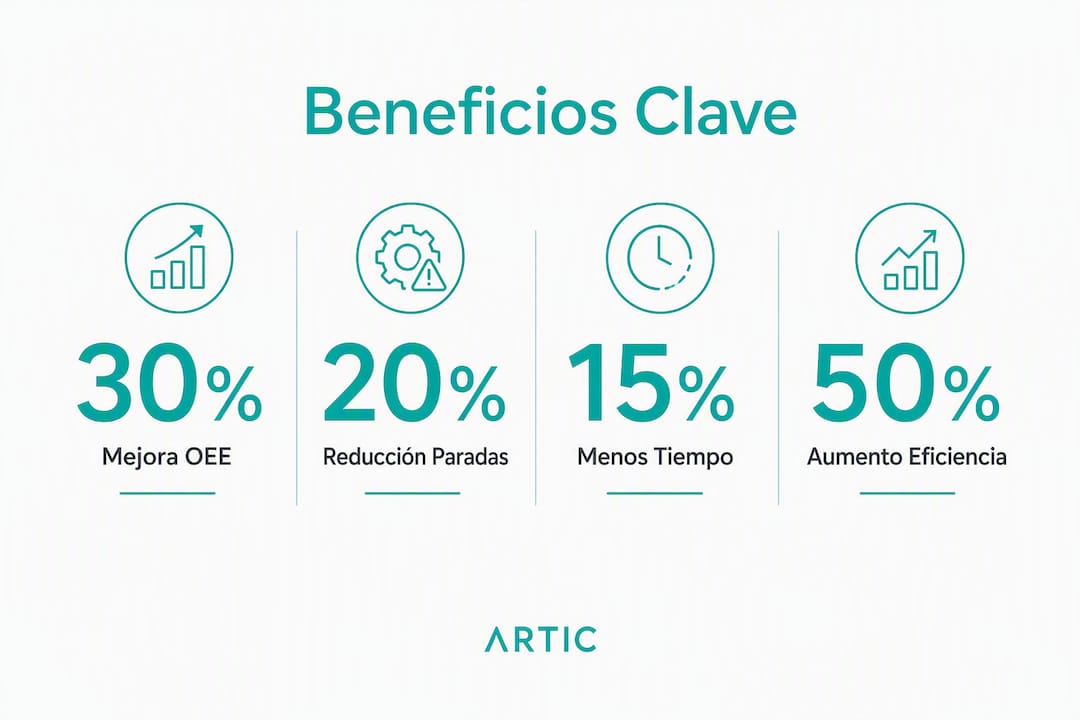
The benefits of digitizing an industrial company are measured in KPIs that already exist on the plant floor: there is no need to create new metrics, but rather to start capturing them and acting on them.
Direct operating benefits:
- Reducing unplanned downtime through predictive alerts on critical equipment.
- Improved OEE (Overall Equipment Effectiveness) by eliminating downtime due to lack of real-time information.
- Less scrap thanks to more granular control of process parameters.
- Hours freed up in maintenance and administration by automating work orders, reports, and spare parts orders.
Practical KPIs for measuring impact:
| KPI | How to measure it | Timeframe for seeing improvement |
|---|---|---|
| OEE | MES or SCADA system with shutdown recording | Visible improvement in a few weeks |
| MTBF (Mean Time Between Failures) | Fault history in CMMS or ERP | visible improvement in a few months |
| man-hours recovered | Before/after comparison of payroll and benefits | Visible improvement in a few weeks |
| Qualified B2B leads | CRM with origin traceability | Visible improvement in weeks |
| Average repair time | Work order log | Visible improvement within several weeks |
Industrial automation today prioritizes high-return processes: end-of-line, repetitive tasks, and bottlenecks. Starting there guarantees visible results before scaling up.
Professional advice: Before choosing any technology, export three months of data from your ERP or maintenance system. If you already have records of downtime, cycle times, or rejections, you have enough to justify an AI pilot without buying a single new sensor.
Funding available in 2026: MANTRA, Digital Europe and how to apply
Main programs
| Program | Maximum amount | Implementation period | Eligibility |
|---|---|---|---|
| MANTRA (Horizon Europe) | 50.000 € | 12 months (6+6) | manufacturing SMEs (NACE) |
| Digital Europe Programme | Variable per call for applications | 12 months | EU SMEs and consortia |
| ERDF / Structural Funds | According to autonomous community | Until 31/12/2026 | EU industrial SMEs |
MANTRA, under Horizon Europe, finances dual-transition projects in a lump-sum format: you receive the agreed amount without needing to justify each invoice individually, thus reducing the administrative burden. second call for applications in 2026 It is aimed at SMEs in the manufacturing sector with specific NACE codes.
Steps to prepare a winning application
- Documented prior diagnosisDefine the operational problem with data (current OEE, monthly downtime, scrap cost). Without this data, the application will not pass the technical evaluation.
- Identify the specific pilot: a limited use case (RAG copilot, predictive maintenance, parts automation) with success metrics defined before starting.
- Verify NACE eligibility: confirm that your activity code is included in the call for proposals before investing time in the proposal.
- Prepare the business case: includes savings projection, payback period and scaling strategy after the pilot.
- Gather financial documentation: latest annual accounts, certificate of being up to date with the Tax Office and Social Security, and accreditation of company size.
- Submit before closingThe 2026 calls for proposals have strict deadlines linked to the closing of the Recovery and Resilience Facility.
The integration of AI and automation in industrial SMEs can also be supported by national and regional subsidies that complement European ones.
How to structure a 6-12 month action plan
| Phase | Duration | Key activities | Expected result |
|---|---|---|---|
| Diagnosis | 4–6 weeks | Process mapping, data auditing, pilot identification | Report with 1–2 prioritized use cases |
| Pilot | several weeks | Limited implementation, minimal integration, KPI measurement | Actual impact data (OEE, hours, scrap) |
| Assessment | a few weeks | Analysis of results, decision to scale or pivot | Business case for management or board |
| Scaling | several months | Deployment across more lines or processes, full ERP/MES integration | Sustained and measurable improvement in plant |
For plants with fewer than 60 employees, the most effective approach is rapid implementation pilots: RAG co-pilots based on technical manuals or automation of parts and reports. For plants with documented critical downtime, predictive maintenance on key equipment offers the fastest return on investment.
The competitive advantage in 2026 lies not in automating more, but in better integrating existing systems and making real-time decisions with reliable data. — rautomation.es
The quick wins The most common results in the first eight weeks are reduced time spent generating work orders, the elimination of spreadsheets in production tracking, and the first predictive alert for critical equipment. These three results are sufficient to garner internal support and justify moving to the next phase.
What technologies do you need and how do you evaluate the available solutions?
The technological architecture of a digitized industrial SME has layers that must be connected in a logical order, not the other way around.
Essential categories:
- Industrial connectivityPLC, SCADA and MES systems to capture plant data in real time.
- ERP/CRM: backbone of management; without it integrated, plant data does not reach sales or finance.
- Data platform / ETL: normalizes and centralizes data from different sources before applying AI.
- Light AI (RAG co-pilots): models based on internal documentation, manuals and historical records; they do not require large infrastructures.
- Robotic Process Automation (RPA): eliminates repetitive tasks in administration, logistics and customer service.
- Visualization and reporting: dashboards accessible to operators, plant managers and management.
The integration between ERP and CRM is where it's decided whether plant data reaches sales or remains trapped in silos. Always evaluate whether the vendor has real experience connecting both environments, not just installing one of them.
Professional advice: Don't start with computer vision or new sensors if you don't have clean data in your ERP. The initial pilot should rely on existing data: breakdown history, cycle times, orders. Data quality determines whether AI moves from demo to operational tool.
Data culture and change management: beyond software
Technology fails when the organization doesn't change with it. Treating digitization as simply "installing more software" is the most common and most expensive mistake.
Minimum roles that must exist before starting:
- Executive sponsor: CEO or operations director who champions the project to the board and unlocks resources.
- Data Controller: someone on the plant floor who validates the quality of the captured data and detects anomalies.
- Process Owner: the line manager or maintenance manager who adopts the tool in their daily work.
- External technical partner: who integrates, trains and provides support; cannot be just a license seller.
Minimum governance includes an up-to-date data catalog, quality standards agreed upon with the plant, monthly review cadences, and an update plan for AI models when processes change. Without such a plan, a model trained today becomes obsolete in six months.
The most frequent barriers are resistance from plant personnel (who perceive AI as a threat), silos between IT and operations, and a lack of system integration. The most effective solution is a visible pilot program with results within weeks: when operators see that the tool saves them work, adoption accelerates on its own.
Checklist for evaluating a digital transformation partner
Technical and commercial criteria
- Demonstrable experience in industrial projects in the same sector (ask for references with direct contact).
- Ability to integrate with your current ERP, MES or SCADA, not just with theirs.
- Limited pilot projects with defined success metrics before signing, not promises of overall results.
- Transparent pricing structure: no hidden costs for licenses, sensors, or data acquisition.
- Training plan and post-implementation support included in the contract.
Questions you should ask at the first meeting
- How long does your standard pilot program last, and what metrics do you guarantee at the end?
- Who does the integration with our plant system and how long does it take?
- How do you manage data quality if our ERP has inconsistencies?
- What happens if the pilot fails to meet the agreed KPIs?
- Do you have experience with MANTRA or Digital Europe calls for proposals to co-finance the project?
Clear warning signs: Promises of ROI in less than four weeks without having seen your data, lack of an integration plan with existing systems, and proposals that start by buying hardware before the diagnosis. You can use this guide to choosing a digital marketing agency as a reference for criteria also applicable to technical digitization partners.
ARTIC supports your industrial digitization from diagnosis to data acquisition
After generating data and automating processes, a relevant business question is how to reach the decision-makers: how do you get those capabilities to the decision-makers of your potential customers? That's where ARTIC comes in.
As industrial B2B marketing agency, ARTIC combines digital diagnostics, automation implementation with Holded and other tools, and lead generation campaigns on Google, LinkedIn, and Meta to ensure your company is visible when a buyer searches for a supplier with your capabilities. We are a certified partner of Google, Meta, Holded, and SE Ranking, which validates our ability to manage both the technical and commercial aspects of your digitalization process.
The work model is based on bi-weekly sprints with agreed-upon KPIs, without indefinite commitments. If you want to know which pilots of AI and automation They make more sense for your plant, or how to prepare a MANTRA application with a higher probability of success, write to us and we will prepare an initial diagnosis for you at no cost.
Official sources and practical resources for 2026
- European Commission funding portal: official search engine for active calls, including MANTRA and Digital Europe.
- MANTRA 2nd Open Call (DIH Industry 4.0): guidelines, NACE criteria and schedule of the second call active in 2026.
- European funds 2026 for industrial SMEs: summary of ERDF, ESF+, Digital Kit and deadlines of the Recovery and Resilience Facility.
- AI Implementation Guide in Manufacturing 2026: Cost Ranges, Timelines and Use Cases for Pilots in Industrial SMEs.
- Digital transformation for SMEs: where to start: methodological guide for the first steps, useful for preparing the diagnosis prior to the application.
- Dual transition in the EU: institutional framework: analysis of the European regulatory framework that links digitalization and sustainability.
Frequently Asked Questions
How much does MANTRA finance per SME and over what period?
MANTRA offers up to €50,000 per SME in lump sum format, with an execution period of 12 months divided into 6 months of advice and 6 months of implementation.
What KPIs should I measure to justify the investment to management?
The most relevant metrics in the industry are OEE, MTBF, man-hours recovered in maintenance, and work order generation time. Using three months' baseline data, a well-defined pilot program shows improvements in 6–10 weeks.
Why digitize an industrial SME in 2026 and not wait?
The closure of the Recovery and Resilience Facility on December 31, 2026, eliminates an unprecedented funding window. Furthermore, the MANTRA calls for proposals have open deadlines this year that will not be repeated under the same terms.
Which is better: to start with ERP or AI?
Always rely on the existing ERP or data system. AI only generates value when the data is reliable and structured. A RAG co-pilot pilot using technical manuals can get up and running in weeks without touching the ERP, but scaling always requires integration.
Can ARTIC help with both the technical and commercial aspects?
Yes. ARTIC combines automation implementation and integration with Holded with B2B lead generation campaigns on Google, LinkedIn, and Meta, covering everything from technical diagnostics to demand generation for industrial companies in Europe.
