

Digital transformation for SMEs is the process of integrating digital technologies into the processes, culture, and structure of a small or medium-sized enterprise to improve its efficiency and competitiveness. It's not about buying new software. It's about changing how the company works, how it makes decisions, and how it serves its customers. The recognized technical term in the sector is "business digitization," although digital transformation better describes the scope of the cultural change it entails. The statistic that best summarizes the current situation: 82 % of SMEs It considers digitization vital for its survival, but the 71 % lacks a defined strategy. This gap is precisely the problem this article helps to address.
What is digital transformation for SMEs and why is it urgent to address it?
Business digitization in SMEs encompasses three simultaneous dimensions: technology, processes, and people. Changing only one of the three does not produce lasting results. A company that installs a CRM without training its sales team or redesigning its sales process is not digitizing. It is simply adding a tool that no one uses effectively.
The urgency is real. operational resilience in 2026 It depends directly on the company's level of digitalization. SMEs that don't digitize their operations fall behind competitors that do, and that gap grows every quarter.

The right starting point isn't technology. It's the diagnosis. Before investing a single euro, the company director must identify which processes generate the most friction, where hours are wasted on repetitive tasks, and what information doesn't arrive in time for decision-making. This analysis determines what to digitize first and with what priority.
What are the phases and duration of digital transformation in SMEs?
The complete digital transformation in SMEs It takes between two and three years, with the first visible results between three and six months after it begins. This is important because many managers abandon the process before seeing a return, precisely because they expected immediate results.
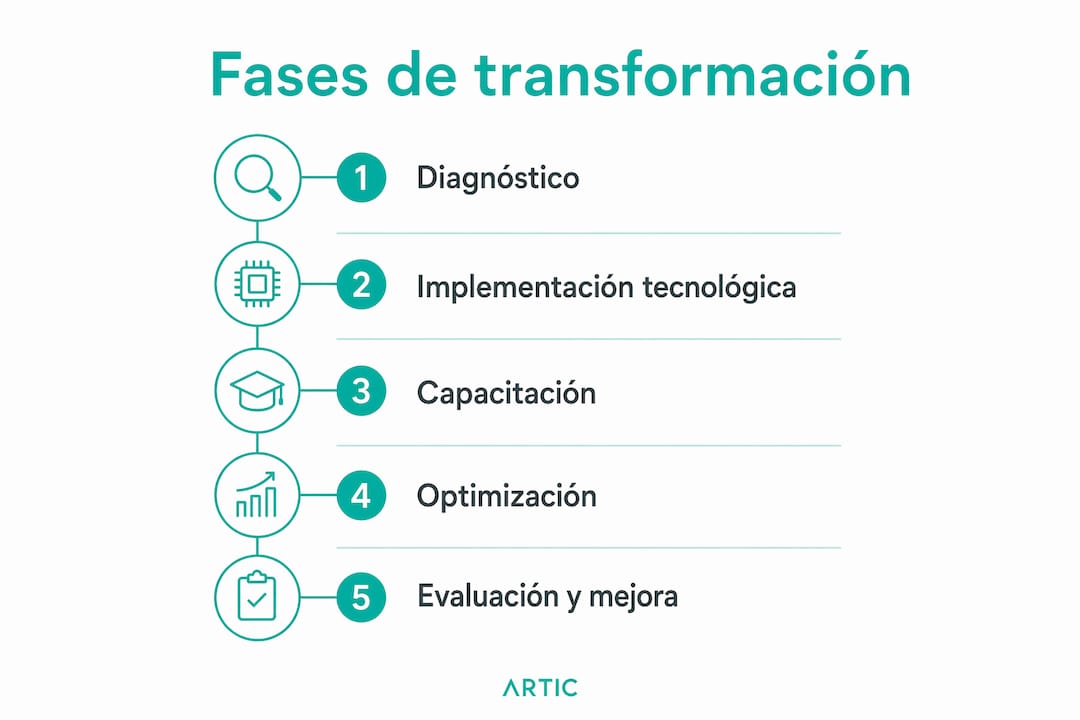
The process is divided into three phases:
Technological base (months 1–6). The company establishes the minimum infrastructure: reliable connectivity, cloud storage, collaboration tools, and a basic data management system. Without this foundation, any subsequent investment will fail. The first tangible benefits, such as reduced manual errors and improved access to information, emerge at this stage.
Digitization of processes (months 6–18). The processes with the greatest impact are identified and digitized in an orderly fashion: invoicing, order management, customer service, and internal logistics. Each digitized process frees up team time and reduces direct operating costs.
Optimization and scalability (months 18–36). The company analyzes the data generated in the previous phases, introduces advanced automation and artificial intelligence where it makes sense, and adjusts its operating model to grow without adding proportional costs.
| Phase | Estimated duration | Expected results |
|---|---|---|
| Technological base | 1–6 months | Fewer errors, better access to data |
| Digitization of processes | 6–18 months | Cost reduction, increased speed |
| Optimization and scalability | 18–36 months | Growth without proportional costs |
Professional advice: Observe your company's processes for at least a week before deciding what to digitize. Identify the most repetitive tasks with the most friction. Digitizing the most problematic tasks first yields faster results and avoids the so-called "shop window effect," which involves buying flashy technology that doesn't solve any real problems.
What specific benefits does digitization bring to a small business?
The benefits of business digitization are measurable from the very first months. They are not abstract or theoretical. They translate into hours saved, errors eliminated, and better-served customers.
The most relevant benefits for directors and managers of SMEs are:
- Operational efficiency. Repetitive manual processes, such as data entry, report generation, and order management, are automated. The team then dedicates that time to tasks that generate real value.
- Market competitiveness. 41% of small and medium-sized enterprises (SMEs) already use artificial intelligence, and 77% of them report direct improvements in their competitive position. Those that do not adopt these tools are at a structural disadvantage.
- Better customer service. Digital channels allow for faster response times, personalized communication, and the recording of each customer's history. This reduces customer loss due to poor service.
- Data-driven decisions. A digital system generates real-time information on sales, costs, inventory, and team performance. The manager stops making decisions based on intuition and starts making decisions based on data.
- Medium-term cost reduction. Process automation reduces the cost per operation. The cloud eliminates investments in on-premises servers. Document digitization reduces administrative management costs.
The digital training for SME teams It is an inseparable part of these benefits. Without a team that knows how to use the tools, the technological investment does not produce results.
What are the most common mistakes when digitizing an SME?
The most frequent mistake in the digitization of SMEs is buying technology before analyzing the processes. A company that acquires an ERP without understanding how its internal information flows ends up with an expensive system that nobody uses correctly. The priority should be to solve real operational problems., do not acquire new technologies without a solid foundation.
Other common mistakes that slow down the process:
- Lack of a clear strategy. Digitizing without defined objectives produces isolated initiatives that are not connected to each other. The result is a set of tools that do not generate synergies.
- Internal resistance of the equipment. Digital transformation demands a cultural shift. If the team doesn't understand why the way of working is changing, they'll either reject it or only partially implement it. Training and internal communication are not optional.
- Ignoring cybersecurity. The regulations NIS-2 must be incorporated from the beginning, not as an afterthought. SMEs that digitize without protecting their systems take risks that can cost more than the entire investment made.
- Not assigning a clear person responsible. When digitization is "everyone's responsibility," it doesn't progress. Each project needs a single person in charge with the authority to make decisions and monitor progress.
- Underestimating maintenance. Many small and medium-sized businesses budget for implementation but forget the cost of maintenance, updates, and support. This mistake leads to obsolete systems within 18 months.
Professional advice: Before approving any technology investment, ask the vendor to explain what specific problem the tool solves for your company. If the answer is vague, the project is probably not well-defined.
How to design an effective digitization strategy for SMEs?
An effective digitization strategy follows concrete and measurable steps. It's not a statement of intent. It's a plan with assigned responsibilities, deadlines, and metrics.
Define objectives with clear KPIs. Every digital initiative must have a measurable objective: reducing billing time by 40%, increasing customer response time to 24 hours, or reducing order errors to zero. projects with clear goals, a single responsible party, and a budget for maintenance They are substantially more successful than those that do not define them.
Prioritize by impact. Not all processes deserve to be digitized at the same time. The prioritization criteria are simple: How much time does this process consume? How many errors does it generate? How much does it cost to maintain manually? The processes with the highest scores in these three areas are prioritized.
Adapt the strategy to the available budget. SMEs with technology budgets exceeding €100,000 should formalize a strategy with documented KPIs. Below that figure, agile quarterly planning is sufficient and more realistic. Digital transformation for SMEs without a large budget is possible if priorities are well prioritized.
Integrate cybersecurity from day one. The NIS-2 standard is not just a legal obligation. It's a guarantee of business continuity. Implementing it from the start is cheaper than addressing a security incident later.
Search for available financing. Programs like the Digital Kit for SMEs They offer direct aid for investing in digitalization without covering the entire cost. Other European initiatives cover everything from web development to the implementation of CRM and automation tools.
Measure and adjust every quarter. Digitization is not a project with a fixed end date. It's an ongoing process. Reviewing KPIs every three months allows you to detect deviations before they become bigger problems.
For SMEs that want detect which processes to automate, The most practical starting point is to observe for a week which tasks are repeated daily and which generate the most interruptions or errors. This analysis, without any technological investment, already defines 80% of the digital worksheet.
Digital marketing trends in 2026 are also part of the digital strategy of any SME that wants to gain visibility over its competitors. A digital presence is not just operational; it's also commercial.
ARTIC supports SMEs in their digitization process
ARTIC works with SMEs and industrial companies that need a clear, actionable, and measurable digital plan. The ARTIC team combines strategic consulting, Technical SEO, Automation with artificial intelligence and digital channel management in an integrated model that functions as an outsourced marketing department. Each project begins with a thorough analysis of the client's processes, defines specific KPIs, and is executed in bi-weekly cycles with continuous monitoring. If your company needs to take the leap toward digitalization with a specialized team that understands the industrial B2B sector, ARTIC offers a free initial assessment to identify areas for greatest improvement.
Frequently Asked Questions
What exactly does digital transformation mean for an SME?
Digital transformation for SMEs is the integration of digital technologies into a company's processes, culture, and structure to improve its efficiency and competitiveness. It goes beyond simply using software: it involves changing how the organization works and makes decisions.
How long does it take for an SME to complete its digitization?
The entire process takes between two and three years, although the first tangible results appear between three and six months after the start. The duration depends on the company's starting point and the clarity of its plan.
Is it possible to digitize an SME with a limited budget?
Yes. Agile quarterly planning is sufficient for SMEs with technology budgets under €100,000. Furthermore, programs like the Digital Kit offer direct financing to reduce the initial investment cost.
What is the most common mistake when digitizing a small business?
The most common mistake is buying technology before analyzing the processes. Digitalization should stem from real operational problems, not from the novelty of a tool. Without that prior analysis, the investment won't generate the expected return.
Why is cybersecurity part of digital transformation?
Because digitizing systems without protecting them exposes a company to risks that can disrupt its operations. The NIS-2 standard establishes minimum security requirements and must be incorporated from the beginning of the process, not as a later addition.
