
An industrial B2B value proposition is a concrete promise of measurable operational results that connects what your technology does with what the buyer needs to justify to their committee. It's not a feature list. It's a statement like: "Our IIoT platform reduces unplanned downtime in continuous process plants, with a demonstrable return on investment within a reasonable timeframe.".
The minimum components that any industrial decision-maker expects to see:
- Target customer: specific segment (plant size, sector, process criticality).
- Critical problem: the real cost of the problem, not just its technical description.
- Measurable result: uptime, MTTR, energy efficiency per unit, batch traceability.
- Evidence: documented case, pilot with data, certification or verifiable reference.
- Business model and SLAs: service levels, availability guarantees, maintenance conditions.
Without these five elements, the proposal reaches the purchasing committee as just another technical data sheet, and technical data sheets don't approve themselves.
Why do industrial buyers demand a well-translated proposal?
Decision-makers in industrial accounts don't buy technology; they buy risk reduction. Their real priorities are avoiding unscheduled downtime, ensuring traceability during audits, complying with energy efficiency regulations, and demonstrating to management that the expenditure is justified. A proposal that mentions "high-precision sensors" without translating that into a clear operational improvement won't pass the engineering filter, much less the purchasing filter.
The industrial purchasing process involves several decision-makers with distinct roles: operations wants continuity, engineering wants integrability, purchasing wants cost transparency, and management wants payback. A proposal that doesn't speak to each of them in their own language creates friction within the committee and lengthens the sales cycle by months. difference between a B2B website and a B2C website It clearly illustrates why messages should be tailored to both technical and purchasing audiences simultaneously.

Professional advice: Prepare at least three versions of the same message: one for operations (impact on production), one for purchasing (TCO and terms), and one for management (payback and residual risk). The same data, three different perspectives.
What elements should an industrial B2B value proposition contain?
The structure that convinces an industrial committee is not free-flowing. There is a logical order that governs how these teams make decisions.
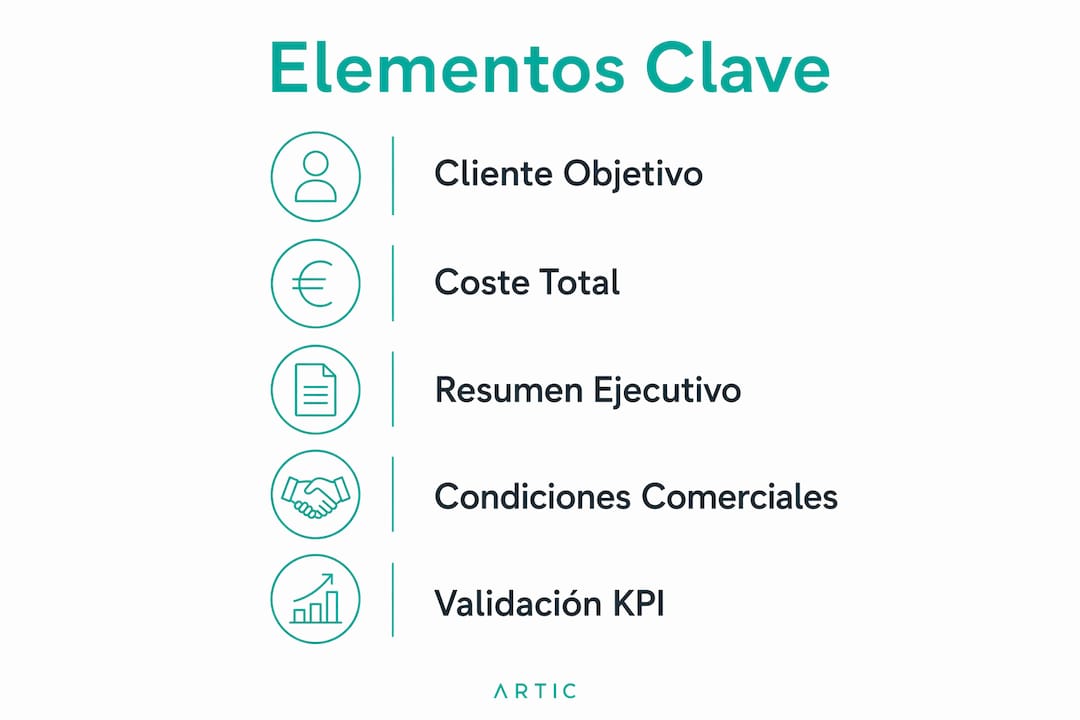
| Element | What to include | Concrete example |
|---|---|---|
| Target customer | Sector, plant size, main decision-making role | Chemical plant, operations manager |
| Critical problem | Cost of the problem in euros or lost hours | 3 stops/month × 4 h × cost/h = X € per year |
| Measurable result | KPI before/after with source | Uptime from 94 % to 98 %; MTTR from 90 minutes to 22 minutes |
| Evidence | Documented case, pilot, certification | Pilot in reference plant |
| Business model | SLAs, service levels, guarantees | High availability guaranteed; response within 4 hours |
Total cost of ownership (TCO) is the framework industrial buyers use for evaluation: the purchase price is just one line item in a calculation that includes installation, training, maintenance, spare parts, energy, and downtime costs. Ignoring these lines in your proposal is tantamount to losing the conversation before it even begins.
Recommended formats depending on the recipient include an executive summary for management and purchasing with payback, risk and key conditions; a technical data sheet translated into impact for engineering; and a complete dossier for the homologation process with cases, certifications and implementation plan.
Professional advice: The one-page summary is the material that the internal "champion" forwards to the committee. Without it, the project dies in someone's email inbox.
How to translate technical capabilities into results that a committee buys.
The process has four steps, and the order matters.
| Passed | Action | Tool or source |
|---|---|---|
| Identify the capacity | List what the product does technically | Product data sheet, engineering |
| 2. Map the operational impact | Connecting capability with a customer process | Interviews with operations |
| 3. Quantify the metric | Express the impact in measurable KPIs | SCADA data, ERP, stoppage history |
| 4. Validate with a pilot | Confirm the hypothesis under real-world conditions. | Proof of concept 8–16 weeks |
Three concrete examples that illustrate the translation:
- Vibration sensor → early wear detection → reduction of unexpected failures → process uptime increases from 94 % to 98 %.
- IIoT Platform → real-time batch traceability → average location time drops from 4 hours to 18 minutes.
- Line automation → elimination of manual intervention in format change → MTTR reduced from 90 minutes to 22 minutes.
For the internal "champion" to defend the investment, they need reliable materials: a concise case study with comparable data, the implementation plan, and agreed-upon success metrics. Without this package, the proposal relies on their memory and ability to summarize—two variables you don't control.
What retail formats do industrial buyers prefer?
Industrial buyers avoid uncertainty. That's why they prefer bundled offers with phased commitments over individual components that force them to calculate the total cost themselves.
A three-tier model works well: basic tier (hardware or software with reactive support), standard tier (preventive maintenance included, rapid response SLA), and premium tier (predictive maintenance, dedicated account manager, high uptime guarantee). Each tier has a predictable price and a clear commitment, simplifying budget approval.
«"Voice of the customer studies in markets such as Germany, France, and Italy reveal clear differences: engineering values integrability, purchasing values cost transparency, and operations values service continuity."»
Mordor Intelligence
Contractual conditions that reduce perceived risk include: maintenance terms with guaranteed response times, availability of spare parts in Central Europe, training included in the implementation, and reasonable exit clauses. For centralized purchases, the dossier should include the total cost of ownership (TCO) broken down by year, a scenario comparison, and an implementation timeline with verifiable milestones.
How to measure and validate the proposal with KPIs and pilot programs
Validation is not optional. An industry committee doesn't approve promises; it approves evidence.
Recommended operational KPIs for any industrial proposal:
- Uptime (%): actual availability of the asset or process during the pilot period.
- MTTR (hours): average repair or recovery time after an incident.
- Energy efficiency per unit: kWh consumption per unit produced before and after.
- Traceability: average time to locate a batch or incident.
- Incident reduction: number of unscheduled strikes per month.
| Pilot phase | Duration | Deliverable |
|---|---|---|
| Scope definition | 2 weeks | Signed success criteria, agreed data sources |
| Execution and measurement | 8–12 weeks | SCADA/ERP data, incident log |
| Analysis and report | 2 weeks | Results report vs. initial hypothesis |
| Justification for committee | — | Executive summary with payback and residual risk |
Market validation requires assessing urgency, decision-makers, budget, technical fit, and adoption capacity. A well-designed pilot answers all these questions with data, not sales pitches. To delve deeper into which metrics to track after the pilot, consult the guide from Key metrics for industrial B2B marketing It offers a directly applicable framework.
Checklist for discovery workshops with potential clients
Before the workshop, collect this information from the customer:
- Production schedules and shifts (to calculate the real cost of a stoppage).
- Cost per hour of unscheduled downtime (data that purchases usually have).
- Current service contracts and their SLA conditions.
- Technical managers by area (operations, maintenance, engineering, purchasing).
- Energy efficiency targets or current ESG commitments.
During the workshop, the questions vary depending on the role. To operations: "How many unscheduled downtimes did you have last quarter, and how long did each one last?" To engineering: "Which systems need to be integrated with our solution, and what is the biggest technical obstacle?" To purchasing: "How do you evaluate the TCO in these types of decisions, and what guarantees do you need to document?" To management: "What is the minimum acceptable payback period, and what is the timeframe?".
The workshop findings are transformed into measurable hypotheses for the Value Proposition Canvas tailored to each role. Industrial purchasing decisions typically involve 4–8 decision-makers and require a different canvas for each one, not a generic document that attempts to speak to everyone at once.
Professional advice: Document each response with the exact quote from the person you're speaking to and their position. These verbatim quotes are the most valuable material for drafting internal "champion" messages and for the committee dossier.
How ARTIC works to position industrial B2B value propositions
The ARTIC approach begins with a digital audit that identifies how the company currently communicates its capabilities and where it loses credibility with industry decision-makers. From there, the process follows four phases:
- Voice of the customer: Structured interviews with real buyers to identify the trade-offs between price, reliability and support that guide the decision.
- Message design by role: Differentiated versions of the proposal for operations, engineering, purchasing and management, with the KPIs that each profile prioritizes.
- Materials for the committee: One-page executive summary, technical data sheet translated into impact, and complete dossier with cases and pilot plan.
- Execution in bi-weekly sprints: quarterly planning with clear KPIs, regular reports and continuous adjustment based on data.
ARTIC is a certified partner of Google, Meta, Holded, and SE Ranking, allowing us to integrate our value proposition into organic search engine optimization (SEO), paid media, and CRM automation campaigns from the very first sprint. We don't operate as an external provider; we act as your digital marketing department, with a dedicated account manager and measurable results every quarter.
ARTIC can help you turn your proposal into real sales
If your company has strong technical capabilities but the purchasing committee doesn't understand or approve them, the problem isn't the product. It's the translation. ARTIC works with industrial companies in Europe to transform technical specifications into proposals that pass the scrutiny of purchasing, engineering, and management simultaneously.
The first step is a SEO positioning audit which diagnoses how you communicate your proposal digitally and where you lose visibility with decision-makers seeking solutions like yours. Based on the diagnosis, we design role-specific messaging, committee materials, and a pilot plan, all executed in bi-weekly sprints with KPIs agreed upon from the outset. Contact ARTIC through the website of industrial B2B marketing services to begin the diagnosis.
Frequently Asked Questions
What is a B2B value proposition in the industrial sector?
It is the concrete promise of measurable operational results (uptime, MTTR, energy efficiency) that connects the technical capabilities of a supplier with the decision criteria of an industrial purchasing committee.
How many decision-makers are involved in an industrial purchase?
Several people with diverse roles are involved: operations, engineering, purchasing, finance, and management. Each role prioritizes different criteria, so the proposal needs versions adapted to each one.
How long should a validation pilot last?
A pilot project of sufficient duration to obtain measurable data and validate hypotheses, with agreed success criteria and defined data sources (SCADA, ERP, maintenance records).
What differentiates a B2B proposal from a B2C proposal?
In industrial B2B, the decision is collective, the cycle is long, and the buyer demands quantifiable evidence and clear contractual terms. In B2C, the decision is individual, and the message can be emotional and brief.
How can ARTIC help position a B2B value proposition?
ARTIC designs role-specific messages, materials for the purchasing committee, and digital positioning strategies (SEO, paid media, LinkedIn) so that industry decision-makers can find and understand the proposal at the moment they are looking for a supplier.
