

Real estate email marketing is the channel with the highest return on investment for acquiring and converting clients in a sector where decision-making cycles last for months. While portals and social media rely on algorithms that change without warning, email operates on its own database, which no third party can take away. The reason why email marketing works in real estate is straightforward: it combines low cost, personalized communication, and consistent presence throughout a buying process that can last between 4 and 18 months. No other digital channel maintains that pace with such efficiency.
Why does the long real estate cycle make email marketing an indispensable strategy?
He real estate decision cycle It lasts between 4 and 18 months for buyers, and between 1 and 4 months for sellers. This duration makes email the only channel that maintains profitable contact throughout that time without blowing the budget.
Real estate portals generate fleeting visibility, but they don't build relationships. Social media relies on organic reach, which fluctuates with algorithm changes. Email, on the other hand, goes directly to the inbox of a lead who has already given permission to receive communications. This difference is structural, not tactical.

Your own database is the most valuable asset generated by a well-executed email campaign. Unlike contacts on portals or social networks, your own database grows over time, increasing in value with each new qualified subscriber. There's no cost per impression and no dependence on external platforms.
The specific benefits of maintaining a consistent email presence throughout the real estate cycle are:
- Reduction of cold lead loss: A lead who doesn't buy today may buy in six months if they have received relevant content during that period.
- Positioning as a local benchmark: Emails with market information, prices by area, and trends make the agent a trusted source before the first call.
- Reactivation of inactive contacts: A well-designed reactivation sequence recovers leads that seemed lost without additional acquisition costs.
- Automated tracking without manual effort: Nurturing workflows maintain contact even when the agent is handling other operations.
Professional advice: Segment your database from the first contact. Distinguish between active buyers, buyers in the exploration phase, and owners who want to sell. Each group needs a different email sequence.
What data demonstrates the effectiveness of email marketing in real estate?
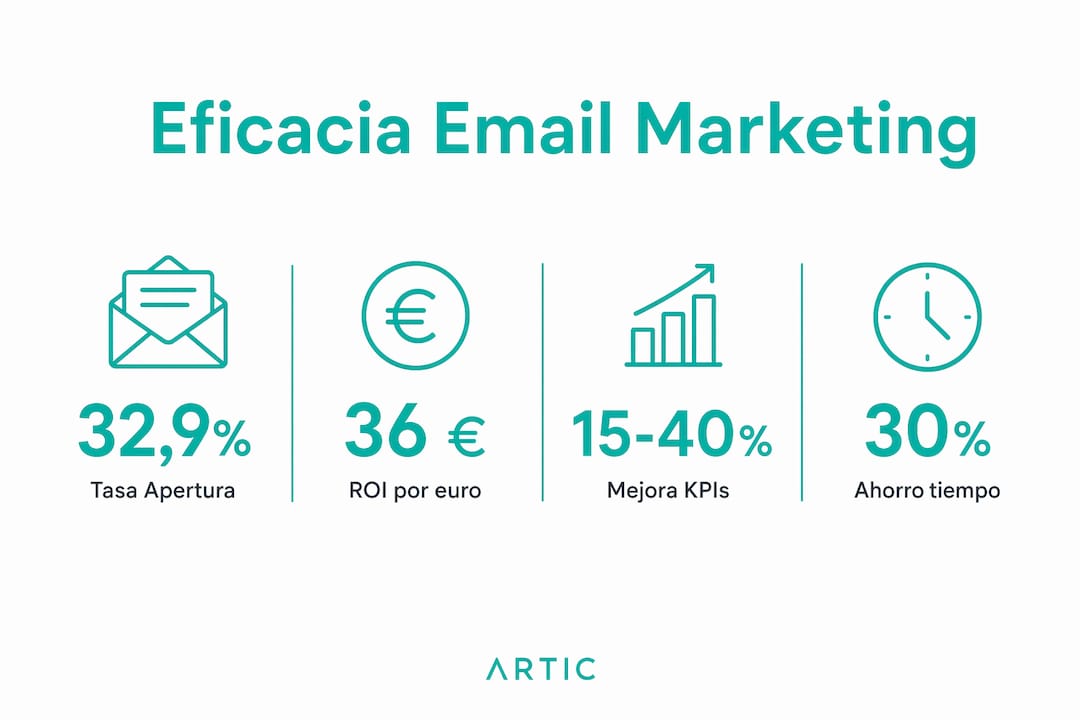
The channel metrics speak for themselves. opening rate in Spain It reaches 32.9% TP4T in 2025, with a soft bounce rate of 0.49% TP4T and a subscription cancellation rate of 0.06%. These numbers indicate that the channel has high receiver tolerance and very solid deliverability.
The financial return reinforces this interpretation. The ROI of real estate email marketing is estimated at €36 for every euro invested, a figure that clearly surpasses paid channels such as Google Ads or advertising on real estate portals. This difference is explained by the fact that the marginal cost of sending an additional email is practically zero once the list is built.
Segmentation multiplies those results. Emails personalized by price, location, and property type reach Opening rates of 40–60 %. This means that a well-segmented email can double the industry average rate simply by tailoring the content to the recipient's profile.
| Metrics | Value in Spain (2025) | Sector reference |
|---|---|---|
| Opening rate | 32,9 % | High vs. medium global |
| Soft rebound rate | 0,49 % | Very low |
| Subscription cancellation | 0,06 % | Minimum |
| Opening with segmentation | 40–60 % | Personalized emails |
| Estimated ROI | 36 euros for every euro invested | Real estate sector |
List hygiene directly impacts these results. A list with many inactive contacts or incorrect addresses damages the sender's domain reputation and reduces the deliverability of all campaigns. Cleaning the database every quarter is not optional: it's the foundation upon which all other metrics are built.
How do automation and segmentation improve the performance of real estate email marketing?
Automation transforms email marketing from a one-off task into a system that works continuously. automated workflows Sales KPIs improve between 15% and 40% in the first 90 days of implementation. This leap occurs because the system responds in real time to lead actions, without relying on the agent to remember to follow up.
The most effective types of workflows in real estate are:
- Nurturing buyers: A sequence of 6–12 emails sent over 60–180 days that educates the lead about the local market, pricing, and the buying process.
- New property alerts: Automatic submission when a property matches the saved contact criteria.
- Recovery of inactive leads: Reactivation sequence for contacts who have not opened emails in 60 days, with an incentive or high-value content.
- Post-visit follow-up: Automated email sent 24 hours after a visit to a property, with technical specifications and similar properties.
- Owner acquisition sequence: Emails sent to owners who have consulted valuations, with information about the sales process and the current market.
Automation also detects signs of interest in real time. When a lead opens the same email three times or clicks on a property listing repeatedly, the system can alert the agent to call at that precise moment. This ability to identify "hot moments" increases conversions because contact occurs when interest is at its peak.
Operational savings are another compelling argument. Automation recovers up to 30% of the time staff spend on manual follow-up tasks. For an agency with multiple agents, this translates into more time closing deals and less time sending emails one by one.
Professional advice: Before automating, map your leads' actual journey: from first contact to signature. Every touchpoint in that journey is an opportunity for an automated email. Consult a automation guide for SMEs to structure the implementation steps.
What content strategies and calls to action are most effective in real estate emails?
The most effective real estate email isn't the one with the most elaborate design. It's the one that generates a human response: a call, a visit, an inquiry. CTAs designed to encourage interaction Direct commands, such as "Reply to this email if you want to see this property," produce more signed commands than generic "See more" buttons.
The types of emails that work best in this sector are:
- Property alerts: Customized by region, price, and type. These emails have the highest open rates because the content exactly matches what the lead is looking for.
- Local market newsletters: A brief analysis of prices by neighborhood, average sales time, and trends positions the agent as an expert before the client makes a decision.
- Post-visit emails: They are sent within 24 hours of a visit, including the property details and two or three similar alternatives. They keep interest high at the most critical moment.
- Reactivation sequences: For leads that haven't interacted for more than 60 days, an email with the subject line "Are you still looking in [area]?" and updated market content typically reactivates between 10% and 20% of those contacts.
- Emails for acquiring property owners: These are aimed at people who have requested an assessment. They include information about the sales process, estimated times, and testimonials from previous clients.
The right frequency depends on the stage of the funnel. An active buyer can receive alerts twice a week without it being intrusive. A lead in the exploration phase needs a weekly or bi-weekly email with educational content. Sending the same volume to all segments is the most common mistake and the one that generates the most cancellations.
Local content makes the difference between a generic email and one that gets opened. Mentioning the specific neighborhood, the nearest school, or the commute time to the city center transforms a marketing message into useful information. This perceived usefulness is what builds long-term relationships. To reinforce this local relevance, the Local SEO for real estate agencies and email marketing complement each other: one attracts traffic, the other turns it into a lasting relationship.
How to integrate email marketing with a CRM to optimize lead management?
A CRM is the system that transforms email marketing from a communication tool into a measurable sales engine. Without a CRM, emails are sent, but actual business results, such as scheduled appointments, signed agreements, or closed sales, remain outside the analysis. With an integrated CRM, every email interaction is recorded and linked to the lead's history.
He monitoring business metrics in CRM It goes beyond simply measuring opens or clicks. Professionals who integrate metrics like responses received, visits generated, and closed deals into their CRM make campaign decisions based on real data, not assumptions. This integration is what separates an agency that uses email marketing from one that uses it well.
| Without integrated CRM | With integrated CRM |
|---|---|
| Metrics limited to opens and clicks | Complete business metrics: visits, mandates, sales |
| Manual tracking and prone to errors | Automated funnel stage tracking |
| Duplicate or unassigned leads | Leads centralized and assigned by agent |
| No visibility of contact history | Full interaction history accessible |
| Difficulty in segmenting by behavior | Dynamic segmentation by actual actions |
The technical integration between the email system and the CRM allows for automated follow-ups based on lead behavior. If a contact opens an email for a specific property three times, the CRM can automatically assign a task to the responsible agent to call back that same day. This level of response is impossible to maintain manually when managing a large portfolio of leads.
To choose tools that integrate well, the main criterion is native compatibility between the email platform and the CRM. Native integrations are more stable and require less maintenance than third-party connections. lead management in real estate It gains accuracy when both systems share data in real time and without friction.
ARTIC and email marketing for real estate agencies: from strategy to results
ARTIC works with real estate agencies that need to convert their digital activity into closed deals, not just vanity metrics. The ARTIC team designs email marketing strategies integrated with SEO, automation, and CRM, so that each channel reinforces the next. If your agency is attracting traffic but not converting, or has an untapped database, the problem is usually the lack of a structured lead nurturing system. ARTIC also applies technical search engine optimization So that the leads arriving via email are already qualified from Google. Contact ARTIC for a free audit and discover which part of the funnel is missing the most opportunities.
Frequently Asked Questions
What ROI does email marketing generate in real estate?
Real estate email marketing generates approximately €36 for every euro invested, making it the digital channel with the highest return in the sector.
What is the average email open rate in Spain?
The email marketing open rate in Spain is 32.9% % in 2025, with a subscription cancellation rate of 0.06% %, indicating a high acceptance of the channel.
How often should I send emails to my real estate leads?
The frequency depends on the stage of the funnel: active buyers accept two emails per week, while leads in exploration respond better to weekly or bi-weekly communication with market content.
What improvements does automation bring to real estate email marketing?
Automated workflows improve business KPIs by between 15 and 40 in the first 90 days, in addition to recovering up to 30 of the team's operating time.
Is a CRM necessary for real estate email marketing?
It's not mandatory to start with, but it is essential for scaling. An integrated CRM allows you to measure real business results, segment by behavior, and automate follow-ups, which multiplies the effectiveness of each campaign.
