
A B2B sales funnel is a signaling and conversion system that transforms trust signals into repeatable business opportunities, designed for buyers who make decisions in committee and take months to close. If you've just been looking into how it works and how to implement it, here's the minimum viable path to get you started this week:
Three steps to get started:
- Define your ICP and MQL/SQL criteria. Without this foundation, any metric is just noise. Decide which sector, company size, and contact role qualify, and what digital behavior converts a lead into an opportunity.
- Implement basic tracking and simple lead scoring. Three or four signals are enough to get started: visit to the technical page, download of a success story, attendance at a webinar, repeated visit to the pricing section.
- Agree on an SLA between marketing and sales for the first month. Maximum response time, minimum information accompanying the lead, and feedback process. Without this agreement, the funnel breaks down at the delivery stage.
The most reliable signals of trust in B2B are not filled-out forms: they are repeated visits to technical pages, downloads of specifications, attendance at demos, and referrals from contacts within the same industry. B2B sales process It has its own rhythms, and the funnel must reflect them.
Professional advice: Before optimizing anything, validate your hypotheses for eight weeks. Launch the funnel with the minimum configuration, collect real data, and only then adjust scoring, content, or cadence. Changing too soon is the most common mistake.

How does a B2B funnel differ from a B2C funnel, and what changes will it affect your operation?
The difference is not just in speed, it's structural.

In B2C, a person often makes a decision in minutes, driven by emotion, price, or convenience. In B2B, the average buying group involves several decision-makers with distinct profiles, such as the technical director, the purchasing manager, and the CFO. Each has different objections, consumes different content, and needs specific arguments to move forward. This alters the objective of each piece of content: you don't write to convince someone; you write to equip your "internal champion" with the arguments they need to convince the rest of the committee.
The cycles are extended by technical and budgetary validations that can last for months. And here's the fact that most bothers sales teams: the B2B buyer goes through much of the funnel on their own before contacting any salesperson. When they do call, they've already compared options, established criteria, and probably already have a favorite.
Key fact: If your company doesn't appear on the channels where that preliminary research takes place, such as LinkedIn, technical communities, or specialized searches, you're out of the decision before it even begins.
The metrics also change. In B2C, you measure immediate conversions. In B2B, intermediate conversions (from MQL to SQL, from SQL to proposal, from proposal to close) and the time between stages are the indicators that reveal where the pipeline is stuck. A low close rate doesn't always mean sales is failing: it could mean marketing is delivering unqualified leads.
B2B funnel stages: objectives, tactics, and content by phase
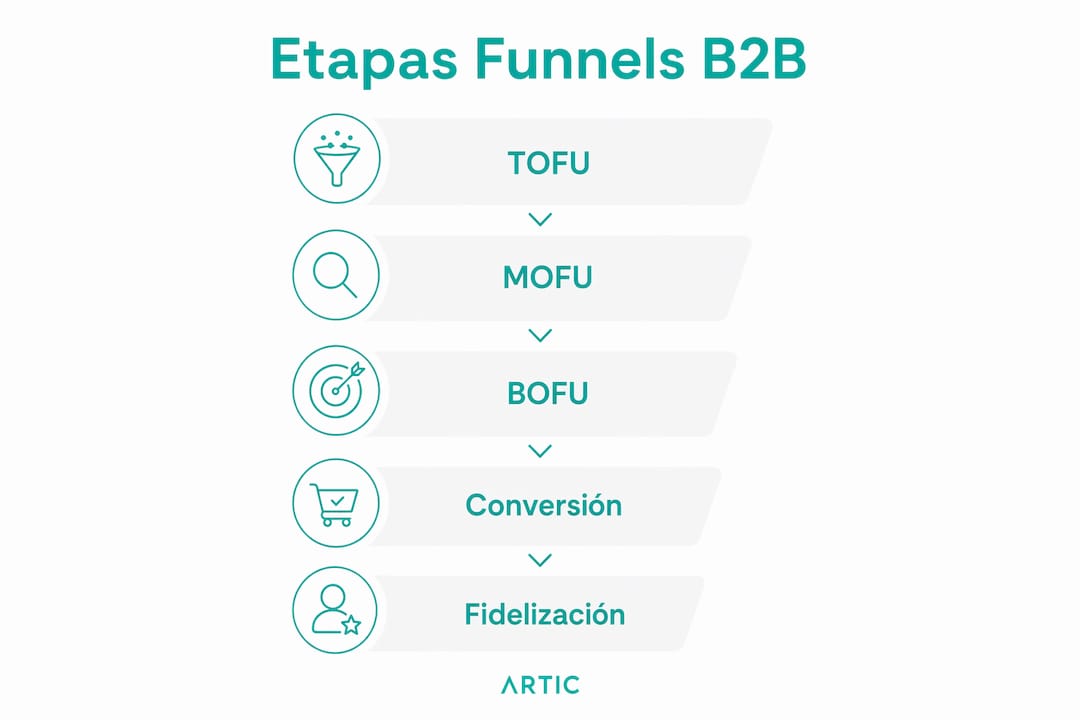
The TOFU/MOFU/BOFU model remains the most useful compass for organizing work, provided it is translated into concrete operational steps. The table below maps each stage with its objective, main metric, and the formats that work in industrial B2B.
| Stage | Main objective | Primary metric | Recommended content | Advance trigger |
|---|---|---|---|---|
| TOFU (catchment) | Visibility and appeal of the ICP | Qualified traffic, new contacts | Technical SEO articles, guides, LinkedIn, industry podcasts | First download or subscription |
| MOFU (qualification) | Technical education and scoring | MQL rate, engagement with content | Webinars, success stories, technical comparisons, ROI calculators | Advanced download or demo support |
| BOFU (closing) | Evaluation and decision | SQL Rate→Proposal, Closing Rate | Customized demos, proofs of concept, proposals, customer references | Request for proposal or technical meeting |
| After-sales | Loyalty and growth | NPS, renewal rate, upsell | Success plans, client cases, training | Renewal or extension of contract |
Tactics and tools by task:
- CRM (HubSpot, Salesforce, Holded): centralizes the history of each account and allows you to see what stage each lead is at in real time.
- Marketing automation (ActiveCampaign, HubSpot): manages long nutrition sequences without manual intervention at each step.
- LinkedIn and paid campaigns: priority channel to reach industrial decision-makers with segmentation by position, sector and company size.
- Analytics and lead scoringTools such as SE Ranking for organic visibility, combined with CRM scoring, allow prioritizing leads with a higher probability of closing.
The B2B marketing automation It doesn't replace the salesperson in the BOFU; it frees them up to focus on accounts that already have clear buy signals. Generative AI is also changing the TOFU: being present in generative search engine results requires structured technical content and domain authority, not just post volume.
How to build a funnel template applicable to your industrial company?
A useful template isn't a pretty diagram. It's a table your team can fill out in a two-hour meeting and start using the following week.
Suggested columns for the funnel map:
| Buyer persona | Main problem | TOFU Contents | MOFU Content | BOFU Content | Scoring signal | Responsible | Expected KPI |
|---|---|---|---|---|---|---|---|
| Director of operations | Reduce downtime | SEO article on predictive maintenance | Webinar with a similar client case study | Technical demo + ROI proposal | Case download + price visit | Marketing / Sales | SQL in 60 days |
Applied example: sale of industrial machinery
The buyer persona is the operations manager of a manufacturing plant with 50–200 employees. Their problem: reducing unplanned downtime. The TOFU content is a technical article on predictive maintenance, ranking for searches like "reduce downtime on production line." The trigger from TOFU to MOFU is the download of a technical specifications guide. At MOFU, a webinar with a similar customer case triggers manual lead qualification by sales. The trigger from MOFU to BOFU is a demo request or a repeated visit to the pricing page. At BOFU, a personalized proposal with ROI calculation completes the cycle.
Implementation checklist in 30/60/90 days:
- Days 1–30: Define ICP, create MQL/SQL criteria in writing, configure the CRM with funnel stages and activate basic tracking (Google Analytics 4, LinkedIn pixel).
- Days 31–60: Produce the first TOFU content (two technical SEO articles), launch an automated three-email nurturing sequence for new leads, and establish the weekly marketing-sales meeting.
- Days 61–90: Review conversion rates between stages, adjust scoring based on actual observed behavior, and produce the first MOFU content (webinar or success story).
What metrics should you measure at each stage of the B2B funnel?
The industrial B2B marketing metrics The most useful ones are not the easiest to measure. They are the ones that reveal where the pipeline breaks down.
| Metrics | Formula | Frequency | Responsible |
|---|---|---|---|
| TOFU Rate→Lead | — | Weekly | Marketing |
| Cost per lead (CPL) | Investment / Leads generated | Monthly | Marketing |
| Lead Rate → SQL | — | Weekly | Marketing + Sales |
| Closing rate | — | Monthly | Sales |
| Average time between stages | Average days TOFU→SQL, SQL→closure | Monthly | Address |
| CAC (acquisition cost) | Total investment / New customers | Quarterly | Address |
| LTV (customer lifetime value) | Average income × average contract duration | Quarterly | Address |
Conversion rates in B2B are typically around 1–3 % from visitor to lead, 10–20 % from lead to opportunity, and 15–30 % from opportunity to close, but it is more valuable to detect your own bottlenecks than to compare yourself to general averages.
How to prioritize based on the failing metric:
- High traffic, low leads: the problem lies in TOFU→MOFU. Review your content offering, call to action, and the relevance of your incoming traffic.
- Many leads and few SQLs: the scoring is too permissive or the MQL criteria are not well defined.
- Many SQLs and a low closing rate: the problem is at the bottom of the funnel (BOFU). Review your value proposition, closing materials, and sales cadence.
Common mistakes in B2B funnels and how to correct them
The B2B funnel doesn't fail due to a lack of leads. It fails due to a lack of process: without a defined lead generation process, without scoring, and without nurturing sequences, the closing rate suffers and the customer acquisition cost (CAC) increases.
The most common mistakes and how to correct them:
- Do not segment by ICP. Result: Low-value leads that consume sales time. Correction: Define three or four minimum fit criteria (industry, size, role, buying stage) and apply them as a filter before any human intervention.
- Ignoring qualitative signals. Measuring only completed forms leaves out a large part of the actual buyer's journey. Correction: Add repeat visits to technical pages, time spent on page, video views, and specification downloads to the scoring.
- Absence of SLA between marketing and sales. Without a formal agreement, leads are lost or arrive without context. Solution: Formalize the SLA with delivery criteria, response time, and feedback process.
- Measure only leads, not influence. A lead that closes may have consumed six pieces of content before filling out the form. Fix: Implement multi-touch attribution to measure which content influences the closure, not just which was the last click.
Professional advice: To validate a conversion loss hypothesis, run an eight-week test: change a single variable (email content, scoring threshold, or call to action on a technical page) and measure the impact before changing anything else. Changing multiple variables at once makes it impossible to know what worked.
How to align marketing and sales with an SLA that actually works
Alignment between marketing and sales is not a matter of culture. It's a matter of documented process.
Elements of the SLA:
- Written definition of MQL and SQL with measurable criteria: sector, company size, contact role, minimum scoring score and observed digital behavior.
- Maximum business response time Upon receiving an SQL: in industrial environments, less than 48 hours is the reasonable standard.
- Minimum information that accompanies the lead: company, position, pages visited, content downloaded and scoring at the time of delivery.
- Feedback processSales reports the outcome of each contact (advance, discard, nurturing) in the CRM so that marketing can adjust the scoring.
- Weekly pipeline review meeting30 minutes, using data from the previous week, to detect bottlenecks before they become quarterly problems.
Checklist for the weekly meeting:
- Number of MQLs generated vs. target.
- Number of SQLs delivered to sales and acceptance rate.
- Leads discarded by sales and reason (to adjust scoring).
- Open opportunities and their current stage.
- Lead alerts with active purchase signals (price visits, recent downloads).
Example of an operational flow:
A lead downloads a technical guide from the website → the CRM records the action and adds points to the scoring → if it reaches the MQL threshold, marketing includes it in an automated nurturing sequence → if in the next 14 days it visits the pricing page or requests information, the system escalates it to SQL → sales receives an alert with the complete history → the salesperson contacts in less than 48 hours with a contextualized message → the result is reported in the CRM within a maximum of 72 hours.
ARTIC Recommendations for the Central European B2B Market
ARTIC works with B2B industrial companies using a quarterly planning model with clear KPIs, executed in bi-weekly sprints. They operate not as an external provider, but as an integrated digital marketing department. This close proximity allows them to detect buying signals that a conventional external team would miss.
For the Central European market, the most relevant operational recommendations are:
Prioritize technical SEO for local industrial searches. Industry decision-makers search in their own language, using very specific industry terms. Well-executed technical SEO For those searches, it generates very high-intent traffic that no paid campaign can replicate at the same cost.
Use LinkedIn with precise targeting. In Central European industrial markets, LinkedIn allows you to reach technical directors and purchasing managers in very specific sectors. A well-segmented campaign with 200 impressions on the right profile outperforms a mass campaign with 20,000 irrelevant impressions.
Adapt the technical documentation to the local language. In markets like Germany, Austria, or Poland, a success story in English carries less weight than one in the buyer's language. Localizing MOFU and BOFU content is an underestimated conversion driver.
Practical note: Before implementing advanced tracking or email automation, verify compliance with GDPR and applicable local privacy regulations in each country where you operate. Regulations vary between Central European countries, and an error at this point can invalidate your entire data strategy.
Professional advice: In projects where lead scoring was reorganized and content was segmented by decision-maker profile, the ratio of qualified leads to total leads improved significantly within the first 90 days, without increasing the acquisition budget. The problem is almost never the volume of leads; it's the lack of a process for identifying which ones deserve sales attention.
The content-powered multi-channel funnels They are especially effective in industrial B2B when they combine organic presence, LinkedIn, and well-segmented nutrition sequences.
How to segment and manage leads so that the funnel doesn't get stuck
Segmentation isn't just a marketing task; it's essential for a funnel to function. An unsegmented lead is a lead without context, and a lead without context consumes marketing time without generating a return.
The most useful segmentation in industrial B2B combines three dimensions: profile (sector, size, installed technology), role (who is the person within the purchasing committee) and moment (at what stage of the decision cycle they are). A junior technician who downloads a specifications guide is not the same lead as an operations manager who visits the pricing page for the third time in two weeks.
To manage this volume without sacrificing quality, the most effective practice is to create three tracking tracks: low-qualified leads go to long-term automated nurturing; moderately qualified leads receive personalized contact but without sales pressure; and highly qualified leads go directly to sales with all the necessary context. This structure prevents the sales team from wasting time on unready leads and marketing from losing leads that are ready.
He inbound-oriented content marketing It is the most efficient lever to feed the top of the funnel with leads already pre-segmented by the content they consume.
How to use qualitative and quantitative data to adjust the funnel
Quantitative data tells you what's happening. Qualitative data tells you why.
A lead-to-SQL conversion rate of 8% (%) is a number. But if you also know that leads that don't advance mention in calls that they "didn't have a budget this year" or "had already chosen a provider," you have information to adjust the scoring (adding an "active budget" signal) and the timing of the sales intervention.
The most useful sources of qualitative data in B2B are: sales call recordings, short post-demo surveys, interviews with both closed and unclosed leads, and the feedback sales enters into the CRM after each interaction. This last point is the most overlooked yet most valuable: if sales doesn't report the reason for rejection, marketing will never know if the problem lies in the scoring, the content, or the timing.
The practical combination is this: review quantitative metrics weekly to detect anomalies, and dedicate a monthly session to reviewing qualitative data with the sales team. That session is where the most important adjustment decisions are made, because it connects the numbers with the real-world context of each conversation.
The more effective digital channels To capture qualitative signals in B2B, these include LinkedIn (comments and direct messages), webinars (live questions), and the discovery calls themselves, provided they are documented in the CRM.
Frequently Asked Questions
What are the main stages of a B2B sales funnel?
A B2B funnel is structured in four operational phases: lead generation (TOFU), lead qualification and nurturing (MOFU), lead evaluation and closing (BOFU), and post-sales. Each stage has its own metrics and specific content types to guide the buyer through the process without forcing the decision-making committee to adapt.
How many people are involved in a B2B purchasing decision?
The average B2B buying group includes several decision-makers with different roles, ranging from technical users to CFOs. This means that each piece of content must address the objections of a specific role, not a generic buyer.
What is the rule of 7 in B2B marketing?
A buyer needs several interactions with a brand before being ready to make a decision. In B2B, where cycles are longer and committees are larger, this reinforces the need for multichannel nurturing strategies and a consistent presence in the channels where the buyer researches.
What are the most effective B2B marketing strategies?
The four levers with the greatest impact on industrial B2B are: Technical SEO for specialized searches, LinkedIn, with segmentation by job title and industry, lead nurturing automation with long sequences, and differentiated technical content for each stage of the funnel. The combination of these strategies, with a clear SLA between marketing and sales, is what makes the funnel a predictable system.
When should I start optimizing my B2B funnel?
Wait until you have enough data before making major changes. In B2B, with long sales cycles, you need at least several months of activity for the metrics to be representative. Optimizing too early, with small samples, leads to decisions based on statistical noise, not real trends.
