
B2B remarketing involves showing targeted messages to individuals and accounts that have already interacted with your company, with the goal of moving them further down the sales pipeline, not just encouraging them to revisit your website. It works best when you combine lists by account and by role, sync the data with your CRM, and measure whether it actually generates meetings and incremental revenue, not just cheap clicks. Without this rigorous measurement, you risk wasting budget on impressions that were going to convert anyway.
What is B2B remarketing and why does it differ from B2C?
B2B remarketing retargets messages to specific individuals within an account who have already shown intent (visited a data sheet, downloaded a catalog, abandoned a contact form) in order to keep the brand top of mind throughout a decision-making cycle that can last for months. In B2C, the goal is usually an impulse purchase; in B2B, the goal is for the buying committee to keep your name in mind when it comes time to compare suppliers.
The most important practical difference is that a single lead in B2B almost never makes a decision alone. Behind every visit, there's a technical buyer, a financial decision-maker, and sometimes an end user, and each needs a different message at the same point in the process. That's why typical retail conversion proxies (add to cart, complete checkout) don't apply: here, the key is a download, a demo request, or a return to the pricing page.
A experiment published in 2019 The study found that retargeting increased the likelihood of a user returning to the site by 14.6%, and that this effect was strongest on the first day after the initial visit. The takeaway for B2B is clear: the sooner you activate remarketing after the first visit, the more impact each impression has.
Main advantages of remarketing in B2B sales
Well-executed remarketing does not replace prospecting; it reinforces it in the areas where sales tend to lose ground to the competition.
- It keeps your brand on the buying committee's radar. while they evaluate alternatives, something critical in sales cycles of three, six or twelve months.
- Block the competition at the exact moment when an account is actively researching, because your ads appear right when they are looking for comparisons.
- Reduce the cost per qualified lead by focusing investment on audiences that already know your proposal, instead of competing for cold attention.
- Take advantage of anonymous traffic that is lost today: visitor identification tools allow those formless sessions to be converted into real accounts to which campaigns can be directed.
A 2026 field study However, this is nuanced: in the sample analyzed, retargeting produced significantly lower returns than pure prospecting. The practical conclusion is not to abandon remarketing, but to treat it as a complement to prospecting, not a substitute, and to always measure its incremental impact before increasing the budget.
Audiences and segmentation: how to build useful lists for B2B
The question that determines whether a remarketing campaign works isn't which channel to use, but who you're talking to. In B2B, the segmentation unit is usually the account, not the individual.
Account versus individual. When the average order value is high and multiple stakeholders are involved, account-based retargeting outperforms individual retargeting: instead of targeting a single contact, you show ads to all relevant roles within the same target company. This makes sense when you've already identified the account as part of your ideal customer profile (ICP); for individual leads without a clear fit, traditional cookie or email remarketing remains sufficient.
The tools that make this segmentation possible include:
- Visitor identification software (like Leadfeeder) that converts anonymous traffic into lists of real companies.
- LinkedIn matching audiences, which allow you to upload those lists and target ads to specific roles within each account.
- Synchronization with the CRM so that remarketing lists are automatically updated according to the actual status of the opportunity.
A account-based marketing checklist It recommends filtering first by ICP adjustment and only then exporting those accounts to advertising platforms, thus avoiding inflated audiences with companies that would never buy.
Professional advice: Prioritize accounts based on intent rather than size. A small business that visited your pricing page three times this week is usually closer to making a decision than a large account that only read one blog post a month ago.
Effective channels and tactics for B2B remarketing
Each channel serves a different function. according to the buyer's journey and the type of message you need to convey.
LinkedIn It is the natural channel to reach specific decision-makers by position and company. remarketing on LinkedIn It works especially well with matching audiences built from website visitors or CRM lists, because it allows you to show technical content to a purchasing manager and an ROI case study to the finance director of the same account, simultaneously.
Google Display It provides broad coverage and consistent frequency. It's the most effective tactic for blocking the competition while an account researches suppliers in technical forums, comparisons, or industry directories.
Remarketing email Reactivate leads that have stopped responding. A sequence of three or four staggered emails, each with a different angle (technical content, customer case study, demo invitation), usually regains interest without sounding pushy.
CRM synchronization and server-side tracking Server-side tracking (including the Meta Conversions API or equivalent) improves attribution when cookie blockers or browser policies reduce the visibility of advertising platforms. Google privacy policies They determine what data can be used for this purpose, so it's advisable to review the technical requirements of each platform before implementation. A practical guide on How to track B2B Meta Ads campaigns through to the sale It explains how to set up that connection step by step.
- LinkedIn: specific decision-makers, audiences by account.
- Google Display: broad coverage, competition blocking.
- Email: reactivation of cold leads with personalized sequences.
- CRM and CAPI: Reliable attribution when browser tracking fails.
Creativity and messaging for each stage of the funnel
The most common mistake in B2B remarketing is showing the same ad to someone who just discovered your brand and to someone who has already requested three quotes. Each stage needs its own content and its own call to action.
- Education. Technical content, webinars, and white papers that explain the problem without yet trying to sell. The appropriate call to action here is to download a resource or register for a session, never to "request a meeting.".
- Technical validation. Demonstrations, proof-of-concept tests, and detailed technical specifications. At this stage, the technical buyer seeks to confirm that your product meets specific requirements; the call to action (CTA) becomes requesting a demo or a guided trial.
- Decision. Case studies with measurable results and testimonials from similar clients. The correct CTA here is to schedule a sales meeting or request a formal proposal.
Map these stages against your pages B2B sales funnel It helps decide which ad is appropriate for which segment, instead of repeating the same generic message to the entire audience.
Professional advice: When an opportunity stalls, first identify the reason (price, lack of urgency, technical questions) and serve an ad that directly addresses that objection before notifying the salesperson. Alerting sales without this context often results in calls that go nowhere.
Measurement, KPIs and incrementality control
Click-through rates (CTRs) and click-through rates (Ct-through rates) don't tell you much in B2B remarketing, because an account that already knew you was going to click anyway. The metrics that really matter are different:
- Identified accounts that enter the remarketing audience each week.
- Scheduled meetings attributable to the campaign, not just completed forms.
- Actual progress of opportunities within the pipeline (change of stage in the CRM).
- Conversion rate per account, not per impression or per click.
The last click problem: Attributing credit solely to the ad that preceded the conversion ignores the five or six previous interactions that led to that decision. A more honest approach compares a group exposed to remarketing against a control group with no exposure and measures the actual difference in pipeline advancement.
That comparison with a control group is exactly what causal retargeting evaluation recommends: an account returning after seeing an ad doesn't prove the ad caused that return. Without incrementality testing, it's easy to attribute sales that were going to happen anyway to advertising. Connecting your ad platform to your CRM, instead of just looking at the platform's dashboard, is the step that separates a well-measured campaign from one that only generates pretty reports. A guide on Key metrics for industrial B2B marketing It delves deeper into which indicators to connect between both systems.
Step-by-step implementation plan for a B2B remarketing campaign
Setting up an organized B2B remarketing campaign follows a logical sequence that avoids the most common mistake: activating broad audiences before knowing what will be measured.
- Define objectives for each stage and their KPIs. Decide whether the campaign aims to generate meetings, advance stalled opportunities, or simply maintain brand awareness, and determine which metric will test each objective.
- Prioritize two or three high-value segments. Starting with a few well-defined audiences and scaling only when clear pipeline signals appear works better than launching ten segments at once, according to a recommendation from [expert/expert/etc.]. B2B marketing trend analysis for 2026.
- Configure measurement and consent before building audiences. Verify that consent is collected correctly and that the CRM is ready to receive events from the advertising platform.
- Design the message sequences mapped to landing pages and specific CTAs for each stage of the funnel, avoiding generic ads.
- Activate the campaigns and set the frequency to avoid overwhelming the same contacts, rotating creatives when there are no signs of progress.
- Create automatic sales alerts When a priority account shows intent (repeat visit, proposal open) and reviews incrementality every quarter with CRM data, not just from the ad panel.
An academically sound implementation plan follows precisely this logic: objectives, measurement validation, intent-based segmentation, content mapping, and CRM synchronization as sequential, not parallel, steps. Optimizing landing pages at each stage, with the help of landing page creation services for SEM campaigns, often makes a greater difference to conversion than adjusting ad bids.
Compliance and privacy: minimum practices in Europe
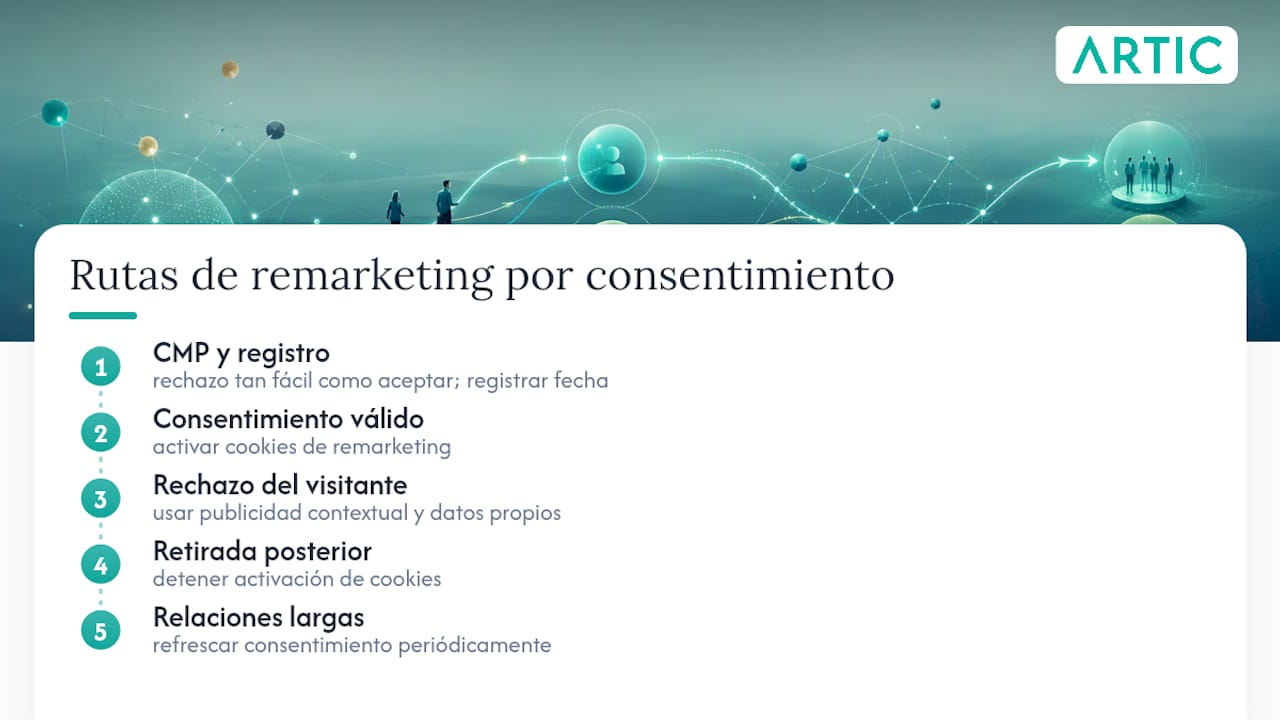
Storing or accessing information on devices (including remarketing cookies) typically requires valid, informed, and demonstrable consent, as clarified by the EDPB guidelines on the technical scope of Article 5(3) of the ePrivacy Directive. This means that a remarketing campaign in Europe needs a consent management platform (CMP) with an opt-out option as accessible as the opt-in option, and a record that can demonstrate when and how each consent was obtained.
The EDPB guidelines on consent add that it should be as easy to withdraw as to give, and recommend refreshing it periodically in long-term relationships. For visitors who do not give consent, the reasonable alternative is to rely on first-party data collected through other means and on contextual advertising, which does not depend on individual identifiers.
How ARTIC applies B2B remarketing to industrial accounts
A B2B remarketing agency integrates audience activation with CRM synchronization so sales can see in real time which accounts are showing intent. Work is organized into bi-weekly sprints within a quarterly plan using pipeline KPIs, not vanity KPIs, and each client has a dedicated account manager who reviews results with the sales team.
This model allows you to adjust segments and creatives every two weeks instead of waiting for the monthly report. For companies that need to build or audit a remarketing strategy from scratch, the page of remarketing campaign management details the scope of the service.
ARTIC: B2B remarketing with real-time tracking all the way to the pipeline
Many industrial marketing teams end up with remarketing campaigns that generate cheap clicks but no new meetings because no one connected the ad platform to the CRM or measured whether those visits would convert as well without advertising. ARTIC solves precisely that blind spot: every remarketing campaign is designed to sync with your CRM from the very first sprint, so the sales team can see which identified accounts are ready for a call, not just how many impressions were served.
The service of B2B paid media ARTIC includes audience setup per account on LinkedIn and Google, server-side tracking to avoid relying solely on cookies, and bi-weekly reviews with your team to adjust segments based on actual pipeline performance. If your industrial company already invests in advertising but isn't sure if remarketing is generating incremental sales or simply repeating impressions to the same contacts, the first logical step is an audit of your current campaigns. You can request one directly from the ARTIC services page.
Sources
- An Experimental Investigation of the Effects of Retargeted Advertising: The Role of Frequency and Timing
- Prospecting Versus Retargeting: Insights from a Geography-Based Field Experiment
- EDPB guidelines on the technical scope of Article 5(3) ePrivacy Directive
Frequently Asked Questions
What is remarketing and how does it work?
Remarketing shows ads to people who have already visited your website, opened an email, or interacted with your brand, using cookies, contact lists, or account identifiers to recognize them across other platforms. In B2B, it works best when these lists are updated based on the actual status of the opportunity in the CRM, not just browsing history.
What is B2B in marketing?
B2B means that a company sells products or services to other businesses, not to end consumers, which implies longer sales cycles and multiple stakeholders in the purchasing decision. This necessitates designing campaigns targeted at entire accounts, not just individuals.
What are the 4 main B2B marketing strategies?
The most common strategies combine technical content creation to educate the buyer, account-based marketing (ABM) to target specific companies, B2B advertising on LinkedIn and Google to capture and reactivate interest, and email automation connected to the CRM to nurture leads throughout the sales cycle. Remarketing is usually integrated within the last three, reinforcing each rather than replacing them.
What is B2B and what are some examples?
B2B encompasses any transaction between companies: a machinery manufacturer selling to an industrial plant, a software provider billing other companies, or a component distributor supplying manufacturers. In all these cases, B2B remarketing helps maintain a presence with buyers who have spent weeks or months comparing suppliers before making a decision.
How can I tell if my B2B remarketing is generating real incremental growth?
Comparing a group exposed to the campaign with a control group without exposure is the most reliable way to determine this, rather than relying solely on CTR or last-click conversions. If the pipeline progress between the two groups is virtually identical, the campaign isn't generating new sales, but rather repeating impressions on accounts that were already likely to convert.
