Meta Ads do work in B2B, but not as a first-contact channel: they perform well as a retargeting engine, lookalikes, and funnel support, but almost never as cold prospecting for accounts with low conversion rates. Before investing, there are three priorities: activate your own data from the CRM, build lookalikes from closed leads, and connect the Conversions API to optimize for a real pipeline, not just cheap forms.
Operational summary: The 5 tactics you should try first in B2B meta ads
Before touching the budget, define the execution order. These five tactics cover the first two to six weeks for a B2B account on Meta:
- Sync your CRM with Meta. Upload SQL contact lists and closed clients as custom audiences; it's the foundation of everything else.
- Create closed-won and SQL lookalikes. These are the audiences that most closely resemble the profile of your actual buyer.
- Combine Lead Ads with landing pages based on intent. Use native forms (Higher Intent) for low-friction volume and dedicated pages for demos or high-consideration content.
- Design retargeting sequences by time window. Adjust the message based on how many days the visitor has gone without converting.
- Activate the Conversions API and send pipeline events. Without this, Meta optimizes blindly towards the cheapest lead, not the one that actually buys.
How to build B2B audiences on Meta: practical steps and minimum viable requirements
The Meta algorithm needs a quality signal, and in B2B that signal almost never comes from generic interests. It comes from the CRM.
- Priority sources: Export closed-won contacts, visitors to pricing pages or success stories, and active product users if you already have trial customers.
- Minimum thresholds: You need at least a 300 closed-won contacts as a seed for a lookalike to make statistical sense; below that, the system does not find a reliable pattern and it is better to wait or widen the data window.
- Segmentation layering: It combines job title (commercial director, operations director) with sector and behavioral intention, and excludes current customers so as not to waste budget on people who are already buying.
- Update cadence: Refresh your CRM lists every one or two weeks; an audience that's been stagnant for two months no longer represents who you're selling to today.
Professional advice: If your monthly traffic to high-intent pages doesn't reach 1,000 visits, first dedicate your budget to generating that qualified traffic before scaling Meta Ads; without that foundation, any lookalike ad is born weak.
Formats and messages that convert to B2B (examples and recommended A/B tests)
The choice between Lead Ads and landing pages isn't just cosmetic: it changes the volume and quality of leads you'll receive. Meta's native forms reduce friction and generate more leads, but with In Higher Intent, volumes decrease between 20 % and 40 % while quality increases versus the standard instant form. For awareness, a Lead Ads with a short form works well; for a demo or consultation, a dedicated landing page is better at filtering out those who aren't ready to buy.
The structure of the ad matters as much as the format:
- Title addressed to the position, not to the generic sector: “For industrial operations managers” carries more weight than “Solution for companies”.
- Brief social proof: a number, a recognizable client logo, or a result phrase, without embellishment.
- CTA with explicit benefit: “Reduce quoting time” converts better than “Request information”.
Regarding formats, short videos work well at the top of the funnel, carousels with practical case studies are ideal, and forms are best suited for the decision stage. For A/B testing, always compare headlines, creative formats, and call to action types separately, never all three at once.
Campaign architecture and budget guidelines based on account size
The most effective B2B structure follows three layers: prospecting with lookalikes or Advantage+, retargeting segmented by intent level, and a final layer optimized directly for pipeline conversions, not individual leads. B2B account audits They usually recommend Advantage+ only when there is enough volume for the system to learn.; In small accounts, maintaining manual control over retargeting prevents the algorithm from diluting the budget on cold audiences.
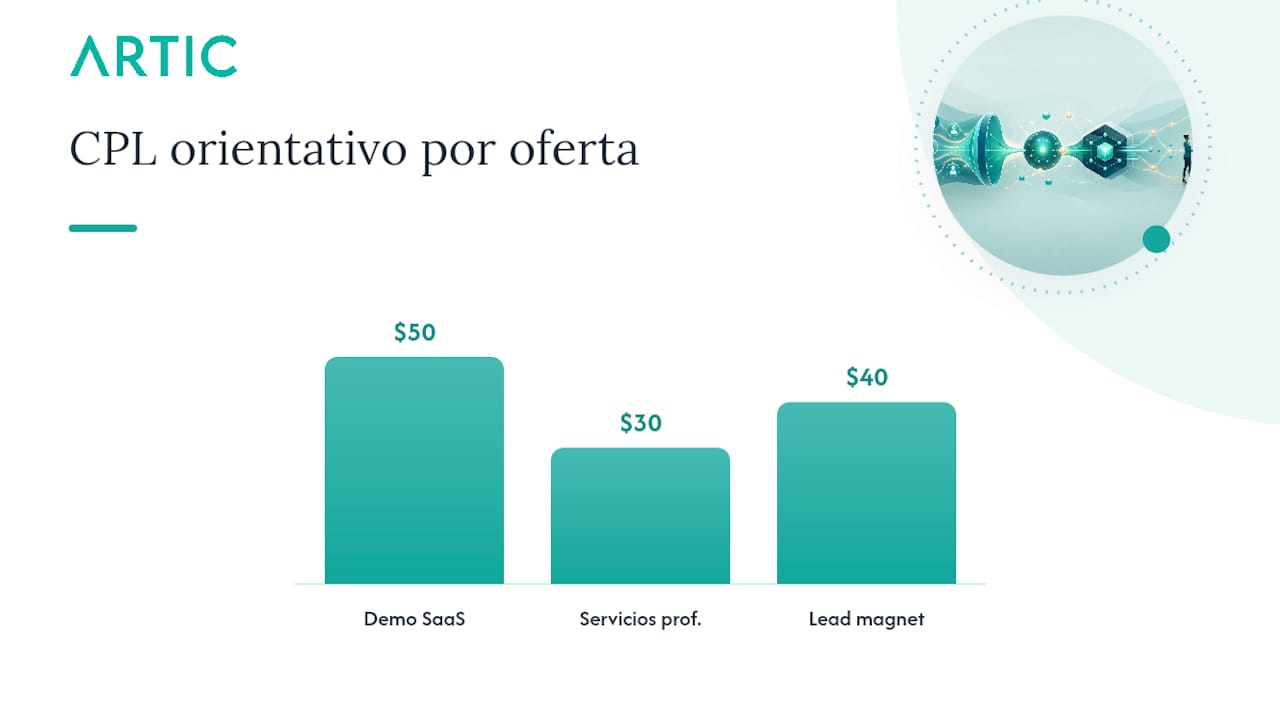
Cost per lead ranges vary widely according to the offer:
| Type of offer | Indicative cost range per lead |
|---|---|
| Software Demo (SaaS) | 50 $ |
| Professional services | 30 $ |
| Content or lead magnet | 40 $ |
These ranges reported in B2B audits serve as a reference, not a fixed target: a higher CPL with leads that do advance to opportunity is worth more than a low one that doesn't reach sales. Distribute the budget. according to Average Contract Value (ACV): the higher the ACV, the more budget can be justified for long-term retargeting and less for broad prospecting. The key KPI is not cost per lead, but cost per qualified lead (CPQL) and the SQL-to-opportunity conversion rate.
Advanced Measurement and Conversions API: How to measure the actual contribution of metadata to the pipeline
Cost per lead is misleading in B2B. A low CPL can mask hundreds of forms that never reach SQL, while a campaign with a high CPL might be generating the opportunities that close the quarter. That's why serious reporting prioritizes cost per qualified lead, conversion rate to SQL, and, above all, pipeline contribution measured over 180 days, which is the recommended timeframe for capturing the true impact of Meta in long sales cycles.
The Conversions API is the piece that makes this measurement possible. Without it, Meta loses between 20% and 40% of the signal due to ad blockers and privacy restrictions, and ends up optimizing for the cheapest available event instead of the one that really matters.
Events that should be sent via CAPI, synchronized from the CRM:
- Lead Qualified, when sales confirms that the contact meets the profile.
- Opportunity, by opening a formal opportunity in the pipeline.
- Closed Won, upon closing the contract, the event that feeds back into the lookalikes.
The data that changes the reporting: Analyzing performance over 180 days instead of 7 or 30 days often reveals a much higher contribution from Meta than that shown in the platform's standard report, precisely because the B2B decision cycle rarely closes in the first week.
For this monitoring to have operational meaning, it is advisable to rely on a B2B sales funnel well defined, with clear stages between lead, SQL and opportunity.
Recurring mistakes and a launch checklist to avoid budget runs
Most B2B accounts that "don't work" on Meta share the same three flaws: measuring only cost per lead, building audiences without their own data, and launching without a Conversions API connected to the CRM. None of these are platform issues.
Checklist before activating spending:
- CRM audiences uploaded and lookalikes generated with at least 300 closed-won contacts.
- Creatives with headlines by position, social proof, and benefit CTAs, ready in at least two variants.
- Active and proven CAPI, sending Lead Qualified, Opportunity and Closed Won.
- CRM synchronization confirmed and sales notifications set up for immediate contact.
- Campaign objective set on conversion to pipeline, not on clicks or raw leads.
Professional advice: For the first two to four weeks, don't touch the bid or the budget: let the system get out of the learning phase. Only pause if there are no SQLs after four weeks, not if the CPL seems high.
How we apply these tactics to industrial B2B clients
At ARTIC we work with quarterly planning and KPIs defined from the first sprint, executed in fortnightly cycles together with the client, not as one-off deliveries disconnected from the business.
- We act as the client's digital marketing department, with a dedicated account manager and regular follow-up meetings.
- We integrate CAPI with the client's CRM so that Meta optimizes towards SQL and opportunity, not towards the cheapest form.
- We are a certified partner of Google, Meta and Holded, which supports the technical management of campaigns and automations connected to the B2B sales funnel.
- We apply these same segmentation and measurement tactics to industrial accounts with long sales cycles, where CPL is never the metric that decides whether a campaign is maintained.
Outsource your B2B Meta Ads management to a specialized team
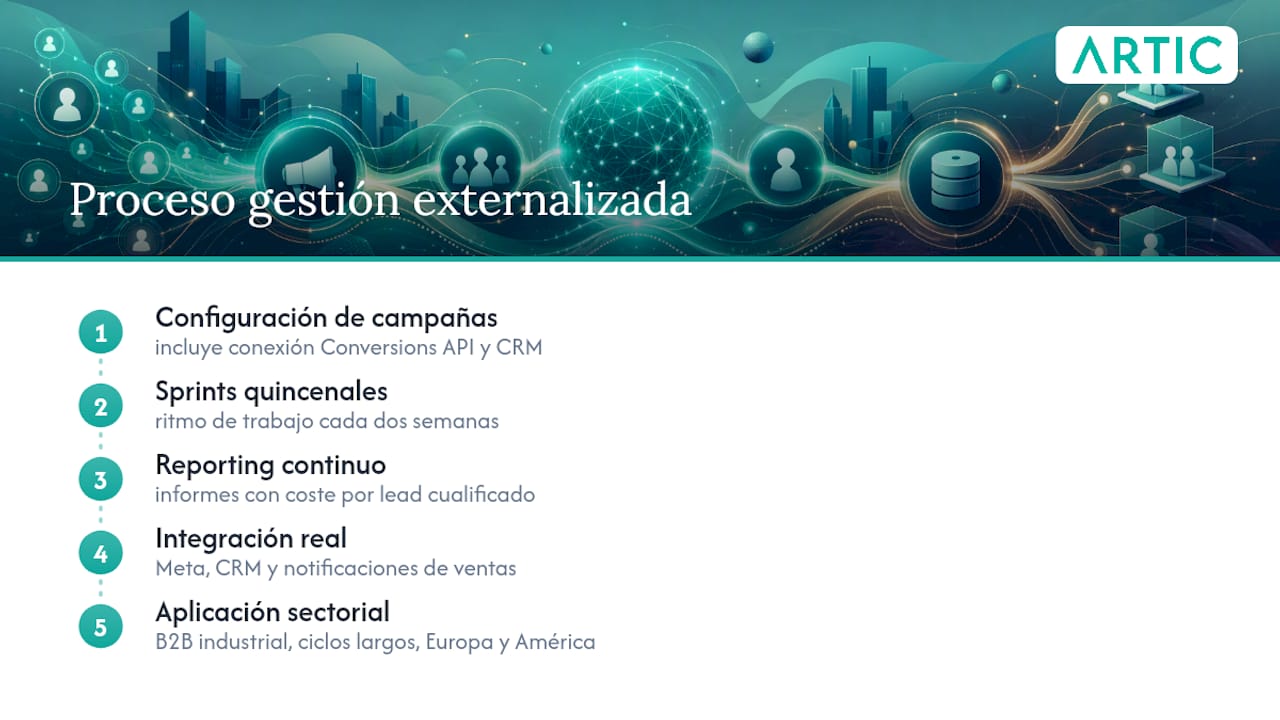
Setting up audiences from the CRM, keeping CAPI synchronized, and reviewing the pipeline every 180 days requires time that an internal sales team rarely has available each week. ARTIC manages this work as an extension of your team: bi-weekly sprints, continuous reporting, and true integration between Meta, the CRM, and sales notifications, so that every euro invested can be traced back to a closed opportunity, not just a random form.
The service includes complete campaign setup, Conversions API integration with your CRM, and reports that show cost per qualified lead, not just cost per click. As a certified partner of Meta, Google, and Holded, we apply the same integrated workflow to industrial companies with long sales cycles in Europe and the Americas.
If you want to outsource the management of your social media campaigns to a team that understands industrial B2B, check out our service for advertising on social media and requests a proposal.
Sources
To expand on each section of this guide, these resources cover everything from technical integration to channel comparison:
- Meta Ads for B2B Teams: When They Work and How to Connect Spend to Pipeline
- Meta Ads for B2B: Lead Generation Strategies That Work in 2026
- Meta Ads Best Practices (2026): 18 Data-Backed Tips
Frequently Asked Questions
Are Meta Ads and Meta Business the same thing?
No. Meta Ads is the platform for buying and managing ads, while Meta Business (Meta Business Suite) is the panel for managing pages, messages, and ad assets; they are used together, but they serve different functions.
What are the 4 types of ads on Facebook?
The basic formats are single image, video, carousel and collection, although in B2B the most relevant are usually short video for awareness, carousel for case studies and native form (Lead Ads) to capture demos.
How can you make money with Facebook Ads in B2B?
You don't make money directly with the platform: the return comes when the generated leads advance to SQL and then to a closed opportunity, something that can only be measured with Conversions API connected to the CRM and a 180-day pipeline analysis.
How do I pay for Facebook Ads?
Payment is made via automatic or manual bidding on the chosen objective (clicks, impressions, or conversions), with direct charges to the card or bank account linked to the Ads Manager, in cycles that Meta invoices. according to accumulated spending or a fixed monthly date.
When is it better to invest in Meta Ads instead of LinkedIn for B2B?
Once you have qualified traffic and CRM data for lookalikes, Meta typically offers CPMs between 50% and 70% lower than LinkedIn for comparable audiences, making it more cost-effective for retargeting and high-intent remarketing.
