
The B2B conversion rate is the percentage of prospects who move from one stage to the next in the sales process, or who ultimately become customers. It's calculated by dividing the number of conversions achieved by the total number of available opportunities and multiplying the result by 100. If you close deals with a small proportion of qualified leads, that's your rate. It's that simple.
What complicates interpreting this metric in B2B is that there isn't just one rate: there's one for each stage of the funnel. The most relevant are:
- Visitor to lead: percentage of website visitors who leave their data or request contact.
- Lead to a qualified contact (MQL/SQL): how many leads pass the marketing and sales quality filter.
- Qualified contact upon proposal: those who receive a formal offer.
- Closing proposal: the percentage of budgets that become signed contracts.
The overall success rate of the funnel is the product of all these interconnected stages, and it's usually surprisingly low without specific improvement efforts. Knowing where the most opportunities are lost is the first step toward acting strategically, not intuitively.
What are the B2B conversion benchmarks in 2026?
Benchmark ranges vary depending on the industry and stage of the sales funnel, but there are figures that serve as a solid starting point. For B2B software-as-a-service (SaaS) companies, the average website-to-lead conversion rate is typically low. Most overall B2B rates remain at moderate levels, which doesn't mean they're bad: in B2B, a lead is worth much more than in B2C.
Key reference: For B2B sales managers, HubSpot sets as its objective a lead-to-customer conversion rate of between 2 % and 5 %, although it varies depending on the sector and the complexity of the sales process.
The following table lists the benchmarks by stage for B2B technology services and SaaS, which are the most documented globally and serve as a guiding reference for the Central European market:
| Funnel stage | Average benchmark |
|---|---|
| Visitor to lead | 1-3% |
| Lead a MQL | 40-60% |
| MQL to SQL | 45% |
| SQL to opportunity | 45% |
| Opportunity for sale | 40% |
Source: Global benchmarks for B2B IT and SaaS services
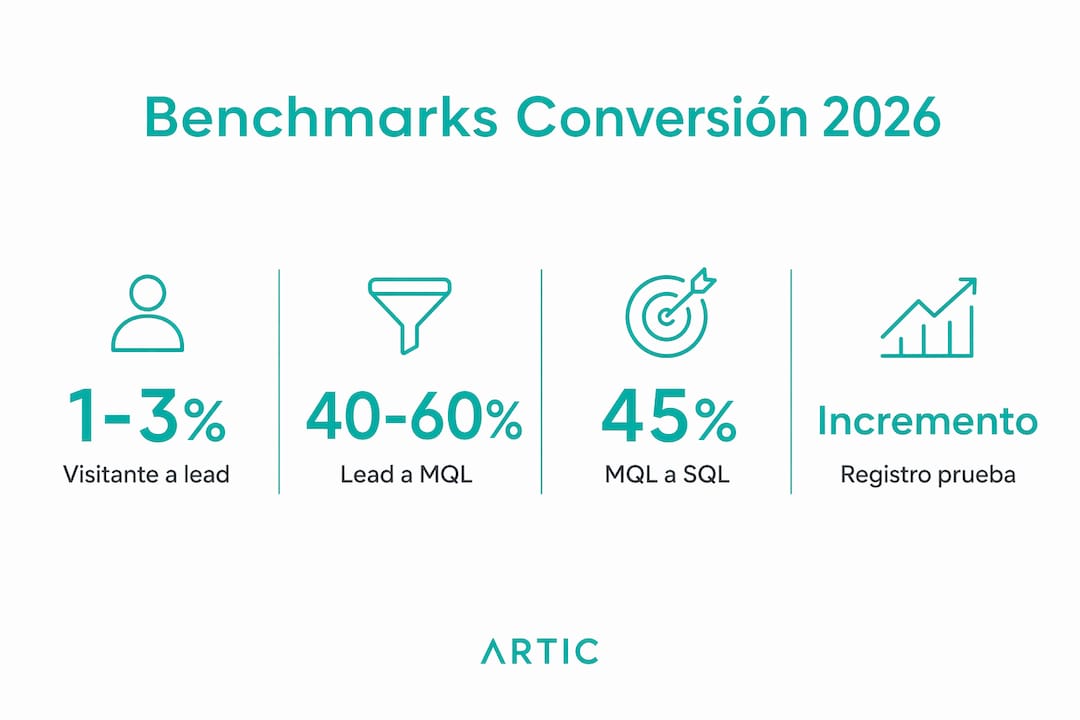
Source: Global benchmarks for B2B IT and SaaS services
For free trial sign-ups in SaaS, rates are higher compared to other stages. Professional and consulting services, where sales are based on personal relationships, typically achieve higher closing rates thanks to shorter decision cycles. The difference between sectors is real and shouldn't be ignored when setting internal goals.
Why improving conversion rates matters more than increasing traffic
Doubling web traffic without improving conversion rates also doubles acquisition costs, but not necessarily revenue. Improving the conversion rate enhances process efficiency: the same resources generate more business.
The specific benefits of working with this metric are:
- Lower cost per customer acquired: By converting more leads with the same budget, the unit cost falls.
- Best pipeline qualification: Identifying the stages with the highest leakage forces the refinement of quality criteria, which improves segmentation from the outset.
- Higher return on investment in marketing and sales: Every euro invested in demand generation yields more when the funnel is fine-tuned.
- Reduction of invisible losses: In B2B services, a significant proportion of leads are lost during the initial contact phase, before any digital tools can intervene. Measuring this loss is the first step to closing it.
- Data-driven decisions: A well-measured, staged funnel reveals where to act, instead of applying generic improvements that don't move the needle.
The clearest argument for prioritizing conversion over volume is this: optimizing the conversion process can triple the leads generated without increasing traffic. No acquisition campaign can achieve that on its own.

Strategies to increase the B2B conversion rate in Central Europe
The Central European B2B market has unique characteristics that directly impact conversion rates: long decision cycles, multiple stakeholders within the client organization, and a business culture where trust is built before signing a contract. The tactics that work here are not the same as those in Anglo-Saxon markets.
- Forms with real value: Replacing the generic contact form with a return on investment calculator, a diagnostic tool, or specific downloadable content improves both lead generation and lead quality. Visitors provide their information because they receive something useful in return.
- Website loading speed: Every extra second of loading reduces conversion. A slow mobile site loses opportunities before the visitor even reads a single line.
- Persistent multichannel tracking: 80% of B2B sales are closed after the fifth contact, but most sales teams give up after two attempts. Combining email, LinkedIn, and phone calls into a structured sequence makes the difference between losing a lead and closing it.
- Messages localized in language and culture: In Poland, the Czech Republic, Austria, or Germany, a value proposition written in the local language and adapted to the sector's cultural references is more effective than a literal translation from English. Cultural sensitivity isn't a minor detail; it's a competitive advantage.
- Alignment between marketing and sales: When marketing delivers leads without clear qualification criteria and sales discards them without feedback, the funnel bleeds on both sides. Defining together what a qualified lead (MQL and SQL) is and reviewing that definition quarterly is the lever with the greatest impact on the closing rate.
- Lead nurturing with industry-specific content: he email in B2B industrial It remains one of the channels with the best return on investment when the content addresses real industry problems, not generic product messages.
Professional advice: Contacting a lead within an hour of their first interaction can significantly increase the chances of qualification. In Central Europe, where competition for the same decision-makers is fierce, speed of first contact is just as important as the quality of the message.
How to effectively measure B2B conversion rate?
Accurate measurement is a prerequisite for improvement. Without data segmented by stage, any improvement action is a shot in the dark.
The key metrics that every B2B team should monitor are:
- Conversion rate per funnel stage: visitor to lead, lead to MQL, MQL to SQL, SQL to closing.
- Cost per qualified lead (CPL): How much does it cost to generate a lead that passes the sales filter?.
- Proposal closure rate: Percentage of submitted quotes that become contracts.
- Average sales cycle time: How many days elapse from the first contact until the closure?.
- Incoming contact handling rate: The percentage of calls or requests that receive a timely response, a metric that few companies measure and that hides enormous leaks.
The following table summarizes the most commonly used tools for tracking these metrics in B2B environments:
| Tool | Main function | Funnel stage |
|---|---|---|
| CRM (HubSpot, Salesforce, Holded) | Tracking opportunities and closing rates | MQL at closing |
| Google Analytics | Web traffic and conversion analysis | Visitor to lead |
| Microsoft Clarity | Heat maps and session recordings | Visitor to lead |
| Email automation platform | Lead nurturing and tracking | Lead a MQL |
| Sales dashboards | Global overview of the pipeline and KPIs | All stages |
A practical example: a technology services company in Austria, upon segmenting its funnel, discovered that its visitor-to-lead rate was 1.8 (within the normal range), but its MQL-to-SQL rate was falling to 12, well below the benchmark of 30. The problem wasn't in acquisition, but in the qualification criteria. By redefining the ideal customer profile with the sales team and adjusting the acquisition forms, the MQL-to-SQL rate rose to 28 within a quarter. Key B2B funnel metrics They are the map: without them, you don't know where the problem is.
Post-sales follow-up also matters. In SaaS and recurring services, true conversion is measured when the customer receives perceived value within the first 30 days, not when they sign the contract. A poor onboarding process destroys true conversion, even if the pipeline numbers appear healthy.
Factors affecting the B2B conversion rate in Central Europe
The geographical and sectoral context of Central Europe introduces variables that global benchmarks do not always capture. Understanding these variables helps to interpret the data more accurately.

Long decision cycles and multiple stakeholders. In B2B, the purchasing decision is rarely made by a single person. A software project for a manufacturing company in Germany might involve the COO, the IT manager, and the CFO. Each stakeholder has different criteria, and the value proposition must address all of them. This explains why B2B conversion rates are structurally lower than in B2C, but the leads that are closed are far more valuable.
Lead quality versus volume. In markets like Poland, the Czech Republic, and Hungary, where the B2B business sector is more concentrated than in Anglo-Saxon markets, chasing a high volume of unqualified leads exhausts sales resources without improving the closing rate. The priority is to generate fewer leads, but better-qualified ones.
Cultural and linguistic adaptation. A proposal in English aimed at a purchasing decision-maker in Warsaw or Prague inspires less confidence than the same proposal in the local language, with references to the regulatory and sectoral context of their country. Localization is not just translation: it's adapting sales arguments to the local business logic.
Speed in the first contact. In Central Europe, where cycles are long but competition for the same decision-makers is intense, responding to an information request in under an hour makes a real difference in the qualification rate. Teams that take days to respond lose the lead before the conversation even begins.
Website digital infrastructure. A B2B website with slow loading times or unclear contact forms penalizes conversions from the very first point of contact. Differences in digital infrastructure between Central European countries are still significant, and adapting the web experience for slower connections or mid-range mobile devices can directly improve lead conversion rates. If you need a solid technical foundation for your site to convert, the Specialized technical SEO It is the starting point.
ARTIC works with B2B industrial companies in Europe, combining funnel analytics, sales tracking automation, and digital positioning to improve conversion at every stage of the process. If you want to know where in your funnel you're losing the most opportunities, Contact the ARTIC team for a no-obligation diagnosis.
Frequently Asked Questions
What is the conversion rate in B2B?
It's the percentage of prospects or leads who complete a specific sales action, such as moving from one stage of the funnel to the next or becoming customers. It's calculated by dividing the total number of conversions by the total number of opportunities and multiplying by 100.
What is a good conversion rate in B2B?
It depends on the stage and the sector. For overall lead-to-customer conversion, HubSpot places the typical range between 2 % and 5 % in B2B, although professional services can exceed 10 % and SaaS usually stays around 1.1 %.
What is B2B and how does it differ from B2C in conversion?
B2B (business-to-business) involves longer sales cycles, multiple decision-makers, and higher-value leads. This is why B2B conversion rates are structurally lower than in B2C, where purchases are more impulsive and the decision cycle is much shorter.
How is the conversion rate calculated?
The formula is: (number of conversions / total opportunities) × 100. In B2B it is advisable to calculate it separately at each stage of the funnel to detect where the greatest leaks occur.
Why do many B2B companies have low conversion rates without realizing it?
Because they only measure the final closing rate and not the intermediate stages. A common leak occurs in inbound contact management: between 20% and 40% of leads in B2B services do not receive a response within a reasonable timeframe, and this loss does not appear in any sales report.
