

Urgency and scarcity marketing is the deliberate use of time-sensitive or limited-availability signals to accelerate purchasing decisions. It's not an e-commerce trick; it's a psychological mechanism that works in any market where the buyer perceives that the cost of waiting outweighs the cost of deciding now.
The difference between the two concepts is concrete:
- Urgency: The restriction is temporary. "Offer valid until Friday." "Special price for contracts signed before the end of the quarter."«
- Shortage: The restriction is quantitative or related to access. "Only 3 units left." "Onboarding capacity limited to 4 new customers this month."«
Both tactics increase conversion rates on e-commerce platforms when applied correctly, although the exact uplift depends on the industry, channel, and the credibility of the restriction. In industrial B2B, the most valuable effect isn't the immediate click; it's reducing the time to close in long sales cycles where indecision is the biggest enemy.

Why do urgency and scarcity work on a psychological level?
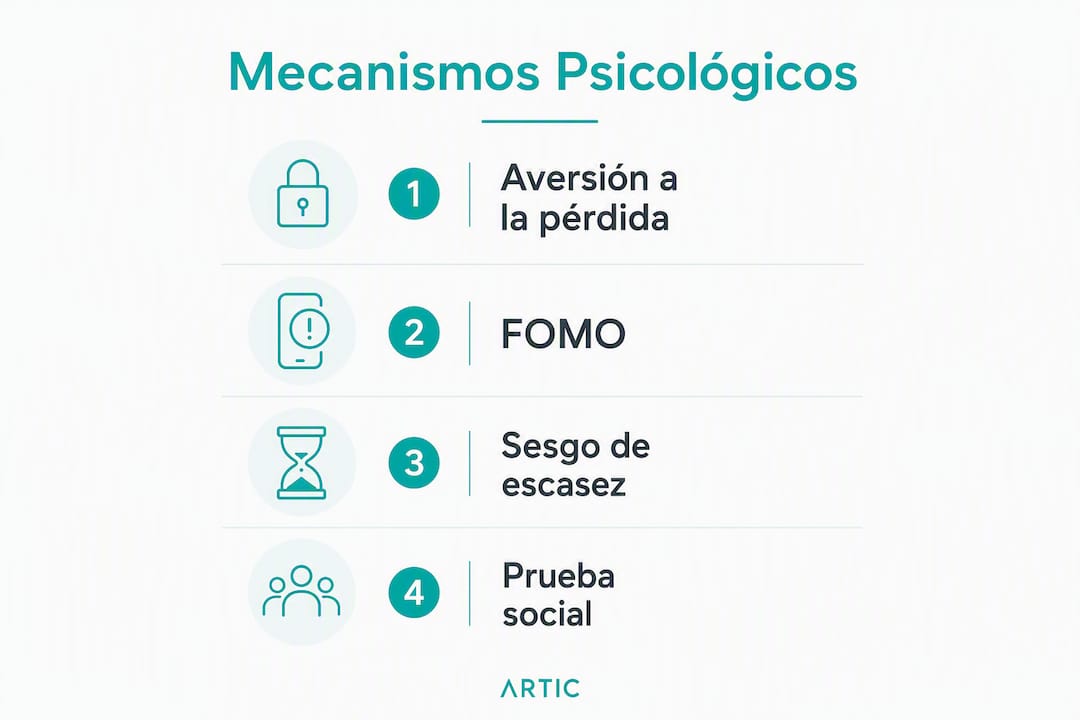
Four mental mechanisms explain the effectiveness of these tactics, and each one translates into a specific design lever.

Loss aversion. People feel the pain of losing something more intensely than the equivalent pleasure of gaining it, a principle documented by Kahneman and Tversky. Communicating what the buyer loses by not acting (unmet production capacity, a rising price, a vacant position) activates this bias more strongly than promising future benefits.
FOMO (fear of missing out). According to Eventbrite data, 691% of millennials have attended events motivated by the fear of missing out. In B2B environments, the equivalent is the decision-maker who approves a project before the competition does or before the implementation cost increases.
Scarcity bias. The perception of exclusivity increases the desire and willingness to pay in categories where differentiated access has real value. An industrial supplier that limits its portfolio of active clients conveys selectivity, not desperation.
Social proof under pressure. When others are already buying or availability drops, the group's behavior validates the individual decision. "12 companies have requested information this week" is more persuasive than any single sales pitch, provided it's verifiable.
Professional advice: If the urgency you communicate doesn't make you feel that the buyer benefits from deciding now, it's a red flag. Perceived manipulation destroys trust faster than any conversion can rebuild it.
1. Time limitation: counters and price windows
The countdown timer is the most visible tactic. It works when the deadline is real and the buyer can verify it. A counter that resets every time the user refreshes the page is exactly the type of practice the EU Omnibus Directive seeks to eliminate.
In B2B, the most credible timeframe isn't a countdown banner: it's the client's budget quarter end, the date a regulation comes into effect, or the deadline before an industry trade show. These dates exist independently of your campaign, making them irrefutable.
2. Quantity shortage: visible stock and limited capacity
Displaying the exact number of units available ("4 left in stock") is standard in e-commerce. In B2B services, the equivalent is onboarding capacity: if your team can successfully onboard three new clients per month, mentioning this isn't a pressure tactic, it's useful information for the buyer.
Scarcity must be real, verifiable, and beneficial to the buyer to be effective without eroding trust. Inventing low stock levels when the warehouse is full is a deceptive practice with legal consequences in the EU.
3. Exclusive access and waiting lists
Waiting lists reverse the sales dynamic: the buyer requests access instead of being recruited. This filters leads with genuine intent and reinforces the perception of value. SaaS tools like Notion and Superhuman built their initial user base using this mechanism.
In industrial B2B, exclusive access can take the form of a closed-place pilot program, a quarterly implementation cohort, or a technical workshop with limited capacity.
4. Price urgency: discounts with an expiration date
Limited-time discounts work best when the base price is stable and known. If the "normal" price is never actually applied, the discount loses credibility and may infringe EU regulations on the indication of previous prices (Article 6a of the Omnibus Directive).
The cleanest tactic in B2B: offer preferential implementation or onboarding terms (not price discounts) for contracts signed before a specific date. The value is real, the price isn't manipulated.
5. Limited places available at events and training
Events with actual capacity are the most natural example of verifiable scarcity. A technical seminar with 20 places, a webinar with limited interaction, or an in-person workshop at an industrial trade fair: all generate urgency without the need for artifice.
The common mistake is to open unlimited registrations and then add a "last places" message when it's not true. Besides being misleading, B2B buyers who discover the manipulation won't return.
6. Flash sales and price windows in industrial e-commerce
Flash sales (short-term discounts) work well in product catalogs with publicly listed prices, such as those of component distributors or suppliers of industrial consumables. The technical requirement is real-time inventory synchronization: a price that expires but the stock isn't updated generates orders that can't be fulfilled, which is more damaging than not having offered the sale at all.
Professional advice: Combining urgency and scarcity in the same message ("only 5 units at the launch price, until Thursday") multiplies the effect, but also multiplies the risk of appearing manipulative. Use it with genuine restrictions and on channels where the buyer already trusts you.
7. Structural shortages in B2B: cohorts and budget windows
This is the most underrated tactic in industrial settings. Instead of creating artificial urgency, the actual business structure is communicated: "We onboard new customers in quarterly cohorts to ensure quality; the next cohort closes on March 15."«
Scarcity can be a strategic signal in B2B by reducing indecision and filtering leads, provided it's backed by authority and evidence. A supplier that actively manages its capacity conveys that it has real demand, not that it's desperate to close down.
In which sectors and contexts do these tactics work best?
The impact varies greatly depending on the sector and purchasing model. Here's the actual map, with nuances for Central Europe.
- E-commerce and industrial distribution: High effectiveness for visible stock, flash sales, and counters. Buyers are accustomed to these signals and interpret them correctly. In Central European markets (Germany, Austria, Poland, Czech Republic), sensitivity to manipulation is high: artificial shortages quickly generate negative reviews.
- Events and training: The most natural case. Real capacity, fixed date, verifiable waiting list. Works in B2C and B2B without special adaptation.
- SaaS and software: Waiting lists, limited beta access, and launch prices with expiration dates are standard tactics. The risk is overexposure: if every update has a countdown timer, users learn to ignore them.
- Professional services and B2B consulting: Capacity scarcity is the most credible tactic. Saying "we have availability for a new client in the second quarter" is more persuasive than any discount, because it implies that other clients are already fully booked.
- B2B industrial with long cycles: Urgency only works when the buyer already perceives their own operational pressure. Urgency in B2B is a segmentation dimension: the same decision-maker acts completely differently depending on the level of stress within their organization.
The differences between B2B and B2C websites They also condition how these signals are presented: in B2B, the scarcity message should be directed to the economic decision-maker, not the end user.
When and how to apply urgency in long B2B sales cycles?
The most important rule: urgency and scarcity should appear after the buyer has perceived value, never before. Using them in the discovery phase generates rejection; using them in the decision phase accelerates the closing.
By stage of the funnel:
- TOFU (attraction): Don't create a sense of urgency. The buyer doesn't know you. Any sign of pressure at this stage destroys credibility before it's even built.
- MOFU (consideration): Introduce the scarcity of access in an informative way. "The next implementation cohort has 3 places available" is useful information, not pressure.
- BOFU (decision): Here, the urgency makes sense. The buyer has already evaluated options; a price window, a capacity closing date, or a guaranteed delivery timeframe can be the final push.
B2B operational checklist before launching an urgency/shortage signal:
- Is the restriction real and can you document it if the client questions it?
- Can you explain to the buyer why that restriction exists in a way that makes sense to them?
- Does acting now benefit the buyer, or just your pipeline?
- Have you verified that the CRM and inventory are synchronized before communicating availability?
- Is the message segmented for buyers in the decision-making phase, not for the entire database?
Professional advice: Signals of intent are your best ally: a prospect who visits the pricing page three times in a week, downloads the technical use case, or inquires about delivery times is creating their own sense of urgency. Detecting that moment with your CRM and acting on it is more effective than any artificial counter.
The B2B sales funnel Define exactly at what stage each tactic makes sense; skipping that logic is the most common mistake.
How to measure impact: KPIs and A/B testing
Measuring the uplift caused by urgency and scarcity requires separating the effect of the tactic from the noise of seasonality, channel, and segment. Without that separation, you don't know if the increase in conversions is due to the timing or the fact that it was the end of the quarter.
5-step A/B testing process:
- Define a specific hypothesis: "adding a 48-hour countdown timer on the product page will increase the conversion rate by a measurable percentage compared to the control."«
- Segment the audience randomly between a control group (no urgency signal) and a treatment group (with signal).
- Calculate the sample size needed to detect a real effect with statistical significance before launching, not after.
- Set a minimum trial duration (at least two weeks to capture weekday variation) and do not interrupt it before then.
- Measure not only immediate conversion, but also churn rate and NPS in the 60–90 days following: a tactic that converts but increases cancellations is not a success.
| Metrics | Aim | Calculation method | Frequency |
|---|---|---|---|
| Conversion rate | Uplift vs. control | (Treatment conversions / Treatment visits) vs. control | For testing |
| Time until closing | Reduction in days | Signature date – date of first contact | Monthly |
| Churn rate | No increase | Cancellations / Total active customers | Monthly |
| NPS per channel | Without degradation | Segmented post-purchase survey | Quarterly |
| Email open rate | Benchmark by segment | Openings / Sent | For the campaign |
For correctly interpreting uplift in industrial environments, In B2B, sample sizes are typically small: with fewer than 200 conversions per variant, results rarely reach statistical significance. In such cases, sequential tests (before/after with control for extraneous variables) are more practical than traditional A/B testing.
Legal and ethical risks in Central Europe
The Omnibus Directive (EU Directive 2019/2161, transposed into the Member States since 2022) establishes specific obligations for any company that communicates urgency or scarcity in its commercial communications aimed at consumers in the EU.
Legal compliance checklist:
- Document the actual stock level before communicating limited availability.
- Record the start and end dates of each discounted promotion.
- The crossed-out reference price must be the lowest price applied in the previous 30 days (Article 6 bis of the Omnibus Directive).
- Counters must reflect actual dates, not be reset per session or cookie.
- Return policies should be clear and accessible from any page where a sign of urgency appears.
- In B2B, the communicated capacity restrictions must be justifiable to the customer if they question them.
What you can do / what you should avoid:
| You can do | You must avoid |
|---|---|
| Display real-time stock | Show low stock when it is not. |
| Communicate actual cohort closing dates | Counters that reset per session |
| Offer a special price with a documented expiration date | Crossed-out prices that were never real |
| Limiting the number of places at an event with actual capacity | Claiming "last places" without a real limit |
The risk of artificial scarcity in mass sales contexts It goes beyond legal sanctions: in Central European markets with a strong culture of review and comparison, a documented case of manipulation can cost more in reputation than in fines.
This article provides general information on marketing regulations. To apply these rules to your specific situation, consult a legal advisor specializing in EU consumer law.
Checklist of practical tools for implementation in Central Europe
Before launching any emergency or shortage campaign, these are the steps that cannot be skipped:
- Define the actual constraint: Is it temporary, quantitative, or related to access? Can you document it?
- Check the technical synchronization: The inventory, CRM, and communication platform must communicate with each other in real time.
- Label correctly on the web: The urgency/scarcity message should appear on the product page or landing page, in the follow-up email, and in the retargeting ads with the same information.
- Prepare the copy: Short, concise, and verifiable messages. "Only 3 places available for the April cohort" outperforms "Don't miss out!" in any B2B context.
- Configure tracking: Create a specific event in Google Analytics 4 or your analytics tool to measure conversions attributed to the urgency/scarcity signal.
- Check for legal compliance before posting, especially if the message includes a reference price.
| Tool | Main function | Compatibility in Central Europe |
|---|---|---|
| WooCommerce + stock plugins | Stock visible in real time | High (WordPress, GDPR-ready) |
| HubSpot CRM | Segmentation by intent signals and automation | High (EU servers available) |
| Holded | Inventory and billing synchronization | Alta (Spanish platform, widely used in Europe) |
| Deadline Funnel | User-verifiable emergency counters | High (compliant with EU cookies) |
| Google Analytics 4 | Measuring events and conversions by variant | High (consent settings required) |
| Mailchimp / ActiveCampaign | Email sequences with time windows | High (EU servers available) |
For the B2B marketing process automation, The integration between the CRM, inventory, and email platform is the critical point: without that synchronization, urgent messages generate promises that the sales team cannot keep.
How does ARTIC apply these tactics in industrial B2B projects?
The goal of any project addressing scarcity or urgency for an industrial client isn't to generate a spike in conversions that will fizzle out in 30 days. It's to accelerate the closing of qualified leads without increasing churn or degrading customer satisfaction.
The process that ARTIC follows in these projects:
- Diagnosis: Identify if there is a real constraint (onboarding capacity, client budget window, trade fair date) before designing any message.
- Constraint design: If the restriction does not exist, one is constructed that is structurally real: an implementation cohort, a pilot program with closed places, or a price window linked to the client's quarterly closing.
- Multichannel execution: The urgency/scarcity message is deployed in a coordinated manner across LinkedIn Ads, nurturing emails, and the conversion landing page, with the same data across all channels.
- A/B testing: The variant with urgency signal is compared to the control, measuring conversion, time to close and NPS at 90 days.
- Measurement of renewals: Real success is measured by the renewal rate at the same or higher pace, not just by the initial closing.
ARTIC is a certified partner of Google, Meta, Holded, and SE Ranking, enabling a single team to manage the technical synchronization between inventory, CRM, and paid media campaigns. Their bi-weekly sprint model ensures that urgent messages are updated when the restriction changes, not just when someone remembers to do it.
If you want to design a digital marketing strategy Integrating urgency and scarcity in an ethical and measurable way, the ARTIC team works like your external marketing department, with clear KPIs from the first sprint. See how they work. ARTIC industrial B2B marketing agency to see if it fits with your project.
Frequently Asked Questions
What is urgency marketing?
Urgency marketing uses time-limiting cues (counters, expiration dates, price windows) to accelerate the purchase decision. It works by triggering loss aversion: the buyer perceives that waiting has a real cost.
What is scarcity marketing?
Scarcity marketing communicates the limited availability of a product, service, or access to increase its perceived value and motivate action. The restriction can be of quantity (stock), capacity (spaces), or access (waiting list).
What is the difference between scarcity and urgency?
Urgency limits the time available to decide; scarcity limits the quantity or access available. They can be combined ("only 3 places at the launch price, until Friday"), but each activates different psychological mechanisms.
Do these tactics work in B2B sales with long cycles?
Yes, but only in the decision stage (BOFU) and when the constraint is real and verifiable. In B2B, urgency works when the buyer already perceives their own operational pressure; applying it earlier generates resistance.
What regulations govern these practices in the EU?
The Omnibus Directive (EU Directive 2019/2161) regulates deceptive commercial practices, including counterfeit meters, fictitious stock, and manipulated reference prices. It has been transposed into national law in all EU member states since 2022.
