
Marketing automation, known in the industry as marketing automation, Marketing automation is defined as the use of software to automatically execute communication and follow-up tasks, without manual intervention at each step. For marketing directors and managers of industrial SMEs, this means that welcome emails, contact segmentation, and quote tracking can run on their own while the team focuses on closing sales. Marketing automation without technical expertise is no longer just a promise: today's platforms are designed for non-technical users, with visual editors and ready-to-use templates. ARTIC works with industrial SMEs that implement these processes from scratch and achieve measurable results in just a few weeks.
What tools exist to automate marketing without knowing programming?
Modern automation platforms allow create workflows With drag-and-drop interfaces, without writing a single line of code. This means any manager with basic email knowledge can set up an automated sequence in under an hour.
The features you should look for in a tool of this type are:
- Visual flow editor: It allows you to design the contact path with graphic blocks, without programming logic.
- Multichannel shipping: email, SMS and notifications from the same platform.
- Automatic segmentation: It groups contacts according to their behavior, sector, or stage in the buying process.
- Predefined templates: pre-configured sequences for common cases such as welcome, lead tracking or reactivation.
- Automatic reports: Results summaries generated without manually exporting data.
The platforms designed for SMEs They are designed for users without a technical background, with visual editors that allow for the configuration of complex automations without programming knowledge. This eliminates the barrier to entry that historically kept industrial SMEs from using these tools.
There are three main categories based on company size and needs. Entry-level platforms handle email and basic segmentation and are sufficient for companies with fewer than 5,000 contacts. Mid-range platforms add CRM integration, lead scoring, and multichannel automation. Enterprise platforms include artificial intelligence, predictive analytics, and advanced personalization, but their complexity and cost are rarely justified for an industrial SME.

CRM integration is the most decisive factor when choosing a tool. CRM integrations These connections are critical for preventing data silos and ensuring that automation works with clean, up-to-date information. Without this connection, automated workflows send incorrect messages to the wrong contacts.
Professional advice: Before comparing prices, verify that the tool connects natively with the CRM or management system your company already uses. A forced integration creates more problems than automation solves.
What preparations does an SME need before automating?
Automation doesn't improve broken processes; it amplifies them. That's why the work done before implementation determines the success or failure of the project.
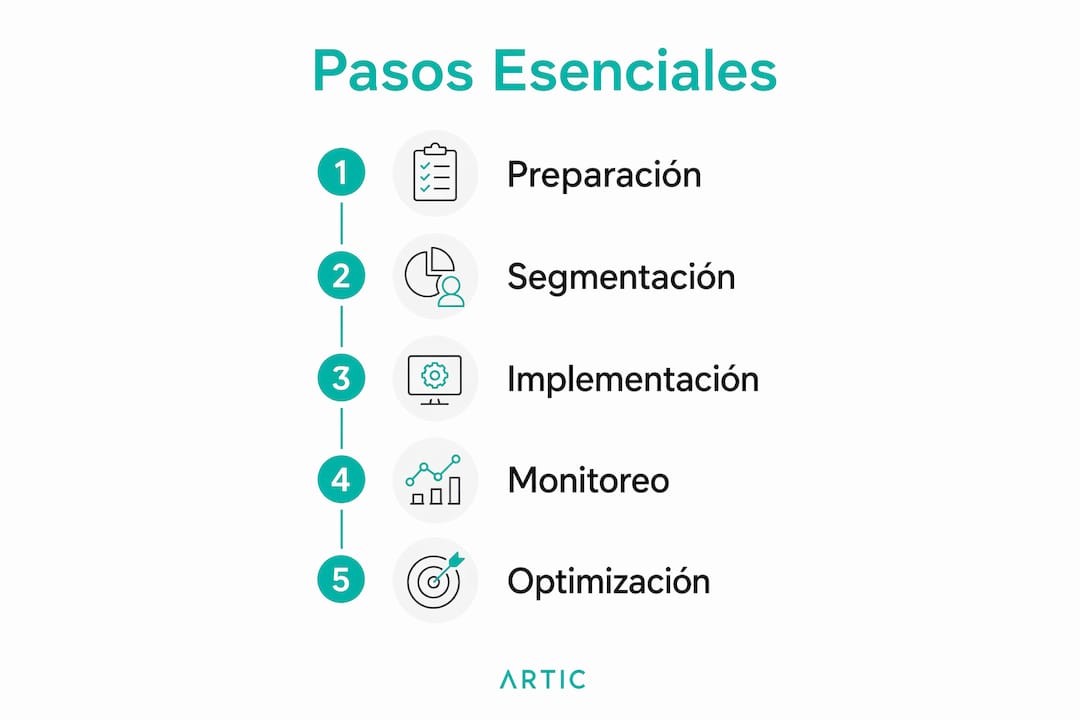
The first step is map current processes of communication and sales follow-up. This means writing down what happens from the moment a contact arrives until they become a customer, identifying the repetitive steps that consume time without adding value.
The essential preparations before activating any automation are:
- Database audit: Remove duplicates, correct erroneous emails, and fill in empty fields. Incomplete data is the most frequent cause of automations that don't work.
- Defining measurable objectives: not "improve communication", but "increase the email open rate to 30% in 90 days".
- Assignment of internal responsible party: Someone on the team must be the system owner, even if they don't have a technical background.
- Review of legal permits: Verify that contacts have given their consent in accordance with the GDPR before including them in automated workflows.
- Selecting the appropriate tool for the current volume: The most frequent mistake in SMEs is choosing business platforms complex and expensive that do not adapt to their needs and generate low internal adoption.
Data quality is the foundation of everything. A database riddled with errors leads to automated processes that send the wrong message, at the wrong time, to the wrong person. Spending a week cleaning up your contacts before launching saves months of problems later.
Professional advice: Start with a list of no more than 500 well-segmented contacts. Validating the process with a small group allows you to detect errors before scaling to the entire database.
Practical steps to set up automation without prior experience
Progressive implementation is the method that works best for industrial SMEs. The process should be gradual: start with high-impact, low-complexity campaigns, refine, and scale based on results. This avoids frustration and keeps costs under control.
The campaigns you should start with
The most effective campaigns to start with are welcome emails, basic lead tracking, and reactivating inactive contacts. These three sequences offer the highest return on investment and allow you to learn the tool risk-free.
The step-by-step setup process is as follows:
- Select a single task to automate first. The welcome email is the ideal starting point: it is triggered when someone registers on the web form and requires no complex logic.
- Use a predefined template from the platform. Don't design from scratch. The templates include the structure, shipping times, and basic conditions already configured.
- Personalize the content with CRM fields. Inserting the contact name or your company name requires no programming: it is a text field that the platform fills in automatically.
- Configure segmentation by industry or company size. In the industrial sector, a message directed to a purchasing manager of a company with 50 employees must be different from that of a multinational corporation.
- Activate the flow in test mode. Send the sequence to your own email address before activating it for the entire list.
- Check the results after 15 days. Check the open rate, clicks, and responses before adding more steps to the flow.
Common mistakes to avoid
Automating only what's necessary prevents overload and allows for gradual improvement of complexity. Not all communication requires extensive customization: simplicity and efficiency are often more effective for SMEs. The most common mistake is creating workflows with 10 steps before validating that the first one works.
Synchronizing campaigns with the sales calendar is another critical point. An automation that sends a follow-up email on the same day the sales team calls the client creates confusion. Coordinating automated workflows with the sales team's manual activity is part of the process design, not an afterthought.
For those seeking a structured reference, the automation guide for SMEs BabyLove Growth offers a step-by-step checklist that complements the initial setup phase well.
How to measure the effectiveness of automation without technical knowledge?
Measuring results doesn't require being a data analyst. Automation platforms include simplified dashboards that display key metrics in real time.
The essential metrics for an industrial SME are:
| Metrics | What does it measure? | Indicative reference |
|---|---|---|
| Opening rate | Percentage of emails opened | 25–35 % in industrial B2B |
| Click rate | Percentage of clicks on the link | 3–5 % in industrial B2B |
| Conversion rate | Percentage that performs the desired action | It depends on the defined objective. |
| ROI of the campaign | Revenue generated versus cost | It must exceed the cost of the tool |
Measure the actual ROI, Not just activity indicators like open rates, but rather automated conversion tracking is the only way to justify the investment in automation to management. Automated conversion tracking connects each campaign to the revenue it generates, eliminating ambiguity about what works and what doesn't.
The platforms' automated reports send weekly or monthly summaries without anyone having to generate them. This allows the marketing director to review performance in 10 minutes and make data-driven decisions.
Reviewing and updating workflows regularly is just as important as setting them up correctly from the start. Contact behavior changes, the market changes, and messages that worked six months ago may no longer be relevant. A quarterly review of each active workflow maintains the system's effectiveness.
Professional advice: Set up an automatic alert on the platform to notify you when the open rate of any flow falls below 20%. This helps you detect problems before they affect the entire campaign.
The well-implemented automation This frees up the team for higher-value activities, such as strategy and personalized attention to key clients. This is especially relevant in industrial SMEs where the marketing team is often small and every hour counts.
ARTIC manages marketing automation for industrial SMEs
ARTIC works as an outsourced digital marketing department for industrial companies that want to implement automation without relying on an internal technical team. The service includes workflow configuration, CRM integration, and continuous results monitoring through real-time analytics. Each project begins with quarterly planning and defined KPIs and is executed in bi-weekly sprints in collaboration with the client. ARTIC is a certified partner of Google, Meta, Holded, and SE Ranking, guaranteeing reliable integrations with the most widely used platforms in the industry. If your company needs AI-powered marketing automation Without technical complications, ARTIC has the equipment and the method to make it work.
Frequently Asked Questions
What is marketing automation without technical knowledge?
It involves using platforms with visual editors and predefined templates to automatically run email campaigns, segmentation, and tracking, without programming. No technical training is required to set up the basic workflows.
How long does it take to implement the first automation?
With the right tool and a clean database, the first automated sequence, such as a welcome email, can be up and running in less than a workday.
What automation tools are suitable for industrial SMEs?
Platforms with a visual editor, native CRM integration, and Spanish support are the most suitable. It's advisable to start with packages for fewer than 5,000 contacts and upgrade as your database grows.
Is it necessary to have a technical team to maintain automation?
No. Platforms designed for SMEs allow a marketing manager without a technical background to manage and update workflows. The important thing is to assign an internal system owner who reviews the results periodically.
How do I know if my automation is working properly?
Review the open rate, click-through rate, and, most importantly, the ROI of each campaign. If the revenue attributable to automated workflows exceeds the cost of the tool and the time invested, automation is working.
