

How to choose a digital marketing agency for SMEs

TL;DR:
- Choosing a digital marketing agency for your small business directly impacts your sales and online visibility in the long term.
- It is essential to evaluate specialization, account ownership, price transparency, and verifiable reputation before hiring them.
Choosing a digital marketing agency for your small business is the decision that will have the greatest impact on your sales and online visibility in the coming years. A poor choice can mean months of lost investment Without measurable results, the right agency multiplies your presence and generates real business. Selecting a marketing agency—the technical term for this process—requires evaluating specific criteria: specialization, account ownership, price transparency, and verifiable reputation. This guide gives you exactly that: a clear process to make the right decision from day one.
What criteria should you consider when choosing a digital marketing agency for SMEs?
Specialization is the first filter. An agency that regularly works with SMEs understands tight budgets, short sales cycles, and the need for quick results. Managing the marketing of a multinational is not the same as managing the marketing of a 10-person company with €1,500 a month to invest. Ask directly how many SME clients they have active and request to see examples from their sector.

Ownership and control of your digital accounts is the most overlooked yet critical factor. Your Google Ads, Google Analytics, Search Console, and social media accounts should be under your ownership from day one, not the agency's. If the relationship ends and the accounts are under their control, you lose all your historical data, built-up audiences, and months of work. This is non-negotiable.
Transparency in pricing and methodology sets professional agencies apart. It requires knowing exactly what services are included in each price, how results are measured, and how often you will receive reports. Clear communication and transparent reporting are direct indicators that the agency operates honestly and doesn't hide negative results.
Other criteria you should consider before signing:
- Verifiable reputation: Real reviews on Google Business Profile, documented success stories, and references from current customers.
- Multidisciplinary team: The agency must have specialists in SEO, SEM, design, development, and strategy. A single generalist cannot cover all areas in depth.
- Adaptation to your sector: An agency with experience in your industry reduces the learning curve and achieves results faster.
- Clear contract: Exit conditions, notice periods, and ownership of digital assets must be in writing, not agreed upon verbally.
Professional advice: Before the first meeting, check if the agency has its own SEO strategy on Google. If they don't rank for searches in their own industry, they're unlikely to rank you well.
How to evaluate and compare digital marketing agencies?
Evaluating agencies requires a method, not just intuition. Follow this process to filter candidates using objective criteria and avoid surprises after signing.
- Check their reputation on Google Business Profile. Look for agencies with a minimum average rating of 4.2 out of 5 and a significant volume of reviews. ranking of best agencies in Spain It is built precisely on these public metrics. An agency with 50 reviews of 4.8 is more reliable than one with 3 perfect reviews. Learn to analyze online reviews to distinguish the authentic ones from the manufactured ones.
- Request owner access to all platforms. Request to be added as an administrator in Google Ads, Google Analytics 4, Search Console, and Meta Business Suite before paying for the first month. If the agency refuses or makes excuses, dismiss them without further discussion.
- Request success stories tailored to your sector. Don't accept generic screenshots. Request real metrics: percentage increase in organic traffic, cost per lead in Google Ads campaigns, conversion rate before and after. If they can't show you concrete data, they don't have results to show.
- Compare proposals with the same basis. Ask three to five agencies to respond to the same brief. This way you can compare price, scope of services, and methodology on equal terms.
- Check the data protection agreement. If the agency will be handling your customers' personal data, There must be a data processor agreement in place to comply with the GDPR. Without this contract, the legal responsibility falls on you as a company.
Professional advice: Send the same briefing to all shortlisted agencies on the same day. Those that respond in less than 48 hours with a customized proposal demonstrate their level of commitment.
The following table summarizes what you should ask for and what signal each answer gives you:
| What you're asking for | Positive response | Warning sign |
|---|---|---|
| Owner access to accounts | They grant it from the beginning | They ask to wait or they refuse |
| Success stories with metrics | Real and verifiable data | Only images or vague testimonies |
| GDPR Contract | They include it without you having to ask. | They don't know what you're talking about. |
| Price Breakdown | Detailed service pricing | Fixed price without explanation |
| References from current clients | They provide you with direct contact. | They only send written testimonials |
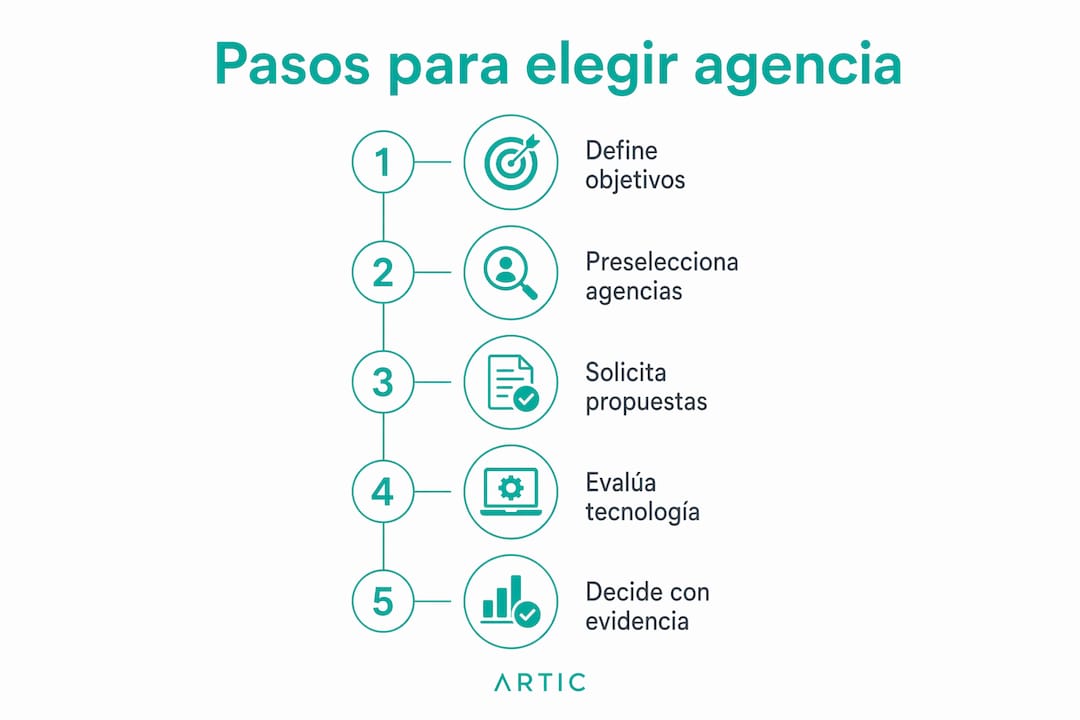
Steps to choose the right agency for your SME
A structured process prevents impulsive decisions based on a good sales presentation. Follow these steps in order.
Step 1: Define your goals and budget. Before speaking with any agency, decide what you want to achieve: more website traffic, more leads, more online sales, or better local search engine ranking. Without clear objectives, you won't be able to assess whether the agency can deliver. Regarding budget, small and medium-sized businesses should consider a range of €800 to €2,000 per month as a realistic investment to obtain measurable results. Below that figure, services are usually too limited to generate a real impact.
Step 2: Shortlist between three and five agencies. Use basic criteria for the initial screening: verifiable online reputation, experience with SMEs in your sector, and services that align with your objectives. Don't waste time evaluating ten agencies in depth. Three well-chosen ones are enough.
Step 3: Request proposals and conduct interviews. The written proposal reveals the level of prior analysis the agency has done on your business. A generic proposal that could work for any company is a clear sign that they haven't listened to you. In the meeting, assess whether the other person understands your industry and asks insightful questions about your business.
Step 4: Evaluate technology and personalization. The best agencies for small and medium-sized businesses combine SEO and Google Ads as a foundation, since SEO generates a return on investment in the medium term and paid campaigns produce immediate results. Also, check if they use analytics tools like SE Ranking, Semrush, or Google Analytics 4 to make data-driven decisions.
Step 5: Make the decision based on evidence. The winning agency doesn't have to be the cheapest or the most expensive. It has to be the one that best understands your objectives, offers full ownership of your accounts, presents verifiable success stories, and proposes a clear methodology. If they also have experience with programs like... Digital Kit, It can help you finance part of the investment with public subsidies.
Common mistakes when choosing a digital marketing agency
Knowing the most common mistakes saves you money and frustration. These are the five mistakes most small business owners make in the hiring process.
- Do not require ownership of the accounts from the beginning. Account ownership is the cornerstone of your company's digital governance. Without it, you're completely dependent on the agency to access your own data, and you can't switch providers without losing all your hard work.
- Ignoring online reputation. Many small and medium-sized businesses hire agencies without checking a single external review. Evaluating agencies based on public reputation and industry experience filters out the noise and reveals the true value of the service.
- Not reviewing the data protection contract. Ignoring legally mandated data protection agreements can lead to costly penalties and a loss of customer trust. The GDPR requires you to formalize this agreement whenever your agency accesses the personal data of your contacts or clients.
- Choosing based solely on price. A cheap digital marketing agency that doesn't deliver results is the most expensive option in the long run. Price should always be evaluated in relation to expected results and included services, not as the sole criterion.
- Accepting poor communication. If the agency takes days to respond during the sales process or doesn't clearly explain its methodology, that behavior won't improve after you sign the contract. Clear communication is an indicator of what the actual relationship will be like.
An agency that doesn't give you owner access to your accounts within the first 30 days of work isn't protecting your interests. It's protecting its own.
ARTIC: your digital marketing partner for SMEs
ARTIC is a digital marketing agency specializing in SMEs and B2B companies that want to grow with customized strategies and measurable results. From day one, ARTIC guarantees that you own all your accounts: Google Ads, Analytics, Search Console, Meta, and your website domain. No dependencies, no hidden clauses.
The ARTIC team combines SEO, SEM, social media management, web development, and AI-powered automation to build a digital presence that generates real business. If you want to know what they can do, SEO positioning by your company or how to take advantage of the SEO with the Digital Kit To finance your digital transformation, ARTIC has the answer. Contact us today for a free, no-obligation consultation.
Key points
The decision to choose a digital marketing agency for your SME should be based on account ownership, verifiable reputation, and alignment of objectives, not the lowest price.
| Spot | Details |
|---|---|
| Account Ownership | It requires ownership of Google Ads, Analytics, and social media from day one. |
| Verifiable reputation | Look for agencies with a minimum rating of 4.2 on Google Business Profile and real reviews. |
| Mandatory GDPR Contract | Without a data processing agreement, you assume legal responsibility for the data. |
| Realistic budget | Small businesses need between 800 and 2,000 euros per month to achieve measurable results. |
| Structured selection process | Shortlist three to five agencies, compare them using the same briefing, and decide based on evidence. |
FAQ
What is the first thing I should ask a marketing agency for?
Request that they add you as an owner on all your digital accounts before signing any contract. Without this, the agency controls your digital assets, and you could lose them if you switch providers.
How much should a small business invest in digital marketing?
Small businesses should consider investing between €800 and €2,000 per month as a minimum to achieve measurable results in SEO and paid campaigns. Below that amount, the scope of services is usually insufficient.
How do I verify the reputation of a digital marketing agency?
Check their Google Business Profile and look for an average rating above 4.2 with a significant number of reviews. Also, ask for direct referrals from current customers in your industry.
Which digital marketing services are most cost-effective for an SME?
The combination of SEO and Google Ads is the most recommended strategy for small and medium-sized businesses with limited budgets. SEO generates sustained organic traffic in the medium term, and Google Ads produces results from the first day of the campaign.
What is a GDPR contract with a marketing agency?
It's a data processing agreement that legally obligates the agency to protect the personal data it manages on your behalf. Without it, your company assumes responsibility for any potential sanctions from the Spanish Data Protection Agency.
