

B2B brand positioning is the perception a company holds in the minds of its business buyers compared to its direct competitors. It's not a slogan or a vision statement; it's the conclusion a buyer reaches when comparing real alternatives in the market. For marketing directors in industrial sectors, understanding B2B brand positioning makes the difference between being the top choice on a shortlist or being left off it altogether. Concepts like the Ehrenberg-Bass Institute's 95/5 heuristic and the Brandformance approach demonstrate that this positioning is built long before the buyer even begins their search.
Why is brand positioning crucial in the industrial B2B market?
Brand positioning doesn't happen at the moment of purchase. It happens long before, when the buyer isn't even looking. The 95% of business buyers They're not actively buying at any point. That means most of your audience won't respond to a product ad today, but they will remember your brand when it's time to make a decision.
This principle, known as the 95/5 heuristic from the Ehrenberg-Bass Institute, redefines the role of B2B marketing. B2B advertising primarily targets buyers outside the market, building memory links that are activated when the buyer enters the decision-making phase. An industrial machinery company that has maintained a presence on LinkedIn, at trade shows, and on search engines for months has a real advantage over a competitor that only launches campaigns when it needs sales.
The importance of B2B positioning translates into three concrete effects:
- Recognition on the shortlist. Industrial buyers typically evaluate between three and five suppliers. Brands that are already familiar to them make it onto that list without any additional sales effort.
- Reduction of the sales cycle. A clear positioning eliminates friction in the evaluation phase because the buyer already has a formed perception of your value proposition.
- Defending market share. Well-positioned brands are harder to displace by a competitor with a lower price, because the perception of value is already established.
Professional advice: Allocate a portion of your marketing budget to brand awareness efforts targeting the 95% demographic that isn't currently making purchases. LinkedIn branding campaigns or long-term SEO content are specifically designed to reach this segment.
How does B2B brand positioning differ from product strategy?
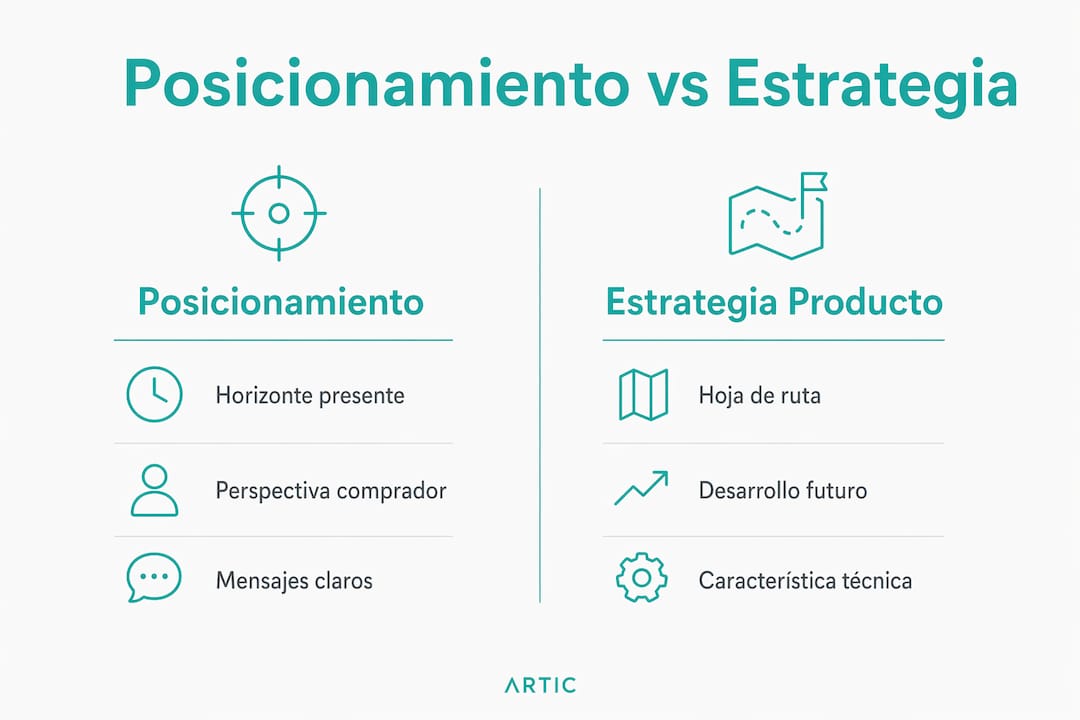
The most common mistake in industrial companies is confusing positioning with the product roadmap. These are two distinct exercises with different time horizons. B2B positioning is based on real alternatives. that the buyer considers today, not what the product will be in the future.

April Dunford, a leading expert in B2B positioning, explains it clearly: positioning is a conclusion about why your offer is the best option among the alternatives the buyer currently has on the table. Product strategy, on the other hand, answers the question of where the product is headed in the next 12 to 24 months. Mixing these two concepts produces messages that don't resonate with any real buyers.
| Dimension | Brand positioning | Product strategy |
|---|---|---|
| Time horizon | Present: current market alternatives | Future: vision and roadmap |
| Key question | Why choose us over X today? | What will we build in the coming months? |
| Main audience | Current buyers and decision-makers | Internal team, investors, product |
| Expected result | Differentiated perception in the market | Development priorities and resources |
| Error merging them | Confusing messages that don't close sales | Promises of the future that do not justify buying today |
Professional advice: When writing your positioning message, ask yourself: “Can a buyer verify this today with our current offering?” If the answer is no, you are describing the product strategy, not the positioning.
Mixing positioning with product strategy leads to confusing messages and makes it harder for the sales team to close deals. A salesperson can't sell a future promise to a buyer who needs to solve a problem today.
Key strategies for achieving effective B2B brand positioning
Effective positioning doesn't emerge from a brainstorming session. It's built through a structured process that starts with the real market and ends with verifiable messages. These are the steps applied by the industrial companies with the best market positioning:
Brand audit and market analysis. Before defining where you want to be, you need to know where you are. B2B digital audit Analyze how your current customers perceive you, what your competitors are saying, and what positioning gaps exist in the sector. Without this analysis, any message is just an assumption.
Definition of the unique value proposition (UVP). The PVU answers a specific question: what do you get with us that you can't get with any other provider on the market today? A strong B2B brand It requires clarity and genuine differentiation to be memorable to industrial buyers. The PVU is not a list of features: it is the core benefit that no competitor can claim with the same credibility.
Formulation of differentiating messages. Once the PVU (Point of Sale) is defined, it is translated into specific messages for each channel and each decision-maker profile. A purchasing director needs to hear different arguments than a technical director, even though both are involved in the same decision.
Application of the Brandformance approach. Brandformance integrates branding and performance to transform brand awareness into a predictable pipeline driver. It's not about choosing between brand building and lead generation: the two levers work together. A LinkedIn content campaign builds awareness among the out-of-market audience while simultaneously generating qualified traffic from the active market.
The attributes that support a lasting position in industrial B2B are specific:
- Proven reliability: Customer cases with real metrics, not generic testimonials.
- Sectoral expertise: technical content that demonstrates knowledge of the buyer's problem.
- Consistent reputation: consistent presence across all channels, from the web to trade fairs.
- Customer focus: messages that talk about the buyer's problem, not the product's features.
What mistakes to avoid in B2B brand positioning?
Positioning fails for predictable reasons. Knowing them allows you to avoid them before investing budget in messages that don't work.
The most costly mistake is failing to identify a genuine differentiator. Many companies fail because they can't find a truly differentiating attribute that allows them to stand out on the buyer's shortlist. Saying "we are leaders in quality and service" isn't positioning; it's the same thing any competitor says. True differentiation comes from understanding what alternative the buyer is considering and why your offer wins that comparison on a specific point.
Other common mistakes that weaken positioning in the B2B market:
- Inconsistency between channels. The message on the website, on LinkedIn, and in sales presentations says different things. The buyer receives contradictory signals, and brand perception becomes diluted.
- Ignore the out-of-market 95%. Focusing the entire budget on capturing active demand leaves most of the potential audience untapped. Designing specific tactics for in-market and out-of-market buyers increases the effectiveness of the total budget.
- Positioning without external validation. Defining positioning solely from within the company, without interviewing current customers or analyzing how buyers talk about the problem, produces messages that sound good internally but do not connect with the market.
Professional advice: Interview your five most recently acquired clients and ask them why they chose you over the alternative they were considering. Their answers reveal your true positioning, which may differ from what you have written on your website.
Offline and online positioning in the B2B industrial sector: how do they complement each other?
Industrial B2B brand positioning does not exist solely in the digital environment. A hybrid strategy It combines trade shows, physical catalogs, and a consistent digital presence to maximize overall impact. The key is ensuring the message is identical across both platforms.
| Channel | Strengths | Main challenges |
|---|---|---|
| Trade fairs and industrial events | Direct contact, product demonstration, networking | High cost per contact, one-off impact |
| Catalogues and printed materials | Tangible credibility, lasting technical reference | Difficult to update, no reach metrics |
| Web and SEO | Continuous, measurable visibility, global reach | It requires sustained investment in content |
| LinkedIn and social media | Precise segmentation by position and sector | It requires consistency and content production |
| Paid media (SEM, display) | Fast results, budget control | Visibility limited to the investment period |
The combined impact surpasses that of any single channel. An industrial automation company that exhibits at a trade show, reinforces its message with technical content on its website, and maintains an active presence on LinkedIn between shows builds a positioning that the buyer perceives as coherent and solid. digital marketing in manufacturing It amplifies the reach of offline actions and allows you to measure their contribution to the sales pipeline.
ARTIC and the B2B industrial brand positioning
ARTIC works with industrial companies that need to be top of mind for their buyers before they even start looking. The ARTIC team combines search engine optimization With content strategy, LinkedIn, paid media, and automation, we build a consistent brand presence across all channels where the industry decision-maker operates. Our working model is based on quarterly planning with clear KPIs and bi-weekly sprints, allowing for adjustments to positioning as the market evolves. If you want to know where your brand stands today against your competitors, the starting point is a B2B brand audit with ARTIC.
Frequently Asked Questions
What is B2B brand positioning?
B2B brand positioning is the differentiated perception a company holds in the minds of its business buyers compared to its direct competitors. It is built upon the real alternatives the buyer considers when making a decision.
How does positioning differ from product strategy?
Positioning describes why your offer is the best option today, based on current market alternatives. Product strategy defines where the offer will evolve in the future. Mixing the two produces messages that don't resonate with any real buyers.
Why is the 95% from B2B buyers not in the purchase phase?
The Ehrenberg-Bass Institute's 95/5 heuristic indicates that at any given time, only 51% of potential buyers are actively searching for a supplier. The remaining 95% will enter the market at some point in the future, and positioning works to ensure it remains top of mind when that happens.
What is Brandformance in the B2B context?
Brandformance is an approach that integrates branding and performance into a single strategy. It combines long-term brand-building actions with short-term demand generation tactics, transforming brand awareness into a measurable driver of the sales pipeline.
How long does it take for B2B brand positioning to work?
B2B brand positioning is a medium- to long-term process. The first measurable effects in terms of recognition and qualified traffic usually appear between 3 and 6 months of consistent effort, although the impact on market share requires a sustained presence over a longer period.
