

The long B2B buying cycle is the business acquisition process involving multiple departments, lasting between 6 and 18 months, and requiring consensus among a committee of 6 to 10 people with different interests. In the industrial sector, this process is technically called complex buying journey It stands out for its independent buyer evaluation process, which far exceeds the time spent in meetings with suppliers. Understanding its phases, its roadblocks, and the tools that accelerate it makes the difference between closing in six months or losing the year.
What are the phases of the long B2B buying cycle?
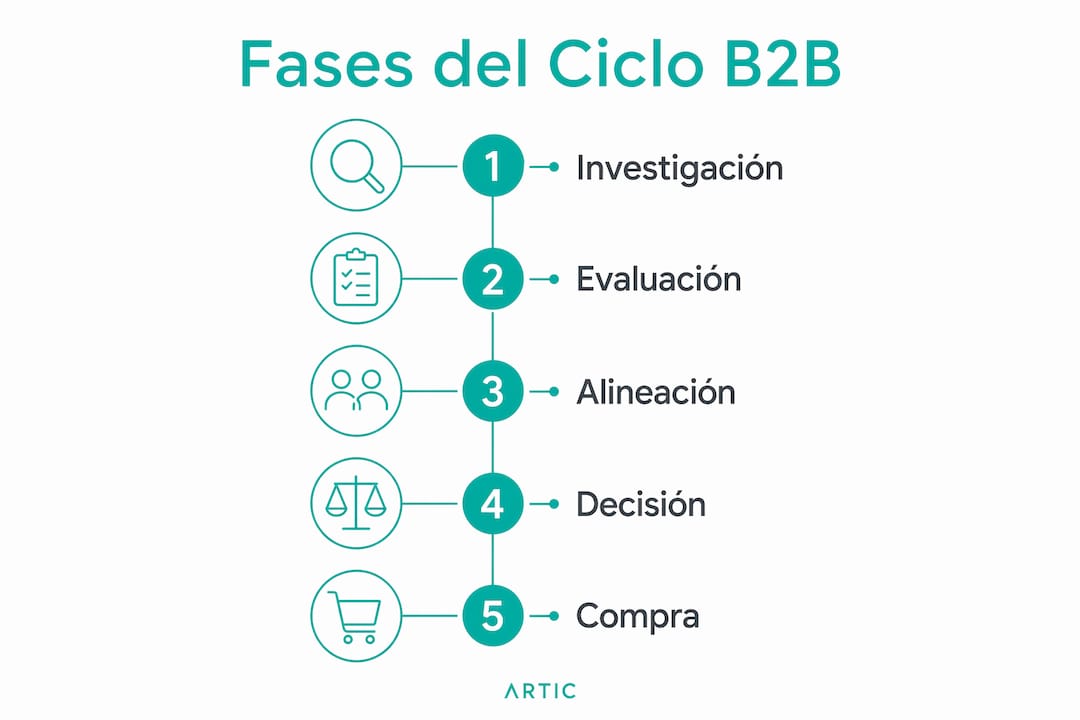
He B2B purchasing process It is structured in five phases: initial research, evaluation of alternatives, internal alignment, negotiation, and closing. Each phase has a different duration and requires specific content and communication. Ignoring this logic, by sending a sales proposal to someone who is still in the research phase, paralyzes the process before it even begins.
| Phase | Typical duration | Main challenge | Recommended content |
|---|---|---|---|
| Initial research | 4–8 weeks | Define the problem precisely | Technical articles, industry guides |
| Evaluation of alternatives | 6–10 weeks | Comparing suppliers without clear criteria | Comparisons, success stories, demos |
| Internal alignment | 8–16 weeks | Reaching consensus between departments | Mobilization kits, ROI calculators |
| Negotiation | 3–6 weeks | Resolve financial and legal objections | Contractual documentation, references |
| Closing | 2–4 weeks | Final budget approval | Executive proposal, value summary |

The internal alignment phase is by far the longest and least attended to by sales teams. The buyer is already convinced, but needs to convince finance, operations, and, in many cases, the legal department. Without specific materials for this task, the process stalls for months.
The total duration of B2B buying cycle The timeframe ranges from 6 to 18 months depending on the contract size and product complexity. The highest risks are concentrated in financial and legal approvals, where a single unanswered objection can restart the process from scratch.
Why does the B2B buying cycle take so long?
The long cycle does not depend solely on the complexity of the product. The real complexity The problem lies in the multi-decision system, where each committee member has different interests, priorities, and risk thresholds. An objection from a single member can stall the process for months, even if the rest of the committee is aligned.
The factors that lengthen the process the most are:
- Size of the purchasing committee. With 6 to 10 people involved, each new addition to the process adds rounds of validation and delays the decision.
- Information overload. Buyers receive proposals from multiple suppliers simultaneously. Data overload leads to indecision, not clarity.
- Corporate risk aversion. In industrial sectors, a supplier error has direct operational consequences. This raises the threshold of trust required for decision-making.
- Blockages in finance and legal matters. These departments enter the process late, and when they do, they raise objections that the internal mobilizer cannot answer without help from the provider.
“B2B decisions involve multiple roles with different interests; one objection can stall the process for months.” This reality makes the internal advocate, the person who champions your proposal within the committee, the most valuable asset in your sales cycle.
The B2B purchasing processes are not linear. When a new stakeholder emerges or information arises that challenges a decision already made, the process backtracks. A purchasing roadmap that doesn't account for these loops doesn't reflect reality and generates strategies that fail at the most critical moment.
How does buyer enablement influence long buying cycles?
Buyer enablement is defined as the systematic delivery of tools, content, and specialized support so that the buyer can independently complete their evaluation process. It is not a sales tactic. It is a discipline that recognizes that The buyer spends 83% of their time In independent evaluations, without contact with any provider. That 83% is where the sale is won or lost.
Companies that master buyer enablement achieve shorter cycles and better conversion rates. The predictable growth that every industrial sales director seeks comes precisely from structuring that autonomous buyer time, not from increasing sales pressure.
The most effective buyer enablement tools are:
- ROI calculators. They allow the internal mobilizer to justify the investment to finance using their own figures, not those of the supplier.
- Kits for mobilizers. Documents prepared to respond to specific objections from each department: technical, financial, legal.
- Assessment frameworks. Structured selection criteria that the buyer can use to compare suppliers objectively.
- Sectoral references and success stories. Evidence that the product works in contexts similar to that of the buyer.
Professional advice: Prepare a dedicated kit for your inner motivator before they ask for it. Include a list of answers to common financial objections, a technical comparison of the most common alternatives, and a one-page executive summary. This kit can cut through weeks of stagnation.
B2B buyers prefer sales-free processes at stage 6, 1, 1, 4, and 1. Standalone content and digital tools aren't just an add-on to the sales process; they are the sales process for most of its duration.
Tactics and content by phase to shorten the decision
Accelerating the buying cycle doesn't mean pressuring the buyer. It means eliminating the friction points that slow them down at each stage. The most effective strategy involves facilitate tasks of definition, exploration and selection by role within the committee, covering all internal needs without waiting for the buyer to request them.
Content adapted by role and moment
Each committee member needs different information. The technical director evaluates specifications and compatibility. The finance director analyzes return and risk. The purchasing manager compares contractual terms. Sending the same document to all three is the most common mistake in industrial B2B marketing.
| Role on the committee | Critical phase | Required content |
|---|---|---|
| Technical Director | Assessment | Technical specifications, performance comparisons |
| Chief Financial Officer | Internal alignment | ROI calculator, total cost analysis |
| Legal representative | Negotiation | Contractual templates, certifications |
| Managing director | Closing | Executive summary, high-level references |
| Purchasing Manager | Negotiation | Terms of service, SLAs, guarantees |
Common mistakes that lengthen the process
- Submit proposals ahead of schedule. A proposal still in the research phase generates rejection, not interest. The buyer doesn't yet know what they want to buy.
- Do not prepare the internal mobilizer. The most frequent bottleneck is that the internal advocate fails to address critical objections in a timely manner. Without a specific toolkit, the process grinds to a halt.
- Ignore the blocking departments. Finance and legal come in late, but they have veto power. Anticipating their objections with specific documentation saves weeks of negotiation.
- Treat the process as linear. When a new stakeholder emerges, the cycle reverses. Long-term B2B strategies must account for these loops and have content ready to restart conversations.
Professional advice: Use LinkedIn to identify when a new decision-maker joins the process. A change in role or a new connection with your primary contact often indicates that the committee has expanded. Act before that new member raises unanswered objections.
How to measure the performance of the B2B buying cycle?
Measuring the long B2B buying cycle requires indicators for each stage, not just overall closing metrics. The average duration of each stage, the drop-off rate between stages, and the number of touchpoints per role are the three data points that allow you to identify where the process is failing.
| Indicator | What does it measure? | Warning sign |
|---|---|---|
| Average duration per phase | Time at each stage of the cycle | Internal alignment greater than 12 weeks |
| Fall rate per stage | Percentage of opportunities that do not advance | Drop greater than 40% under evaluation |
| Touchpoints by role | Interactions with each committee member | Zero contact with finance or legal |
| Time until first proposal | Qualification speed | Proposal submitted within 4 weeks |
Touchpoint analysis reveals which committee roles aren't receiving communication. If finance has never seen one of your documents, their objection during the negotiation phase isn't surprising: it's a predictable consequence of an incomplete strategy.
Professional advice: Configure your CRM, whether it's HubSpot, Salesforce, or Pipedrive, to record the role of each contact within the committee, not just the company. This segmentation allows you to detect in real time which departments are understaffed and take action before they block the closing.
Journey maps for long cycles must account for deviations and loops to reflect the reality of the process. A linear, five-step map is useless for diagnosing why an opportunity has been in negotiations for eight months without progressing.
ARTIC works with industrial companies in complex purchasing cycles
ARTIC is a B2B marketing agency Specializing in the industrial sector, with direct experience in purchasing processes that last for months and require influencing multiple decision-makers simultaneously. We work with SEO, paid media, LinkedIn, and automation to ensure your company is present at every stage of the cycle, from initial research to closing. If you want to know which part of your digital process is failing, our digital audit for industrial Identify the specific bottlenecks and the priority actions to resolve them. You can also explore our B2B influencer tactics to accelerate credibility in technical sectors where trust takes time to build.
Frequently Asked Questions
How long does a long B2B buying cycle last?
The long B2B buying cycle lasts between 6 and 18 months, depending on the size of the contract and the complexity of the product. The highest risks are concentrated in obtaining financial and legal approvals.
How many people are involved in a B2B purchasing decision?
The B2B buying committee includes between 6 and 10 people with different roles and interests. Each additional person introduces rounds of validation that lengthen the process.
What is buyer enablement and why does it matter in industrial B2B?
Buyer enablement is the delivery of tools and content so that the buyer can evaluate independently. It matters because the buyer dedicates 83% of their time to independent evaluations, without contact with suppliers.
What is the most difficult phase of the B2B buying process?
Internal alignment is the most difficult and longest phase. The buyer is already convinced, but needs to convince finance, operations, and legal, and without specific materials, that process can take months.
How can the B2B buying cycle be shortened without putting pressure on the buyer?
The most effective way is to prepare kits for the internal mobilizer, ROI calculators, and role-specific content. These tools eliminate internal friction without increasing sales pressure.
