

In summary:
- A search engine marketing (SEM) strategy in the industrial sector allows you to capture active demand and convert it into sales or leads. It's the most effective way to reach decision-makers at the right time, with key indicators such as a click-through rate (CTR) exceeding 31% and a conversion rate exceeding 21%. Successful implementation requires a segmented campaign architecture, the appropriate use of tools, and continuous optimization of the Quality Score to reduce costs and maximize results.
A Search Engine Marketing (SEM) strategy is a set of search engine advertising campaigns designed to capture active demand and convert it into sales or business leads. For industrial companies, this discipline represents the most direct way to reach purchasing decision-makers at the exact moment they are searching for a supplier. By 2026, with Google Ads dominating over 91% In the Spanish search market, an SEM strategy to increase online sales is not just a tactical option, but a measurable growth lever. The benchmark indicators are clear: a CTR higher than 3% And a conversion rate above 2% in e-commerce or 3% in services makes the difference between a profitable campaign and an expense with no return.
What tools do you need for an effective SEM strategy?
The starting point is not the budget. It's the data architecture and tools that allow for informed decision-making.
Essential tools:
- Google Ads. The central ecosystem for any SEM campaign in Spain. It concentrates most of the commercial search traffic and offers specific formats for industrial catalogs, such as Google Shopping.
- Google Analytics 4. It measures post-click behavior: which pages users visit, how long they stay, and what actions they complete. Without this tool, there is no real visibility into performance.
- Google Search Console. Analytics complements by showing which terms generate organic impressions and clicks, a key piece of information for coordinating SEM and SEO.
- Automation and CRM platforms. Tools like HubSpot or Holded allow you to connect leads generated by campaigns with the actual sales pipeline, differentiating quality contacts from noise.
- SE Ranking or equivalent keyword analysis tools. They allow you to identify terms with commercial intent before investing a single euro.
Before launching any campaign, the marketing team must complete three preliminary tasks. The first is to define the profile of the industrial buyer: job title, industry, buying cycle, and decision criteria. The second is to audit the catalog or services to identify which products have the highest margins and the strongest active demand. The third is to verify that the landing pages are optimized for conversion, with clear forms, load times of less than three seconds, and messaging that aligns with the ad.
The recommended initial budget for a manufacturing company starting from scratch ranges from €1,500 to €3,000 per month. This amount allows for the accumulation of sufficient conversion data to make statistically based decisions in the first few weeks.
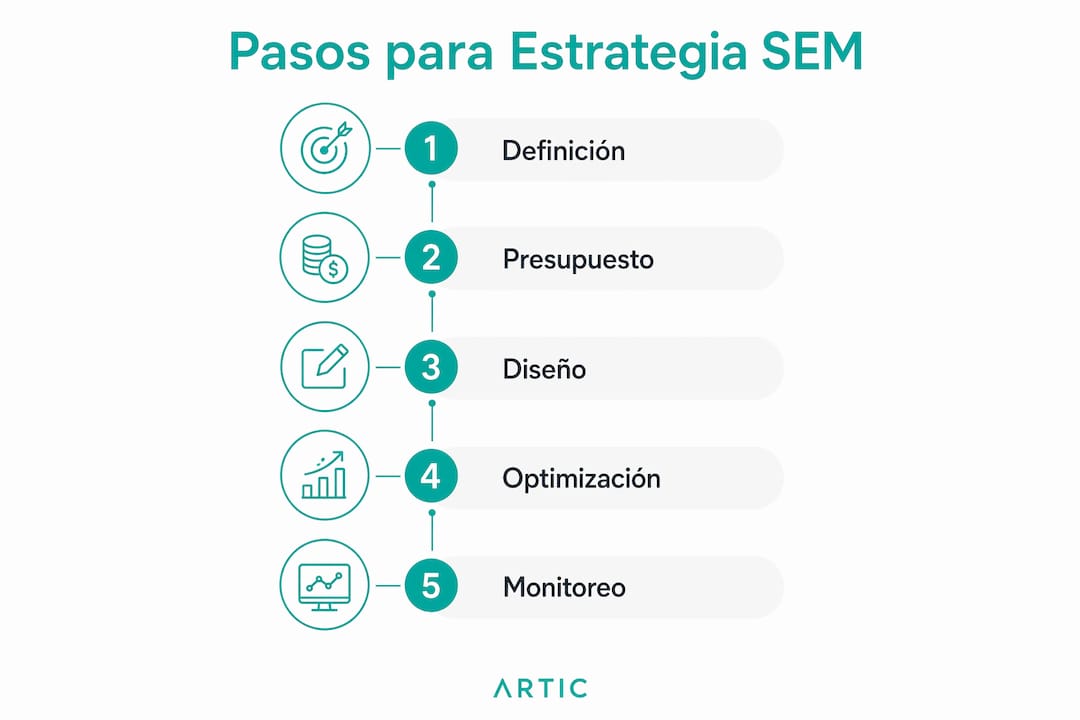
How to design SEM campaigns that maximize industrial sales?
For industrial companies, simply raising bids isn't enough to generate traffic. The key is designing a campaign architecture that captures commercial intent and reflects real margins. Here's the step-by-step process:
Segment by product or service with a clear intention. Create a separate campaign for each priority product or service line. Mixing categories in a single campaign prevents you from adjusting bids according to each product's margin and makes it difficult to analyze results.
Select keywords with commercial intent. Terms that include words like "buy," "price," "supplier," "quote," or "company" indicate that the user is close to making a decision. Avoid generic informational terms that attract visits without purchase intent.
Write ads that are consistent with the landing page. The ad message, landing page headline, and call to action should form a logical sequence. If the ad promises "budget in 24 hours," the page should display that form on the first scroll.
Configure conversion tracking before activating. Define what counts as a conversion: form submission, phone call, catalog download, or demo request. Without this setting, Google Ads cannot learn or optimize.
Start with manual CPC for the first 2–4 weeks. Google's automation system requires initial learning with manual CPC to accumulate conversions before handing control over to artificial intelligence. Activating automated strategies from day one produces erratic results.
Activate Google Shopping for industrial catalogs. If the company sells components, machinery, or consumables with a visible price, Google Shopping generates a visual format that improves the CTR compared to standard text ads.
Professional advice: Create a branded campaign from day one. Protecting your name on Google Ads costs little and prevents competitors from appearing when someone searches directly for your business.
Organizing by intent and service allows for adjusting bids based on margin and sustainably improving conversions. This structure also facilitates internal communication: the sales manager can see which product line generates the most qualified leads each week.

How to optimize SEM campaigns to reduce costs and increase conversions?
The mentality of “spending more to sell more” is obsolete. Optimize the cost per useful conversion Working across the entire funnel, from user experience to measurement, is the strategy that generates real scale.
The quality score as a lever for profitability
Google Ads' Quality Score measures ad relevance, landing page experience, and expected click-through rate (CTR). Increasing your Quality Score from 5 to 7 can reduce the cost per click by 30%. This means you can get a third more qualified visits with the same monthly budget.
To improve Quality Score in industrial campaigns, the three most effective actions are: aligning the ad text with the exact keyword of the ad group, improving the loading speed of the landing page, and increasing the relevance of the content of that page to the search.
Continuous optimization tactics
- A/B testing of advertisements. Always keep two or three variations of each ad active. Change only one element per test: the headline, the description, or the call to action. Pause the losing variation every 30 days.
- Adjust bids by device and time. In the industrial sector, most quote requests arrive during business hours via computer. Reducing mobile bids outside of office hours can lower the cost per conversion by between 15% and 25%.
- Negative keywords. Reviewing the search terms report weekly and adding negative keywords is the optimization task with the highest immediate return. An industrial machinery company doesn't need to pay for searches for "toy machinery" or "used machinery.".
- Landing page optimization for conversion. Short forms (maximum five fields), testimonials from industrial clients, visible certifications, and a headline that directly answers the user's search are the elements that most impact the conversion rate.
| Optimization lever | Expected impact |
|---|---|
| Increase Quality Score from 5 to 7 | Reduction of 30% in cost per click |
| Add negative keywords | Reduction of 10–20% in non-conversion spending |
| Monthly A/B testing of ads | Improvement of the 5-15% in CTR |
| Landing page optimization | 20–40% conversion rate increase |
Professional advice: Integrate post-click metrics like lead scoring and sales pipeline into your monthly analysis. A lead generated through SEM and closed within 90 days has a very different value than one that doesn't respond. Measuring the real impact on sales, not just clicks, changes investment decisions.
Common mistakes when implementing SEM in the industrial sector
The most costly mistakes in industrial SEM campaigns are not technical. They are strategic and are repeated with alarming frequency.
Automating bids without sufficient data. Google recommends accumulating at least 30 genuine monthly conversions before activating automated strategies. Doing so sooner results in an algorithm that optimizes for low-quality or phantom conversions.
Do not segment campaigns by intent. Grouping all products into a single campaign makes it impossible to know what generates sales and what consumes budget without a return. Intent-based targeting is the foundation of any successful search engine advertising strategy.
Send traffic to the homepage. An industrial company's homepage is designed to introduce the company, not to convert a specific search query. Each campaign needs its own landing page with a single objective.
Failing to differentiate between quality leads. A submitted form does not equal a real sales opportunity. Without lead scoring or CRM integration, the sales team wastes time with unqualified leads, and the marketing director cannot calculate the true return on investment.
Ignoring the relationship between SEM and SEO. SEM and SEO do not compete: They complement each other strategically. SEM offers immediate results and validates which messages convert; SEO builds solid long-term positioning. Furthermore, Pay for ads on keywords with good organic ranking It increases the total CTR by between 5% and 15%, especially in complex sales cycles such as those in the industrial sector.
The biggest mistake in industrial SEM isn't technical: it's launching campaigns without a defined conversion strategy. Traffic without a clear destination only generates invoices, not sales.
He Zero-Click Content It complements SEM by building brand awareness and trust without relying on immediate clicks. For industrial companies with long sales cycles, this combination balances digital strategy between short-term and long-term results.
Key points
A profitable SEM strategy in the industrial sector requires intent-based campaign architecture, measurement of actual conversions, and continuous optimization of the Quality Score to scale without increasing spending.
| Spot | Details |
|---|---|
| Segmentation by intent | Create separate campaigns for each product or service to adjust bids based on actual margin. |
| Manual CPC at startup | Accumulate at least 30 conversions before activating automated bidding strategies. |
| Quality Score as a priority | Upgrading the quality level from 5 to 7 reduces the cost per click of a 30% without increasing the budget. |
| Specific landing pages | Each campaign needs its own landing page aligned with the ad message. |
| Integrated SEM and SEO | Combining both strategies increases the overall CTR and reduces dependence on a single channel. |
How ARTIC designs SEM campaigns for industrial companies
ARTIC is a B2B marketing agency Specializing in the industrial sector, with experience in designing and managing SEM campaigns that generate measurable results from the first quarter. The team works with quarterly strategic planning, clear KPIs, and bi-weekly sprints alongside the client, acting as an integrated digital marketing department, not an external provider.
If you're looking for a SEM agency If you understand industrial sales cycles, product margins, and the difference between a quality lead and noise, ARTIC is the team you need. We manage Google Ads campaigns with real-time conversion tracking, CRM integration, and continuous data-driven optimization. Contact us and we'll analyze your situation with no obligation.
Frequently Asked Questions
What is an SEM strategy and what is it used for in industry?
A search engine marketing (SEM) strategy is a set of search engine advertising campaigns designed to capture users with active purchase intent. In the industrial sector, it serves to reach decision-makers at the precise moment they are searching for a specific supplier or solution.
How much budget do I need to get started with Google Ads?
For an industrial company starting from scratch, an initial budget of 1,500 to 3,000 euros per month allows for the accumulation of sufficient conversion data to optimize campaigns with statistical criteria in the first few weeks.
When should I activate automatic bidding in Google Ads?
Activate automated bidding strategies only after accumulating at least 30 real monthly conversions. Before that threshold, Google's algorithm doesn't have enough data to optimize effectively.
Is SEM or SEO better for selling more online in the industrial sector?
SEM generates immediate results and validates marketing messages; SEO builds solid long-term positioning. The most effective strategy combines both channels, as using them together can increase the overall CTR by between 51% and 151%.
What conversion rate should I expect in my SEM campaigns?
A well-configured SEM campaign should exceed a 3% conversion rate for services and a 2% conversion rate for e-commerce. If the results fall below these thresholds, the problem is usually with the landing page, not the ad.
